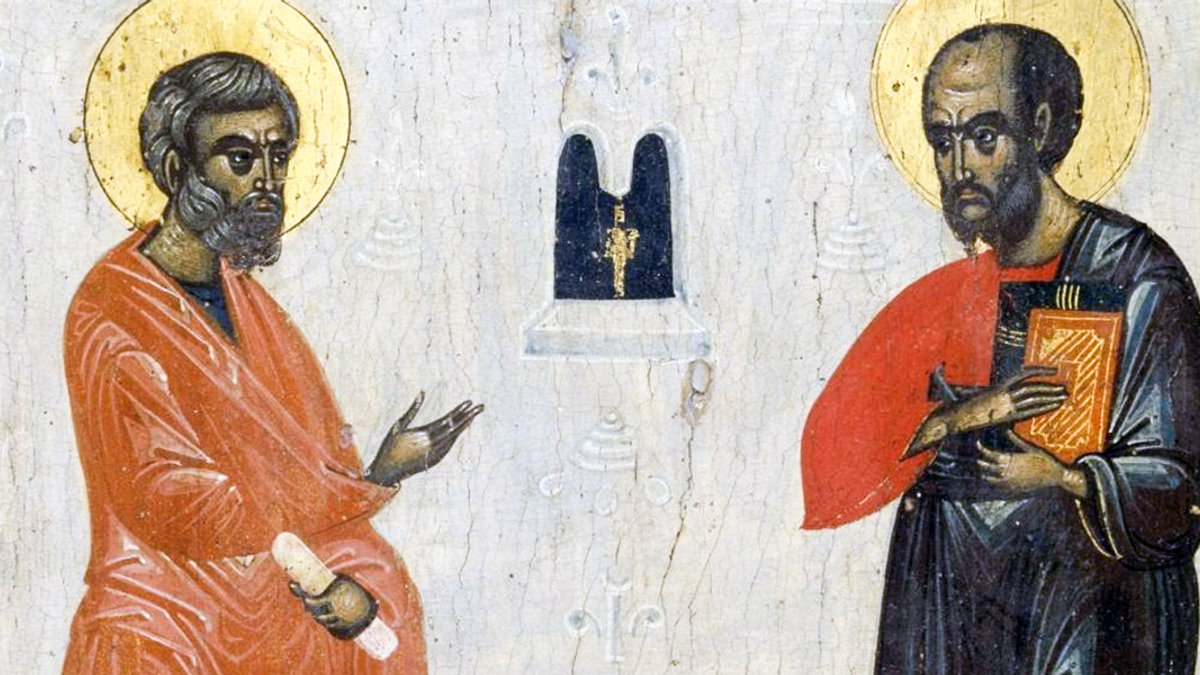
The saints we celebrate today were flawed human beings just like you and me -- who God used to transform the world.
Sts. Peter and Paul are great saints to look to, because they are flawed human beings just like you and me who God used to transform the world.
Look at what God did with them to see what God can do with you.
God can transform your natural gifts to supernatural ends, like the tentmaker who made eternal homes.
It is ironic that Paul was a tentmaker who teamed up with Jesus, who is the Word of God who “pitched his tent” (the ancient Greek verb for “dwelt”) among us.
He started to build much bigger than tents. As he told the Corinthians, “if the earthly tent we live in is destroyed, we have a building from God, a house not made with hands, eternal in the heavens.”
… and God can transform your work like he did for the fisherman who became a fisher of men.
There is a similar irony in the life of Peter, the fisherman who could never catch fish quite as well as Jesus did.
He transformed the captain of boats that kill fish into the captain of the Church, the “barque of Peter” that Peter compared to Noah’s ark — a boat that “saves through water.”
God also wants to use you like he did the “minor” Christian who converted St. Paul.
Jesus started Paul’s conversion by calling him by name, but then he sent a plain and ordinary Christian to go and speak to him.
Ananias had a hard job. He had to go to “Straight Street” where Paul was staying, and tell the fearsome persecutor of Christians about Christ. He didn’t want to, but he did it anyway, and changed the history of the Church.
… or God could use you to convert a family member, like the brother who converted St. Peter.
In the Gospel of John, when Andrew meets Jesus, John reports: “He first found his brother Simon and told him, ‘We have found the Messiah’ (which is translated as Christ).”
Only after Andrew piques his interest does Jesus call Peter by name. Then, John says that he didn’t just call him by name, he renamed him, saying, “‘You are Simon son of John. You will be called Cephas’ (which is translated as Peter).”
God may want to introduce Christ to us as someone new, as he did with St. Paul …
It is interesting to note that St. Paul never saw Jesus at all. When the resurrected Jesus met him on the road to Damascus, Paul saw only a flash of light, which also made him blind.
St. Paul believed anyway, the first example of what Jesus told Thomas: “Blessed are those who have not seen and yet believe.”
… or God may want us to really meet Jesus, after knowing him for a long time, like Peter.
Peter, of course, saw Jesus often. But he needed to recognize him more fully. When Jesus asked, “Who do you say I am?” on the road, only Peter had the right answer — but, as with St. Paul, this faith was a gift of God.
“Blessed are you, Simon, son of Jonah, for flesh and blood has not revealed this to you but my heavenly Father,” Jesus told him.
God wants you to learn from St. Paul what hope looks like …
Paul endured much in his life — whippings, beatings, stoning, and muggings — but he never lost hope. He also clearly stated the reason for his hope:
“Suffering produces endurance, and endurance produces character, and character produces hope, and hope does not disappoint.”
… and God wants you to learn from St. Peter that it’s your job to explain what hope looks like.
In giving a reason for his hope, St. Paul was just doing what his pope said to do: “Always be prepared to give a defense to everyone who asks you the reason for the hope that is in you."
If you struggle with pride, you can learn from St. Paul that love can conquer it …
Paul is the first to admit that he can come across as boastful at times. So he had to battle his temperament to learn love. He learned it better than anybody, saying:
“If I give away all I have, and if I deliver my body to be burned, but have not love, I gain nothing. Love is patient and kind; love is not jealous or boastful.”
…. and if you struggle with failure, you can learn from St. Peter to conquer that the same way.
After his opening failure with him, Peter begged Jesus to go away. But then after a lifetime of more failure and betrayal, he also shared his hard-won wisdom:
“Above all, love one another deeply, because love covers over a multitude of sins.”
Pope Leo on the Feast of Sts. Peter and Paul, 2025
The New Testament does not conceal the errors, conflicts and sins of those whom we venerate as the greatest Apostles. Their greatness was shaped by forgiveness. The risen Lord reached out to them more than once, to put them back on the right path.
Jesus never calls just one time. That is why we can always hope. The Jubilee is itself a reminder of this.