His conversion started shortly after the deaths of his mother and fifth wife in 1966, when he hit the bottle to deal with unremitting grief and impecuniousness.
“The most talented man in the history of the movies,” Cary Grant said of Mickey Rooney.
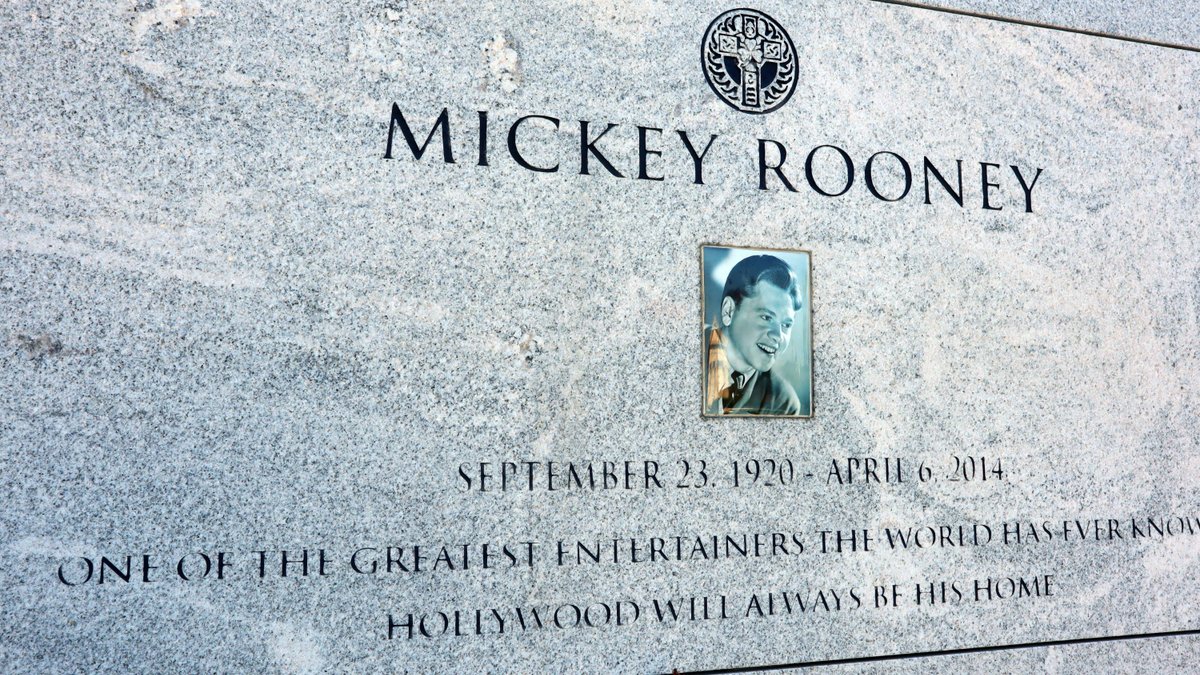
Born Ninnian Joseph Yule, Jr., 105 years ago today in Brooklyn to a pair of burlesque actors, this hyperactive theatrical genius captured the heart of the world and was America’s most famous teen by age 19.
By 1950, just 30, he was dirt poor.
That’s Hollywood. Going from exhilarating highs to dispiriting lows.
From the time he first went on stage, not yet two, he enthralled audiences. By age seven, he was playing the wisecracking “Mickey Maguire” ripped from the comic strips, after his mother, Nellie Carter, leaving her hard-drinking, womanizing husband when Mickey was three, drove a hard bargain before inking the deal.
Catching the eye of studio bosses, Mickey was given a supporting role in Manhattan Melodrama (1934) — a box-office dud until John Dillinger’s “lady in red” girlfriend tipped off the feds who gunned him down as they walked out of the Biograph Theatre in Chicago where it was showing.
Dillinger was dead and Manhattan Melodrama rocketed to the top, and, along with it, newly christened “Mickey Rooney,” who signed a long-term contract with MGM in 1935.
His father, too, signed a contract at a Burbank burlesque house – the marquee announcing, “Mickey Rooney’s Father, Joe Yule starring in …”
“Dad, you can’t do this,” Mickey protested. So MGM put him under long-term contract.
Meanwhile Mickey soared in Little Lord Fauntleroy (1936) and Captains Courageous (1937). But it was the “Andy Hardy” “B film” series, telling homespun Hardy family tales featuring the escapades of their teenage son — and “man-to-man” talks with Judge Hardy — that made Mickey a star, and MGM a bundle, especially when paired with lifelong friend and legend Judy Garland.
On track to be an all-American, clean-cut kid, he pivoted to play the meanest, toughest miscreant of all in Boys Town (1938). After that, he was number one at the box office for three years straight with such hits as The Adventures of Huckleberry Finn (1939) and Young Tom Edison (1940).
But he was a hellraiser off-screen and, when it came to romance, he was indefatigable, starting with his pursuit of Ava Gardner whom he met on the MGM lot in August 1941.
Such determination theatrically was box office gold. Romantically, it was emotional nitroglycerine, and the start of his implosion — his deficient formation in fidelity sending him spiraling downward in fits of depression. Gardner eventually agreed to marry him but predictably the nuptials did not last, nor did his seven other marriages, producing 10 children.
Mercy
Then, mercifully, God entered his life. As he said in July 1983, “I’d hit the bottom. I couldn’t go any lower. I was dying. So I said, 'Lord, come into my life.'”
His conversion started shortly after the deaths of his mother and fifth wife in 1966, when he hit the bottle to deal with unremitting grief and impecuniousness. One day, over breakfast in Lake Tahoe, he had a mystical experience. A busboy came up behind him and called his name. A phone call, Mickey thought, and began to rise.
Instead, the busboy leaned down and whispered in his ear, “Mr. Rooney, Jesus Christ loves you very much.” Mickey turned around to get a look at him. “He was wearing a white jacket, had blond curls, a white-rose complexion and shining teeth.” Smiling at Mickey, he vanished into the kitchen. When queried, the coffee shop knew of no such employee.
After that, he embraced true love, quit drinking, and became a believer.
But he eschewed the “fundamentalist” label.
“I am also a spiritual member of various Catholic and Jewish congregations… believing in an all-loving God who wants us close to him,” he wrote. “We’re the ones who make life difficult for ourselves by thinking God wants us to be (great)… In God’s sight, it’s good enough just to be…”
On the way to "being," Mickey would, once again, reach heights of theatrical greatness.
In 1980 he received his fourth Oscar nomination for his performance in The Black Stallion (1979) after which he returned to Broadway and gave a Tony-nominated performance in Sugar Babies. This tribute to his father’s burlesque days, running from October 8, 1979, to August 28, 1982, and co-starring Ann Miller, garnered many warm reviews.
The show was a long time in coming.
When his father died in 1950, Mickey and a musician friend went over to his house in North Hollywood, and “they were going through his belongings,” said Ewing Miles “Lucky” Brown.
“And, they see this big old chest of drawers…” Suddenly his friend started laughing and said, “‘Mickey, this stuff – I can put a show together.’” Just like in his films, starting with his Oscar-nominated Babes in Arms (1939) — all variations on the “Let’s put on a show” plot line.
Years later, Lucky poignantly reminded his old friend that his father “reached out from the grave … and took you from broke to a big star, again …”
More importantly, God reached down from Heaven and told Mickey, in the biggest, most transformational “man-to-man” of his life, "Jesus loves you."
It changed his life.