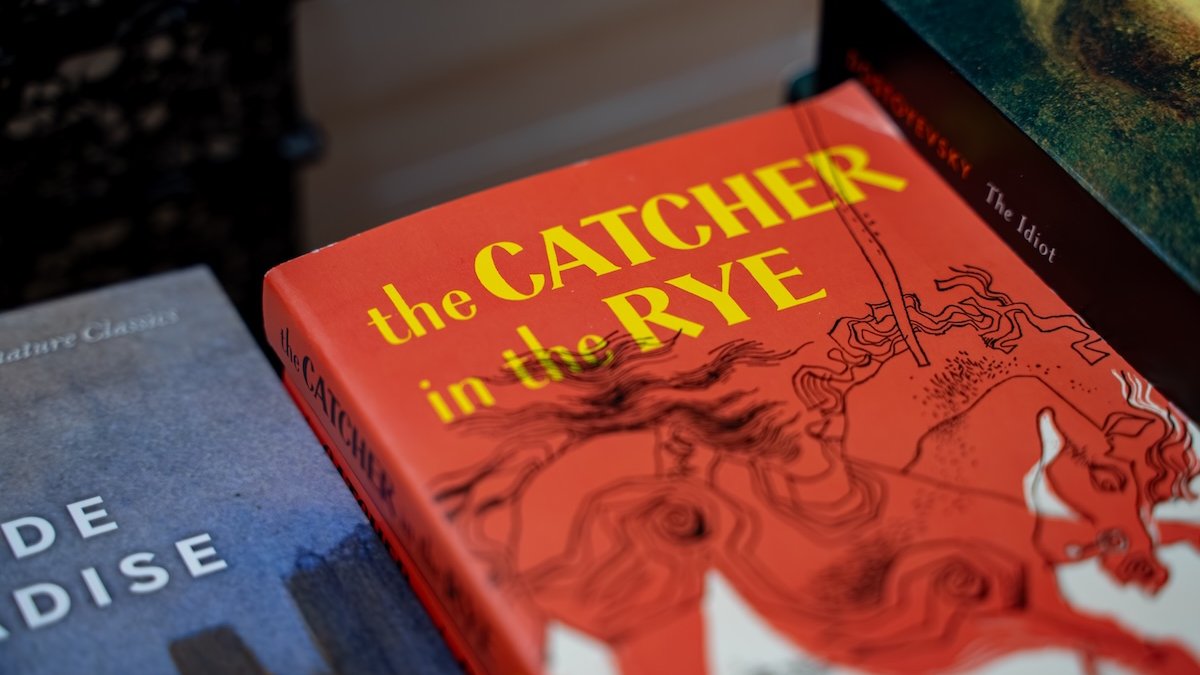
This book was massively influential after it came out in 1951, and once you have read it, you can see its point of view everywhere today.
I read Catcher in the Rye for the first time ever this year, and I’m glad I did — though I can’t exactly recommend the book. Its reputation for profanity is well earned.
But it is the 75th anniversary of the publication of this novel which is both enormously influential and shrouded in mystery because of the reclusive habits of its author, J.D. Salinger.
What I can recommend are the lessons that can be found in it, quite intentionally, I think.
I became interested in it because of its author’s other work.
Catcher in the Rye was written by J.D. Salinger, an author who shunned media interviews and refused to allow his books to be made into a movie or even audiobooks. He published very little apart from Catcher, but he did publish the Catholic favorite Frannie and Zooey, a book in which one character discovers the Jesus prayer. Salinger himself was raised in the Jewish faith, only finding out as a teenager that his mother was Catholic.
Catcher was originally meant for adults, but like any work that is “for adults” but features kids or teens, it was immediately adopted by adolescents. The book has sparked outsized reactions throughout its history. First, it became a best seller, then it landed on “most banned” lists in the 20th century. In the 21st century it has appeared on influential “Greatest novels of all time” lists and today it is far more likely to be required reading in classrooms than to be banned from them.
Startingly, a recent review in First Things calls Catcher “the most Christian novel ever published.”
It’s hard to tell why, at first.
Catcher in the Rye begins with the first-person narrator being kicked out of private boarding school in Pennsylvania. Knowing he has time before word reaches his parents, he leaves to spend a night in New York in which he attempts to pursue a life of debauchery.
Caulfield harshly judges everyone he meets, usually by dismissing them as “phony.” What the reader soon realizes is that Caulfield’s caustic persona is the more “phony” than all of them.
In one beautiful passage, Holden sneaks into his younger sister Phoebe’s bedroom at night and wakes her up. She is the most authentic person in the story, and his appreciation for her is endearing and telling.
The reader is also slowly brought to understand what has made Caulfield the way he is: Trauma in his past, including the death of one brother and the perceived betrayal of another.
For me, reading Catcher in the Rye shed a new light on the last several decades in popular culture.
This book was massively influential after it came out in 1951, and once you have read it, you can see its point of view everywhere in the cynicism about institutions and cult of authenticity that started in the 1950s and kept picking up steam from Dr. Strangelove to Saturday Night Live to Judd Apatow.
After Catcher in the Rye, and at least in part because of it, the culture became willing to laugh at anything and everything, good or bad, that human beings did.
But Catcher also has an undeniable sweetness. The narrator genuinely cares for people, though he tries very hard not to. His repeated concerns about ducks in New York’s Central Park, the dream he has that gives the book its title, and his revelation watching children at a merry go round, all paint the picture of someone who is more a victim of the world than a victimizer.
It doesn’t entice readers to sin so much as it saddens them at the plight of sinners.
The book does a great job of demonstrating acedia.
Acedia, the boredom with life that Aquinas defines as “sadness at the will of God” can be translated as “sloth” or “apathy.”
It is an easy malady for young people to fall into. The messy, complicated world gives Caulfield a lot to mock, little to admire, and a compelling motive to flee his responsibilities. The technology and culture of his time — cabs, trains and piano bars — give him the means to escape. The world’s hypocrisy that enraged Caulfield 75 years ago is only worse today, with Church scandals, COVID resentment, and political turmoil — and new technology gives us more ways to escape than ever.
In fact the only people in the novel Caulfield can’t dismiss as phony, and the ones who inspire him to be more, are missionary nuns he meets at a diner.
Their joyful simplicity shows that the real way to rebel against hypocrisy is self-sacrifice — and the only way out of loneliness is love.