<br>Standards are not the enemy of beauty — they are often its condition. The problem is beauty without search, the product without the process of finding.
There is a difference between a standard and standardization. “Autumn Leaves” and “My Funny Valentine” are jazz standards, fixed structures that every musician learns, and that each one plays differently. If anything, the standard is but the beginning of the conversation. Miles Davis, Bill Evans, and Keith Jarrett all played the same standards and sound nothing like each other. The structure gave them ground to stand on. What they did with it was a different thing. While the standard has a beauty of its own, what is really important is that it creates the conditions in which further forms of beauty can thrive.
This distinction matters because the problem with contemporary aesthetic life is not so much that it has standards but that it has standardization: the production of things that meet some standard, thinks that are okay. Walk into your average hotel in any city on earth and the lobby will be more or less the same: a sober palette, Scandinav-ish furniture, monsteras in concrete pots, “lounge” music. Open a music streaming platform and the algorithm will relentlessly serve you songs with the same structure and the same exaggerated vocal processing. Scroll through your screen and you will increasingly find prose smoothed to more or less the same register. It is not that these things are “bad” by any absolute standard. It is that they are not necessarily the result of any aesthetic search. If anything, these are the result of a process of optimization, tailored to ruffle no feathers, reach more people, generate more revenue, make everyone comfortable.
Roger Scruton spent decades arguing that beauty is not decoration but a form of truth — something that discloses a dimension of reality that sheer information cannot convey. The Catechism takes that affirmation to a theological register: sacred art “expresses in some way the infinite beauty of God and turns the human mind more easily toward him.” What makes this turn possible is not the absence of tradition or style (that is, of standards) but the depth of engagement with it. The great medieval cathedrals are recognizably Gothic (that’s a standard) but also irreducibly themselves. Chartres is not Cologne, Cologne is not Burgos, Burgos is not Salisbury. Each team of builders worked within a shared tradition and found, within it, something that belonged to their specific place, their specific community, their specific moment, and their specific skills, or lack of them.
Truths made visible in Spain
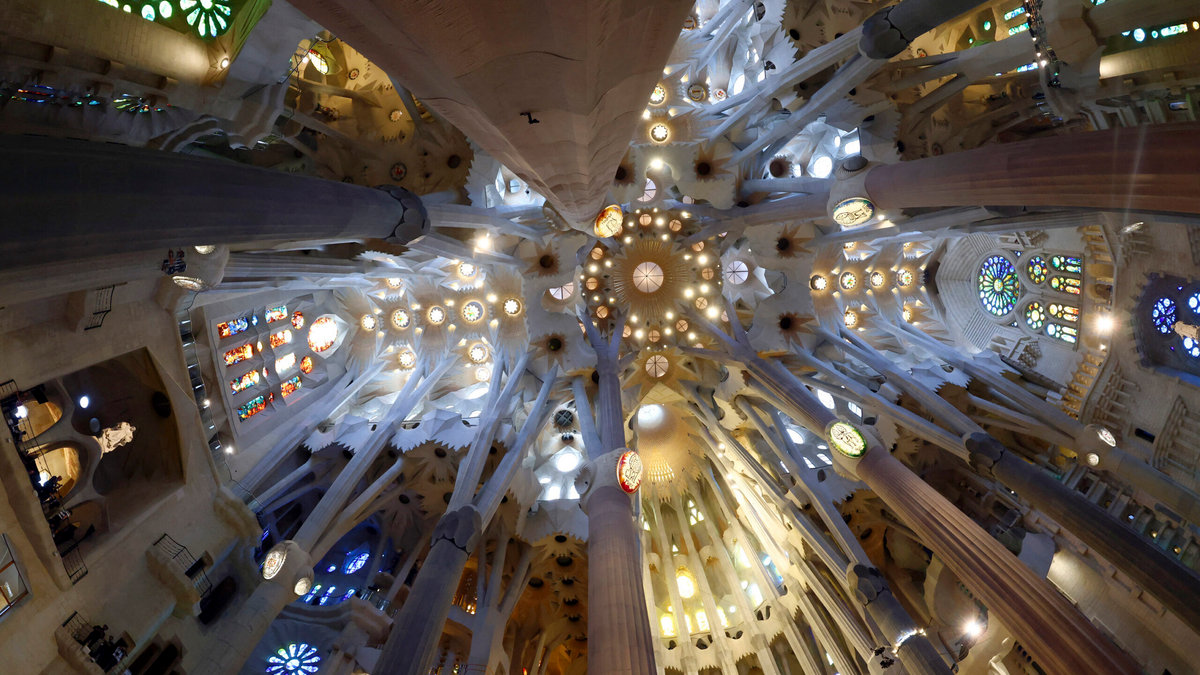
The Sagrada Família is one of the most powerful contemporary examples of this. Gaudí was formed in the Neo-Gothic tradition. He studied it carefully, absorbed it deeply, and then found his unique, even eccentric way through it and out the other side. The hyperboloid vaults and paraboloid surfaces of the Sagrada Família are a discovery made possible by Gaudí’s knowledge of what came before and by his own personal handling of standards handed over to him. It is the most visited building in the world, drawing five million people a year, and it is defiantly weird — a building that could not have been designed by anyone other than Gaudí, built anywhere other than Barcelona, commissioned by anyone other than the Catalan faithful who are still paying for it. Its peculiarity is obviously what draws people to it.
Then there is your grandmother’s kitchen. She learned to cook from someone else, within a tradition, following recipes that existed before her. And then something happened. Maybe she added a different ingredient, shifted proportions, changed this for that, and voilà. She came up with a dish that exists nowhere else. proportions shifted, combinations emerged, a dish took shape that exists nowhere else on earth. It is a masterpiece of particularity. And when she dies, that dish dies with her, unless you took the time to learn it from her. What AI-generated whatever (prose, music, drawings, you name it) cannot replicate is the decades of search, mistakes, unlikely events, and curiosity that produced something. It cannot be weird enough, or distracted enough, or wrong enough, or silly enough, to bring to life something new, unexpected, beautiful. I think I liked AI more when it “hallucinated”. It felt somehow closer to what might happen to you when you are learning to draw, or write.
There is an interesting concept in the Jesuit tradition: magis. It is not “more” in the quantitative sense, but something closer to “more fully yourself:” Magis is, among other things, about becoming more you. Beauty is what happens when a person goes deeply enough into their tradition, their craft, their family, their flaws and strengths, and finds its own way of doing that thing. Gaudí found it in Gothic. Davis found it in the standard. You might find it in your grandma’s counter.
As Pope Leo XIV wrote in Magnifica Humanitas, algorithms tend to decide “who is seen, who remains invisible.” This process, applied to culture, amplifies what already has reach and suppresses what is particular, local, and strange. Standardization produces everything except the search. But, again, the standard is not the enemy. What we do with it is what makes the difference.