With a blackboard, a brilliant sense of humor, and an audience of 30 million, the soon-to-be Blessed knew how to make people listen.
Long before Catholic influencers had to worry about algorithms, follower counts, or whether anybody was actually watching the reel they spent three hours making, Fulton Sheen had rather cracked the problem. At the height of his fame, an estimated 30 million people were tuning in each week to watch a Catholic bishop talk about faith on television.
Admittedly, he didn't have to contend with TikTok dances or remember to film vertically, but as Sheen prepares to be beatified on September 24, it's fascinating to look back at a man who understood something about communicating the faith that feels incredibly modern.
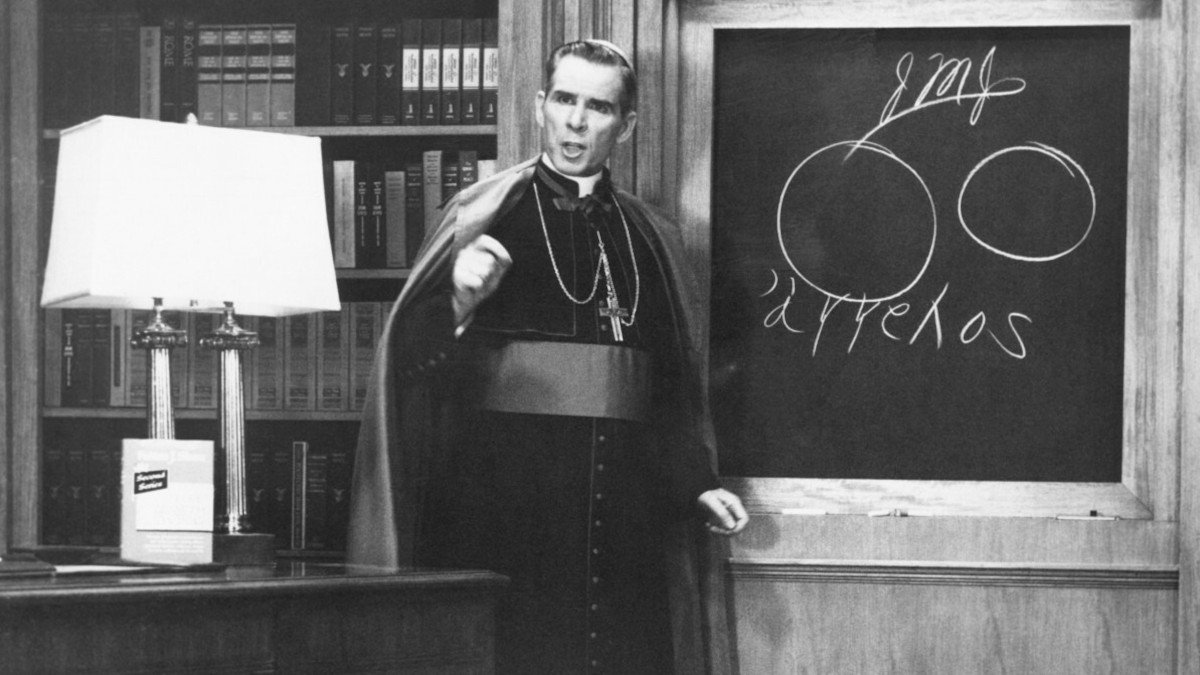
And actually, when you look closer at his achievements, his chosen medium really was modern. When Life Is Worth Living began in 1952, television was still finding its place in American homes. Into this exciting new technology stepped a bishop in full clerical dress, armed with little more than a blackboard, a wonderfully expressive face, and an extraordinary ability to talk directly to the person sitting at home. Somehow, it worked spectacularly well.
A bishop in prime time
Sheen was no stranger to broadcasting. Before appearing on screens, he had already spent more than two decades on radio's The Catholic Hour, but television allowed the audience to put a face to the voice and turned him into something approaching a celebrity.
Life Is Worth Living eventually attracted an audience estimated at an impressive 30 million each week, as shared by the Catholic University of America. What's more, Archbishop Sheen wasn't tucked away in some obscure time slot either; he was competing for viewers in prime time, in an era filled with major entertainers. And what a job he did!
In 1953, the bishop won an Emmy, giving an acceptance speech that contained a one-liner modern social-media managers would probably have snapped up themselves. Sheen thanked his four writers: “Matthew, Mark, Luke, and John.”
Of course, it was funny and unexpected, but it also said rather a lot about why his communication worked. Sheen embraced television and understood how to make the most of this relatively new medium, but he never lost sight of why he was there in the first place: to share the Gospel with as many people as possible.
He used stories, humor, theatrical timing, and that famous blackboard, but there was something else that helped explain his appeal. For a bishop speaking from a television studio, Sheen was remarkably attuned to the ordinary concerns of the people watching at home. He addressed marriage, loneliness, anxiety, suffering, and the social questions of his day with empathy and an understanding that could surprise those expecting a clergyman to be somewhat removed from everyday life.
The hour nobody watched
Yet perhaps the most interesting part of Sheen's extraordinary media career happened well away from the cameras.
On the day of his ordination in 1919, he made a resolution to spend one continuous hour every day in the presence of the Blessed Sacrament. He kept it throughout his priesthood. But it also meant that behind the bishop addressing millions was a priest spending an hour each day in silence before Christ.
Interestingly, Sheen didn't regard the two lives as separate. Quite the opposite. His Holy Hour became what he called “The Hour That Makes My Day,” and he believed it was the source from which his preaching, writing, and ideas flowed.
Sheen himself was wonderfully honest about the fact that even a daily Holy Hour didn't always produce an hour of sublime contemplation. During a visit to the church of Saint-Roch in Paris, he settled down to pray and promptly fell asleep, waking exactly an hour later. Unsure whether he'd fulfilled his promise, he imagined his guardian angel pointing out that the Apostles had spent their first Holy Hour sleeping too -- before adding that he shouldn't make a habit of following their example.
It's a lovely glimpse of the humor that made Sheen so appealing on screen, but also of a spiritual discipline that wasn't dependent on everything going perfectly. For more than 60 years, whether inspired, distracted, or apparently fast asleep in a Parisian church, he kept showing up.
Influence without the influencer
Today, influence comes with numbers attached: followers, likes, views, shares, and engagement. Sheen had the 1950s equivalent in extraordinary quantities, yet the number that seems to have mattered most to him was one: the hour he spent each day before the Blessed Sacrament.
That doesn't mean Catholics should abandon Instagram for an hour of Adoration and expect to emerge with a viral reel. Sheen was exceptionally intelligent, highly educated, charismatic, and extremely skilled at what he did. His success required craft as well as faith.
Perhaps that's what makes him such an interesting figure for anyone trying to communicate Christianity today. He embraced the newest technology available to him, learned how to use it brilliantly and wasn't remotely frightened of entertaining people along the way. Yet popularity wasn't what he was chasing; it was the consequence of being very good at communicating something he genuinely believed.
And at the heart of it all was the faith that gave his extraordinary talent its purpose. Before trying to bring Christ to millions of people, Fulton Sheen made sure he had spent an hour with Him himself.