In 1979, Israeli archaeologist Gabriel Barkay was excavating a series of Iron Age burial caves carved into the limestone cliffs of Ketef Hinnom — “the Shoulder of Hinnom” — on the western slope of the valley southwest of Jerusalem’s Old City, below the Scottish Church of St. Andrew. The site had been plundered over the centuries, and a bone repository in one of the tombs had been used to store Turkish army rifles during the Ottoman period. It appeared that little of archaeological value remained.
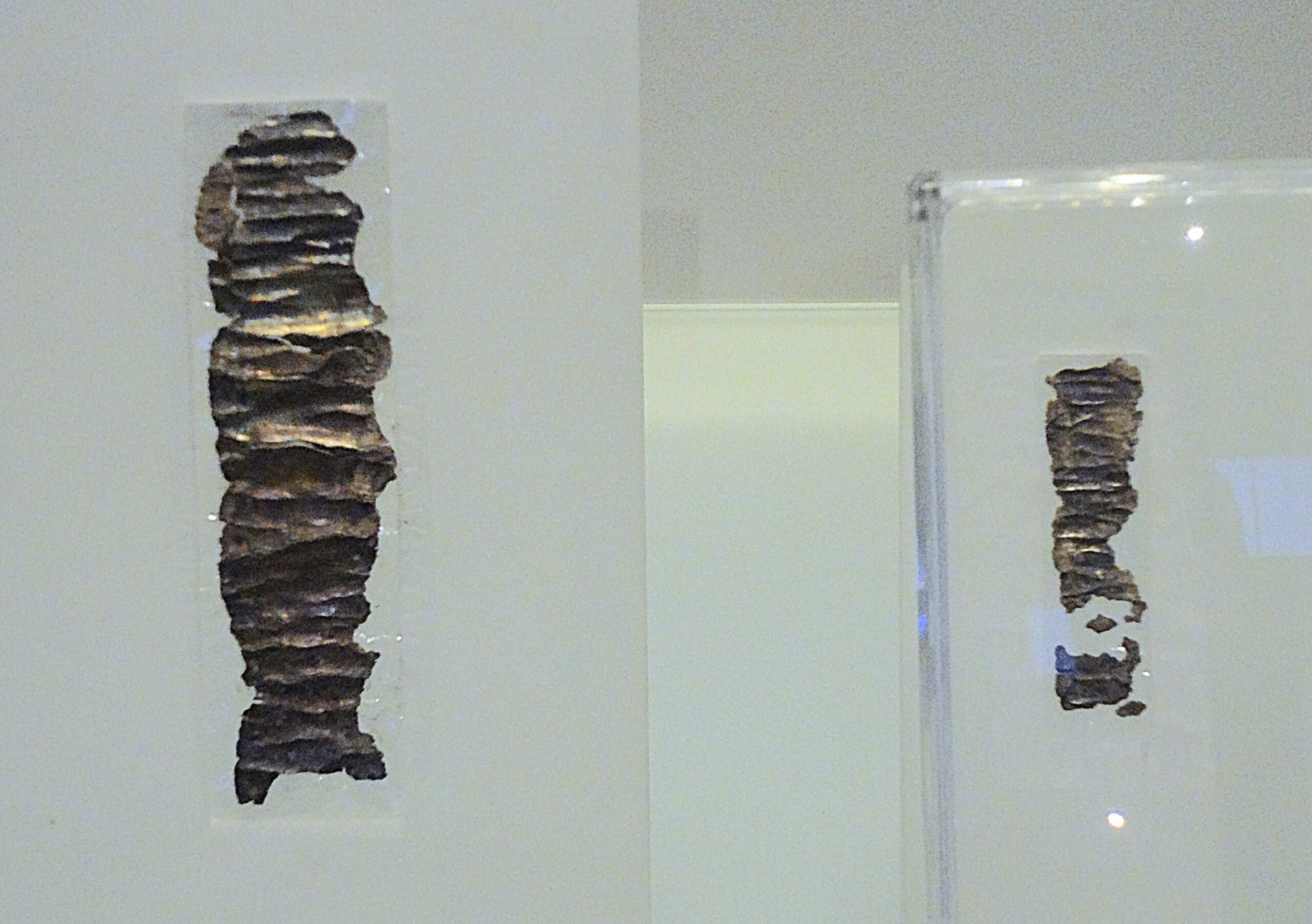
Then a 13-year-old volunteer on the dig, exploring a narrow chamber, discovered a cache of artifacts that had been missed by looters: pottery, jewelry, arrowheads — and two small rolled pieces of silver, corroded and fragile. The larger measures about 97 by 27 millimeters (3.8 inches by 1 inch). The smaller is about 39 by 11 millimeters (1.5 inches by 0.4 inches) — roughly the size of a thumbnail. Both had been worn as amulets around the neck and buried with the dead.
Unrolling them took three years. The silver was so fragile that a new laboratory method had to be developed to prevent the scrolls from disintegrating as they were opened. When the process was complete, researchers found what they had not expected: ancient Hebrew script, inscribed with an exceptionally fine stylus, carrying words still spoken in Jewish and Christian worship today.
What they say
Both scrolls contain versions of the Priestly Blessing from Numbers 6:24-26: “The LORD bless you and keep you; the LORD make his face to shine upon you and be gracious to you; the LORD lift up his countenance upon you and give you peace.” The name of God — YHWH — appears on both, in one of its earliest known written occurrences. The larger scroll also contains additional phrases echoing Deuteronomy and other biblical texts, suggesting the person who inscribed it was drawing on a wider body of scripture already known by heart.
Why they matter
The scrolls date to the late 7th or early 6th century BC — roughly 600 BC, in the final decades before the Babylonian destruction of Jerusalem in 586 BC. This makes them approximately 400 years older than the oldest Dead Sea Scrolls, and roughly 1,000 years older than the Masoretic manuscripts that formed the basis of most modern Old Testament translations before the Dead Sea Scrolls were discovered. Before the Ketef Hinnom find, the earliest known biblical manuscripts dated to the medieval period.
The significance of the dating goes beyond archaeology. The Priestly Blessing of Numbers 6 was already in use as authoritative scripture — inscribed on silver amulets worn by ordinary people, buried with the dead — before the Babylonian exile, before the Second Temple period, and more than six centuries before the birth of Christ. The words spoken at baptisms, weddings, and funerals across the world today were already being written down in Jerusalem when the First Temple was still standing.
The scrolls also demonstrate a remarkable textual stability. The Priestly Blessing as inscribed on the Ketef Hinnom amulets is recognizably the same text found in the Hebrew Bible today — a continuity of 2,600 years across some of the most turbulent centuries in human history.
Where they are now
The Ketef Hinnom scrolls are on permanent display at the Israel Museum in Jerusalem, where they have been since their restoration. They are among the most important objects in the museum’s collection — and among the most quietly astonishing artifacts in the world: two pieces of silver small enough to hold in one hand, carrying the oldest surviving words of the Bible, worn against someone’s skin in a Jerusalem that no longer exists.
The Priestly Blessing they preserve is still used in Catholic and Jewish liturgy. In the Catholic tradition, it is proclaimed at the close of the Mass. In Jewish synagogues, it is recited by the kohanim, the priestly descendants, on feast days. The words have not changed. They were not changed in the 400 years between these scrolls and the Dead Sea Scrolls, or in the 2,000 years between the Dead Sea Scrolls and now.