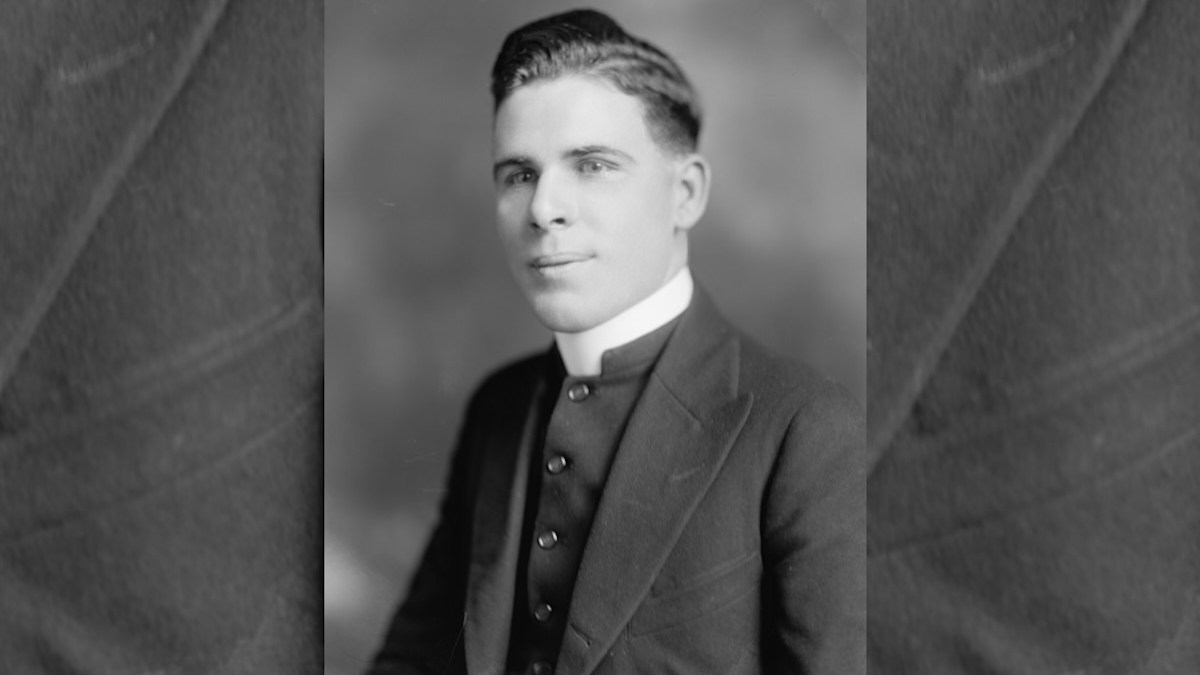
A shattered wine cruet left 8-year-old Fulton Sheen terrified, but a bishop's unexpected response offers parents a lesson worth remembering.
There are few disasters quite as enormous as the ones you create when you're eight years old. Break something at home and you might contemplate emigrating before your parents find out; smash something while serving Mass for a bishop, and presumably there is nowhere left to go! Unfortunately for 8-year-old Peter Sheen -- soon-to-be Blessed Fulton Sheen -- the latter was precisely the predicament he found himself in one morning at St. Mary's Cathedral in Peoria, Illinois.
Long before he became a bishop himself, not to mention one of America's most recognizable Catholic voices, Sheen was serving Mass for Bishop John Lancaster Spalding when he dropped the wine cruet onto the cathedral's marble floor. And if the actual damage was relatively small, the sound apparently wasn't.
Decades later, Sheen could still remember it. In his autobiography, Treasure in Clay, he joked that no atomic explosion could compare with the noise of a cruet smashing on marble in a silent cathedral. At the time, however, the little altar boy found it considerably less amusing, remembering simply: “I was frightened to death.”
His situation became rather worse when Bishop Spalding asked to see him after Mass. Any child who has ever heard the words We'll discuss this later can probably appreciate the horror, and young Fulton must have approached the bishop expecting to hear exactly what he thought of altar boys who smashed his cruets.
Instead of the anticipated telling-off, however, Spalding comforted the frightened boy and began asking him about his future.
From a broken cruet to Belgium
To Fulton's surprise, the bishop didn't seem particularly interested in discussing the smashed cruet. Instead, he asked the little boy where he intended to go to school “when you get big.”
Fulton replied that he would attend Spalding Institute, the local high school that happened to bear the bishop's name. It was an impressively diplomatic answer, although Sheen later admitted that at eight years old he had no idea how diplomatic he was being.
But Bishop Spalding had something much bigger in mind. Had Fulton ever heard of Louvain? The little boy hadn't, but that didn't deter the bishop, who told him to go home and inform his mother that one day he would study at the great Catholic university in Belgium. This was then followed by an even more extraordinary prediction: “Someday you will be just as I am.”
And Spalding was right. Sheen would indeed study philosophy at Louvain before eventually becoming a bishop himself, making the exchange an extraordinary little footnote to the life that followed. But beyond the bishop's remarkable foresight, there is something in his response to a terrified 8-year-old that feels particularly valuable for parents.
When a mistake already feels enormous
Childhood has a way of magnifying disasters. A broken object, a terrible grade, the forgotten homework that was definitely mentioned several times, or an impulsive decision that seemed an excellent idea five minutes earlier can suddenly feel catastrophic once an adult enters the picture.
Of course, children need correcting. They need to apologize when they've hurt someone, take responsibility for their actions and learn that choices have consequences. But sometimes the child standing in front of us has already understood all of that rather painfully.
Young Fulton certainly had. By his own account, he was “frightened to death,” and whatever lesson there was to learn about being careful with a wine cruet had presumably been delivered rather efficiently by the sound of it hitting the cathedral floor.
Bishop Spalding could have added to the boy's embarrassment. Instead, he offered comfort and changed the direction of the conversation completely. Fulton was preoccupied with what he'd just done; the bishop wanted to talk about who he might become.
A mistake isn't an identity
It's an important distinction, particularly when children are still forming their ideas about themselves. There is a world of difference between being told that something you did was careless and being made to feel that you are careless, just as a failed exam doesn't make a child stupid and one spectacular lapse in judgment doesn't make them a disappointment.
Words spoken in frustration can also prove surprisingly durable. The broken vase will be replaced, the bad grade eventually buried beneath dozens of others, and even the most disastrous haircut will grow out. Yet children have an extraordinary capacity to remember how an adult made them feel at the moment they got something badly wrong.
This doesn't require parents to greet every catastrophe with saintly serenity. If a baseball has just sailed through the neighbor's window, there is still a neighbor to apologize to and a window to replace. But once the immediate consequences have been dealt with, the mistake doesn't need to occupy more space than it deserves.
Bishop Spalding's response offers a beautiful example of that sense of proportion. He didn't pretend the cruet hadn't smashed; he simply refused to let a few pieces of broken glass obscure his view of the child standing beside them.
Looking beyond the broken glass
Perhaps that's why this tiny episode survived among the memories Sheen chose to record in his autobiography. The altar boy who approached Bishop Spalding expecting anger went on to Louvain, became a priest and bishop, reached millions through radio and television and, on September 24, will be beatified.
Few parents will be called upon to predict quite such a future while surveying the wreckage of a childhood mishap. But every child needs the security of knowing that an adult who loves them can see beyond today's failure, particularly when they are struggling to do so themselves.
For an 8-year-old Fulton Sheen, the broken cruet must have seemed enormous. Bishop Spalding simply had the advantage of looking at the little boy beside it and seeing something much bigger.
If you're not able to get a copy of Fulton Sheen's autobiography, the Catholic University of America shares some wonderful details about his life.