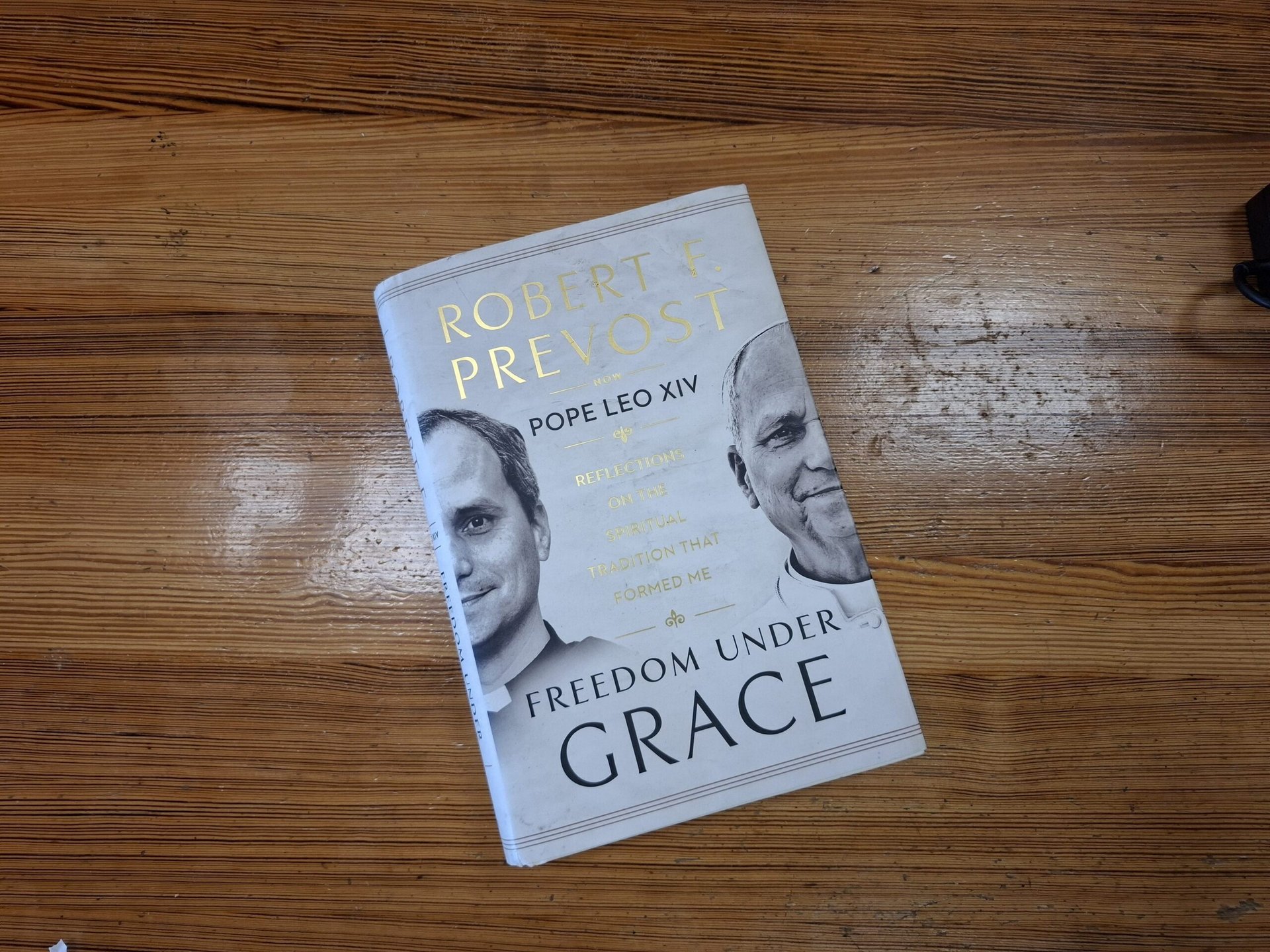
Pope Leo XIV’s first book was released today. It's not just his first book as pope, but his first book ever. And while the book is a collection of works written before he was elected, the central question that arises when reading Freedom Under Grace: Reflections on the Spiritual Tradition that Formed Me is: What themes emerge from the pages that we can trace in his papacy?
Writings from time as the head of the Augustinian order
Freedom Under Grace is not organized by theme, but rather chronologically, specifically covering the future pope's writings from when he was head of the Augustinian order. While the initial idea for the book was approved by Pope Leo himself, it was members of his religious order who compiled many of his writings, addresses, and homilies from that time period, the years 2001-2013.
The original texts themselves convey Pope Leo’s background, first written sometimes in English, others in Spanish and even German. The publisher also notes that most of the texts are not academic works, but homilies that were “written first of all to be heard. ... Those who want to understand him and place themselves under his pastoral guidance will attend not just to his words but the voice in which they’re uttered.”
In his foreword, Fr. Joseph L. Farrell, OSA, current head of the Augustinian Order, highlights several themes he sees in the future pope’s reflections, including “unity, ... the call to renewal and the call to continue making progress on the path of the spiritual life.” These are, of course, far from the only topics touched on by Prevost, but a helpful lens through which to approach the 400+ pages.
Union with God and with others
In his homily to the General Chapter of Augustinians in 2001, then-Fr. Prevost focuses on the importance of interiority in the spiritual life, which the fruit of which is a love of God and others:
We are called to know ourselves that we might know God, and in encountering God, we are also led to deep love of God and our neighbor.
He emphasizes often the connection between loving one another and loving God, another time saying:
We are called to live in such a way that through our sharing of faith and life together, others will somehow come to experience that same mystery of the divine presence in and through us.
Emphasis on St. Augustine
It is not surprising that during this time period as head of the Augustinian Order Pope Leo mentions St. Augustine quite often. He refers to him in a way that supports the charism of the Augustinian order, but also can be extended to all Christians.
Preaching in Iquitos, Peru, for example, he says:
Respect for the human person and his or her dignity, sensitivity to what is truly human, dialogue with diverse cultures, the acceptance of human values and legitimate autonomy, living in tune with the deepest longings of humanity – all these are indicators of what must be the spirituality of persons of faith who seek to imitate Augustine’s style of life.
And in Slovakia, he speaks of Augustine's mother, St. Monica, who generously gave her heart to Augustine, and of Augustine who converted and became a model of Christian life:
Saint Augustine, image of this generosity in giving his heart for others, who gave so much to the Church, promoting the values of unity and truth -- always on the basis of charity, of love.
Over a decade of wisdom
This collection of writings reflects only one period of time during Pope Leo XIV’s life, but it's a significant one. In this collection, the reader can learn much about the Augustinian charism -- the central theme of which, the Pope says in the book, is unity -- and how that charism is already influencing his papacy.
In addition, readers are given the opportunity to get to know the current pope in the years when he was not yet the Vicar of Christ, but a father to an order. In his plainspoken way, his authenticity is encouraging. The final passage of the book sends a message to all of us: “We are going to work with hope, recognizing that it is the grace of God that gives us life.”