Robert Bellarmine met Galileo on February 26, 1616. What transpired that evening is more human and more interesting than the standard narrative suggests.
On the evening of February 26, 1616, Galileo Galilei had a meeting with a saint. Cardinal Robert Bellarmine was 73 years old, one of the most respected theologians in the Catholic world, and a Jesuit who had spent decades in the service of popes, councils, and controversies. Galileo was 52, the most famous scientist in Europe, and in Rome specifically to argue for the Copernican heliocentric theory — the claim that the earth moves around the sun rather than the reverse. The meeting between them that February evening has been retold, simplified, and mythologized ever since. The feast day of St. Robert Bellarmine on September 17 is a good occasion to tell it more carefully.
The context: What 1616 was actually about
The encounter did not come from nowhere. Since at least 1613, Galileo had been arguing publicly not only that the Copernican system was the best astronomical model for predicting planetary motions — which most astronomers of the day were prepared to accept as a mathematical hypothesis — but that it was physically true, and that Scripture should be reinterpreted in its light. This second claim was what alarmed the theologians. In the absence of conclusive proof — and Galileo did not yet have it — the demand to reinterpret Scripture on the basis of a contested scientific theory was, in the institutional logic of post-Tridentine Catholicism, a serious overreach.
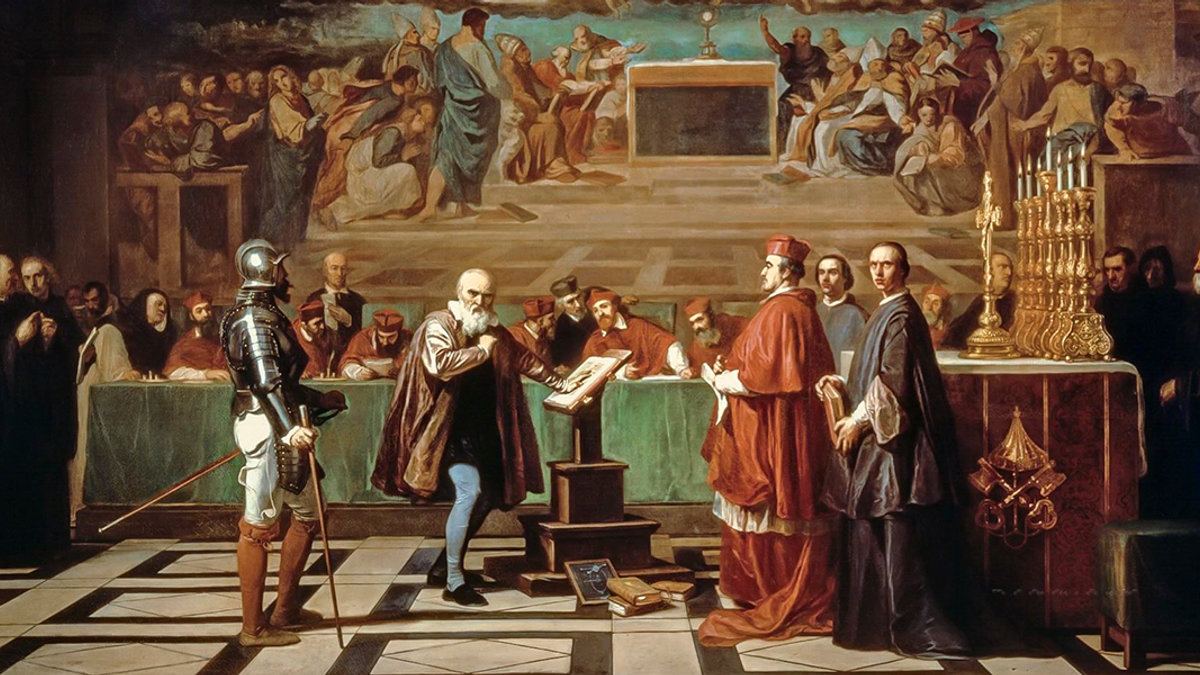
A committee of 11 theological consultors convened in February 1616 and issued a unanimous judgment: the heliocentric theory was “philosophically absurd and formally heretical.” This was the first time — more than 70 years after Copernicus had published his theory — that any official body of the Church had made such a judgment. Pope Paul V ordered Bellarmine to convey the warning to Galileo.
What Bellarmine actually said
Bellarmine called Galileo to his palace and gave him the warning. What exactly was said — and in what form — has been disputed by historians ever since, because two documents from that evening tell slightly different stories.
The official Inquisition record states that after Bellarmine gave his warning and Galileo accepted it, the Commissary-General of the Holy Office immediately read Galileo a further injunction, forbidding him to hold, teach, or defend Copernicanism “in any way whatsoever.” This more restrictive formulation was supposed to be issued only if Galileo refused the Cardinal’s initial warning — which he had not done. As the Rice University Galileo Project notes, the appearance of this further injunction in the record is puzzling and has never been fully explained. Bellarmine himself appears to have been unaware that it had been issued.
The second document is a certificate Galileo later requested from Bellarmine — signed by the Cardinal himself — which makes no mention of any injunction. It states simply that Galileo had been informed that the heliocentric doctrine “cannot be defended or held.” As the Church Life Journal at Notre Dame has noted, Bellarmine had no recollection of the phrase “in any way whatever.” At Galileo’s trial in 1633, 17 years later and 12 years after Bellarmine’s death, Galileo produced this certificate as his primary evidence of innocence — and it was, in fact, a more moderate document than the Inquisition’s own record suggested.
What Bellarmine’s position actually was
It would be a mistake to read Bellarmine as an obscurantist. In a famous letter to the Carmelite friar Paolo Foscarini — who had written defending the compatibility of Copernicanism with Scripture — Bellarmine had laid out his epistemological position with considerable care. He was prepared to accept heliocentrism as a mathematical hypothesis for predicting planetary motions. What he resisted was the claim that it was physically true, in the absence of conclusive demonstration. As the University of Navarra's science and faith research group summarizes, Bellarmine’s position was that if a genuine physical demonstration of heliocentrism were produced, then Scripture would need to be reinterpreted — but that until such a demonstration existed, it was imprudent to demand that reinterpretation in advance.
This was not an unreasonable epistemological position for 1616. Galileo had not yet proved the heliocentric theory beyond reasonable doubt — and his proposed proof, based on the tides, was wrong. Bellarmine was not, in 1616, suppressing a proven truth. He was applying a conservative but not irrational standard of evidence to a contested scientific claim with significant theological implications.
The 1633 trial — which Bellarmine did not live to see
Galileo kept relatively quiet until 1623, when a new pope was elected — Urban VIII, a great admirer of Galileo who had written him an admiring poem. Galileo took this as license to return to the subject and in 1632 published his Dialogue on the Two Chief World Systems — a work in which the arguments for the Copernican side were considerably stronger than those for the Ptolemaic. The Inquisition moved against him. At his trial on June 22, 1633, Galileo was found guilty of “vehement suspicion of heresy.” Only seven of the 10 cardinal inquisitors signed the sentence. He was required to abjure — and the legend that he then whispered “eppur si muove” (“still it moves”) dates from a hundred years after the event.
Bellarmine had died in 1621, 12 years before the trial. The man who met Galileo that February evening in 1616 was one of the most formidable intellects of his age — not a villain, not a hero of science, but a theologian applying the standards of his institution and his moment to a question that genuinely exceeded those standards. He was wrong, in the end, about heliocentrism. The Church itself eventually acknowledged this: John Paul II formally closed the Galileo case in 1992, acknowledging that the theologians of 1616 and 1633 had erred.
Robert Bellarmine was canonized in 1930 and declared a Doctor of the Church. His feast day is September 17. The story of his meeting with Galileo is not a story of science versus religion — it is a story of two highly intelligent men, each right about some things and wrong about others, navigating a question that neither of them could fully resolve with the tools available to them. That is a more honest story, and in the end a more interesting one.