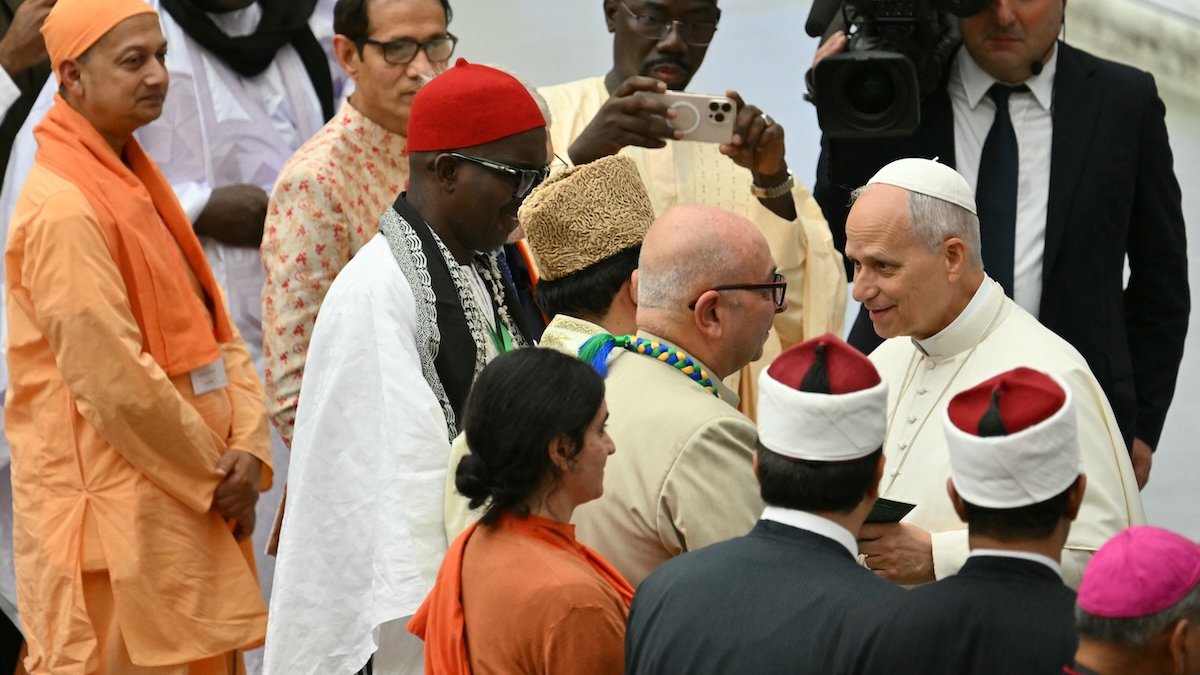
A Vatican Note marking the anniversary of Nostra Aetate calls for a “new ethic of dialogue” and says religions must be bridges, not weapons. Here are 5 keys to understanding it.
On September 16, the Holy See published a doctrinal Note marking the 60th anniversary of Nostra Aetate — the Second Vatican Council’s landmark declaration on the Church’s relations with non-Christian religions, promulgated by Pope Paul VI on October 28, 1965.
Titled “A Journey of Hope: Sixty Years of Interreligious Dialogue and Fraternity in the Light of the Conciliar Declaration Nostra Aetate,” the Note was approved by Pope Leo XIV on June 22 and jointly issued by three offices of the Roman Curia: the Dicastery for the Doctrine of the Faith, the Dicastery for Promoting Christian Unity, and the Dicastery for Interreligious Dialogue.
It arrives at a moment when the themes Nostra Aetate opened — Jewish-Catholic relations, Muslim-Christian encounter, dialogue with Eastern religions — are as urgent as they have ever been, and in some respects more complicated. Here are five keys to understanding what the document says.
1. Nostra Aetate was a genuine turning point — and its significance has not diminished
The Note opens by situating the original 1965 declaration within the history it created. As the Dicastery for Interreligious Dialogue has noted, Nostra Aetate — “In Our Time” — marked a historic turning point. In five concise sections, it urged respect for other faith traditions and explicitly declared that the Catholic Church “rejects nothing that is true and holy” in them. It marked the Church’s first formal repudiation of anti-Semitism. It acknowledged the shared spiritual heritage between Christians and Jews, and recognized that Muslims “worship God, who is one” and share in the faith of Abraham. As the late Chief Rabbi of London Jonathan Sacks observed, encounters between popes and Jewish leaders were “inconceivable” before the Council. Six decades later, they are routine. That is the measure of what Nostra Aetate achieved.
2. A “shift in mindset” is still needed — and must go deeper
The Note does not rest on the achievements of the past 60 years. It calls for a renewed “shift in mindset” to produce what it describes as a “new ethic of dialogue.” The document praises the “shift in perspective” that has developed between religious leaders, resulting in “a culture of dialogue and a ‘culture of encounter’” — but insists this must continue “with renewed impetus so that fraternity may be built up between the various creeds.” The work is not finished. If anything, the fragmentation of the contemporary world and the weaponization of religious identity in multiple conflicts make the unfinished work more urgent.
3. Religious freedom is non-negotiable
One of the Note’s sharpest formulations is its insistence on the connection between genuine dialogue and genuine freedom. “No respectful relationship with other religions can be sincere or feasible without a corresponding respect for the religious freedom of others,” the document states. This is not a diplomatic nicety. It is a theological claim: authentic encounter between faiths is impossible where one party is constrained, persecuted, or coerced. The statement has direct relevance to contexts — in the Middle East, in parts of Asia, in various authoritarian states — where Christians face restrictions and where Christians in majority positions have sometimes failed to extend the same respect they ask for themselves.
4. Religions must be bridges, not walls
The document draws on language that Pope Leo XIV also used in his video message for October 2025, dedicated to interreligious collaboration: “May religions not be used as weapons or walls, but rather lived as bridges and prophecy: making the dream of the common good credible, accompanying life, sustaining hope and being the yeast of unity in a fragmented world.” The Note places this vision within the theological framework established by Nostra Aetate and developed through Francis’ encyclical Fratelli Tutti and the Abu Dhabi document on human fraternity. The trajectory is consistent: the Church increasingly understands interreligious dialogue not as an optional diplomatic courtesy but as a theological imperative rooted in the dignity of every human person.
5. The well of Sychar — and the theology of thirst
A striking passage in Leo XIV’s catechesis for the anniversary — delivered at the General Audience of October 29, 2025, is closely connected to the Note. It was his meditation on Jesus and the Samaritan woman. The Pope placed John 4:24 at the center of his reflection on interreligious dialogue: “God is spirit, and those who worship him must worship in spirit and truth.”
“In the Gospel,” Leo said, “this encounter reveals the essence of authentic religious dialogue: an exchange that is established when people open up to one another with sincerity, attentive listening and mutual enrichment. It is a dialogue that arose from thirst: God’s thirst for the human heart, and the human thirst for God.”
The well at Sychar — where Jesus crossed the boundaries of culture, gender, and religion — becomes, in his reading, a paradigm for what interreligious encounter at its best looks like: not the erasure of difference, but the discovery of a shared thirst for God that no single tradition exhausts.
The Note “A Journey of Hope” is rooted heavily in the themes and linguistic style of Nostra Aetate and the ensuing decades of ecumenical texts. It does not propose dramatic new departures. What it does is insist, 60 years on, that the direction set by the Council was right — and that the journey is far from over.