The future Blessed won one of television's biggest prizes -- and 70 years later, his moment on stage is worth another look.
On Sunday night, some of television's biggest stars made that familiar journey from their seats to the Emmy stage, clutching a statuette and facing one of the entertainment industry's more peculiar challenges: How do you sum up years of work, acknowledge everybody who helped you get there, say something vaguely memorable and remember your partner's name, all while a clock is essentially telling you to hurry up?
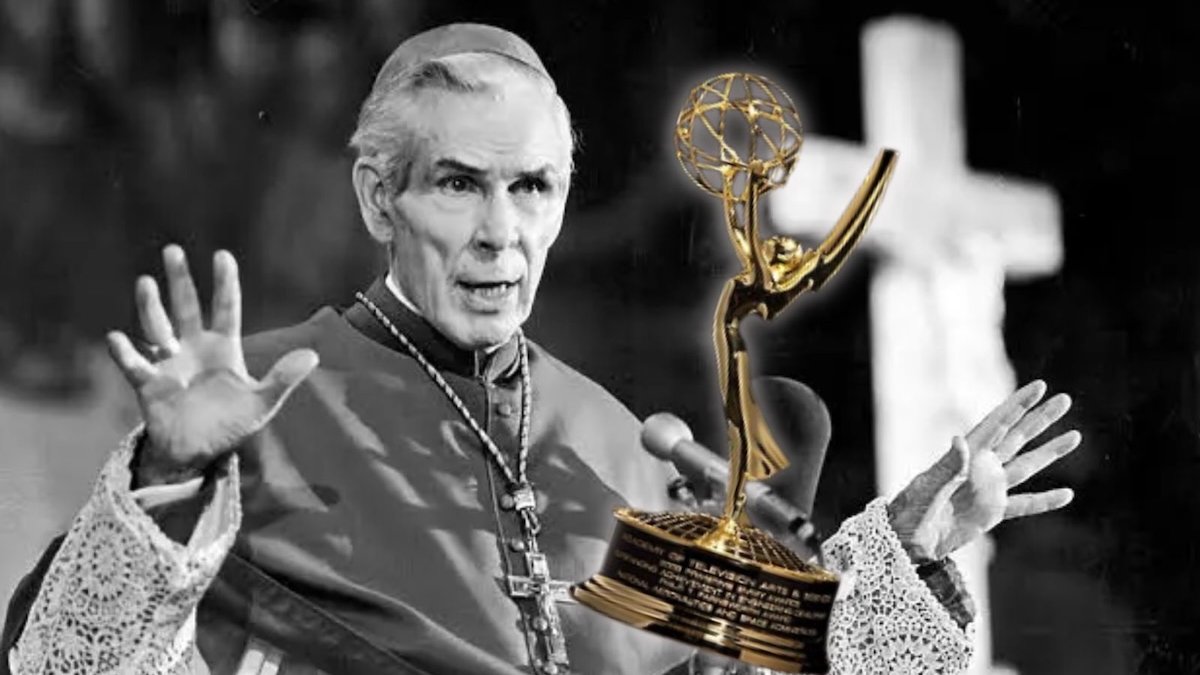
Among the long history of winners, however, there is one acceptance speech that managed to do an impressive amount of work in a single sentence. It belonged to a Catholic bishop, Fulton J. Sheen, whose television program had none of the ingredients we might associate with an Emmy-winning production today.
And now, more than 70 years after becoming one of American television's most unlikely stars, Fulton J. Sheen, will be beatified on September 24. While his Emmy makes for a wonderful piece of Catholic trivia, if you look a little closer there is something more interesting in the story: Sheen understood remarkably well what it takes to be a winner, and very little of it had to do with the statuette.
You don't always need the bells and whistles
Life Is Worth Living was hardly an obvious recipe for television success. There was no expensive set, no cast of famous faces and precious little to distract viewers from the man doing the talking. Sheen appeared in his bishop's robes, accompanied by little more than a blackboard, and spent half an hour discussing everything from faith and philosophy to communism, marriage and human behavior. And millions tuned in.
TIME, profiling Sheen in 1952, described him as America's best-known Catholic priest and television's newest star. He was competing for viewers with some of the biggest entertainers on American television, while demand for tickets to his broadcasts vastly exceeded the number of seats available.
For anyone who has ever sat through a meeting in which somebody insists that success depends upon a bigger budget, a flashier presentation or another piece of technology, a Catholic bishop with a blackboard proved otherwise. Sheen certainly understood television and knew how to use it, but the production never had to compensate for a lack of substance. He had something to say, knew how to say it and trusted an audience to listen.
In 1953, that decidedly uncomplicated formula earned Sheen one of television's highest honors when the Television Academy named him Most Outstanding Personality. And if there were any doubt about the scale of the achievement, he took home the award ahead of a formidable field that included Edward R. Murrow, Jimmy Durante and the woman widely considered the favorite that year: Lucille Ball. With a worldclass acceptance speech:
“I feel it is time I pay tribute to my four writers -- Matthew, Mark, Luke, and John.”
That one line managed to get a laugh, thank the people -- admittedly rather distinguished people -- behind his material, and tell everybody in the room exactly what mattered to him.
Remember that nobody wins alone
Awards are peculiar things because they place one person at the center of an achievement that almost certainly involved a great many others. One name is announced and one person takes home the statuette, but behind that moment may be years of encouragement, collaboration, sacrifice and somebody making cups of tea at exactly the right moment.
Sheen's four “writers” made for an excellent joke, but his instinct was also one worth keeping. When the applause was directed at him, he redirected it towards the source of what he had been sharing with millions of viewers.
Success can make it tempting to concentrate on how far we've come. Sheen's response invited him to remember where he'd started, and perhaps that is part of handling achievement well: knowing the difference between accepting recognition and imagining that you produced everything being recognized entirely by yourself.
Don't become someone else when people start applauding
There is no denying that the soon-to-be blessed was one of the very few people who could have carried off a speech like that. His broadcasts had already shown how naturally faith and humor could sit alongside each other, without either diminishing the other.
He could tackle serious questions about suffering, politics, marriage, or God without becoming remote, and he understood the enormous value of making an audience laugh. So when he found himself standing on an Emmy stage, he didn't suddenly produce a grander, more polished version of Fulton Sheen to suit the occasion. He remained recognizably himself, in both his words and his bishop's attire.
That may actually be harder than it sounds. Success brings attention, and attention can create a peculiar pressure to become whatever version of ourselves seems most likely to keep it coming. Sheen's television career suggests the opposite approach. The bishop with the blackboard became successful precisely because he wasn't trying to look like everybody else on television.
And more than seven decades later, his Emmy acceptance still has something to offer us. Whatever field we work in, there will always be somebody with a bigger budget, a more impressive title, better connections or, these days, considerably more followers. But trying to keep up with everybody else is not only exhausting, it can also distract us from the very qualities that make us interesting in the first place.
Know when you've said enough
Sheen also understood something many of us struggle with: when to stop talking! He could have used his Emmy moment to deliver a sermon, explain the importance of religious broadcasting and thank everybody he'd met since kindergarten. Instead, he gave the audience one sentence they would still be quoting more than 70 years later.
These days, we're not always quite so disciplined. We can announce the achievement, photograph the achievement, post about the achievement, and then follow up with a lengthy reflection on what the achievement taught us about ourselves. Even an innocent question about how the weekend went can occasionally result in a photographic tour of somebody else's Saturday.
Sheen gave people the punchline and left them wanting more. Whether we're giving a presentation, posting online or telling a story over dinner, there's something to be said for resisting the urge to provide the director's commentary, too. If the point has landed, it doesn't need another three paragraphs to make sure.