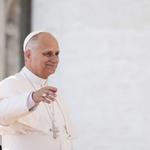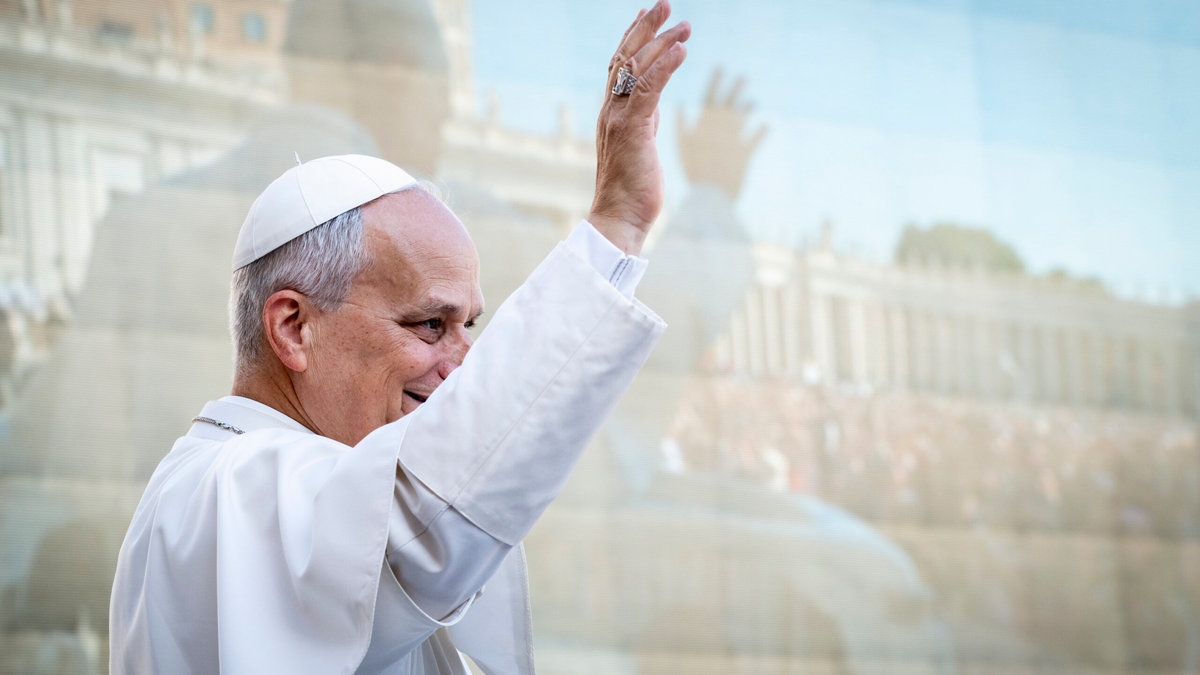
The Pope addressed the first meeting of the Leo XIV International Study Center, founded in Florence in his honor by his own religious order.
Pope Leo XIV received the promoters and participants of the new Leo XIV International Study Center in audience at the Vatican on Friday, September 18, describing the encounter as “something of a family meeting” and setting out a clear mandate for the recently established institution: to form people capable of engaging public and political life as a service to the common good, grounded in the Church’s social doctrine and in the Augustinian intellectual tradition.
The center was founded in August 2025 at the Augustinian Convent of Santo Spirito in Florence, by decree of the then Prior General of the Order of Saint Augustine, Father Alejandro Moral Antón, with the assent of the Holy Father. It operates in collaboration with the Theological Faculty of Central Italy and the Pontifical Patristic Institute Augustinianum in Rome, and aims to build partnerships with universities, public institutions, and civil society organizations both in Italy and internationally. Its academic focus is the pontifical magisterium — in particular the social doctrine of the Church as developed in Magnifica Humanitas.
“Be experts in God’s newness”
The Pope expressed particular gratitude for the initiative, noting “the importance of reflection and critical thinking in building a civilization of love, to which the social doctrine of the Church has much to offer.” He welcomed the Center’s commitment to wide-ranging dialogue — with universities, academic institutions, public bodies, and ecclesial networks — describing it as essential to the mission he was entrusting to the institution.
Against what he called the temptation of withdrawal, Leo urged the Center’s researchers and educators to become “pioneers” and “facilitators” of formation for public life.
“The secret,” he said, “is to walk together, always, without excluding encounter — even with those who seem to think, speak, or act differently.”
The phrase was characteristic of the man who, from his first words as pope, defined himself as a son of St. Augustine — a tradition that places fraternal community, restless inquiry, and the search for truth at the center of the Christian life.
Florence and the humanist tradition
The choice of Florence as the Center’s home carries, in the Pope’s reading, a specific symbolic charge. The city represents “an invitation to let ourselves be inspired by the values of humanism” — a humanism oriented toward peace rather than conflict. “It is not wars,” he said, “but the weaving of peace and just equilibria that produces civilization.”
Drawing on Pope Francis' 2015 address in Florence to the Church of Italy — a speech that Leo XIV has cited as a reference point — he quoted its definition of authentic humanism: “Authentic humanism does not exist unless it contemplates love as a bond between human beings, be it of an interpersonal, intimate, social, political or intellectual nature.”
Augustinian reflection, he said, has much to offer the contemporary world precisely on this point: “Love binds in order to liberate, unites in order to generate, commits in order to build.”
A roadmap for engagement
Leo also emphasized what he called the “popular root” (popular in this case meaning "of the people," not fashionable) of Catholic social doctrine — its connection to the concrete lives of working people, families, and communities — as indispensable tool for articulating faith in relation to the real challenges of labor and the economy. This is the vein Magnifica Humanitas follows, drawing the line from Leo XIII’s Rerum Novarum through to the current challenges of artificial intelligence and digital transformation.
He closed by quoting Magnifica Humanitas directly, inviting the scholars and educators present not to read the present moment as “a closed destiny” but to discern “the newness of God” germinating quietly beneath the surface — against the seductions of a purely technical efficiency.
“Be experts in God’s newness,” he told them: a phrase that distills the whole Augustinian wager — that restless hearts, kept open to what exceeds them, find more than they were looking for.