I read his book on priesthood when I was still an Anglican priest. Now as a Catholic priest, I still carry those truths with me.
When I was a young Anglican pastor, I tried to be the best pastor I could be for my parish, Church of the Resurrection, in Brewster, Massachusetts. It was my first assignment out of seminary and I had a lot to learn, but a ton of energy. I threw myself into researching Church growth, evangelization, running meetings effectively, and how to read a financial balance-sheet. On Sunday, we had our church service. The rest of the week, I led Bible studies and small groups, made visits to parishioners, and attended prayer meetings with other pastors. I’m sure I made lots of mistakes and certainly wasn’t the perfect pastor, but I did my best.
I even thought of myself as a priest who exercised a sacramental ministry. In the Episcopal church, we were taught that we were were Catholic in all the right ways but just weren’t “Roman Catholic” (the very polite implication being that “Roman” was the wrong way to be Catholic). I believed that our Sunday liturgy truly was the Eucharistic Sacrifice. I believed in the sacramental power of baptism. I wore a black clerical shirt and a white collar but, in retrospect didn’t fully understand what it meant to be a priest and how deeply ordination to the priesthood reshapes a man’s identity.
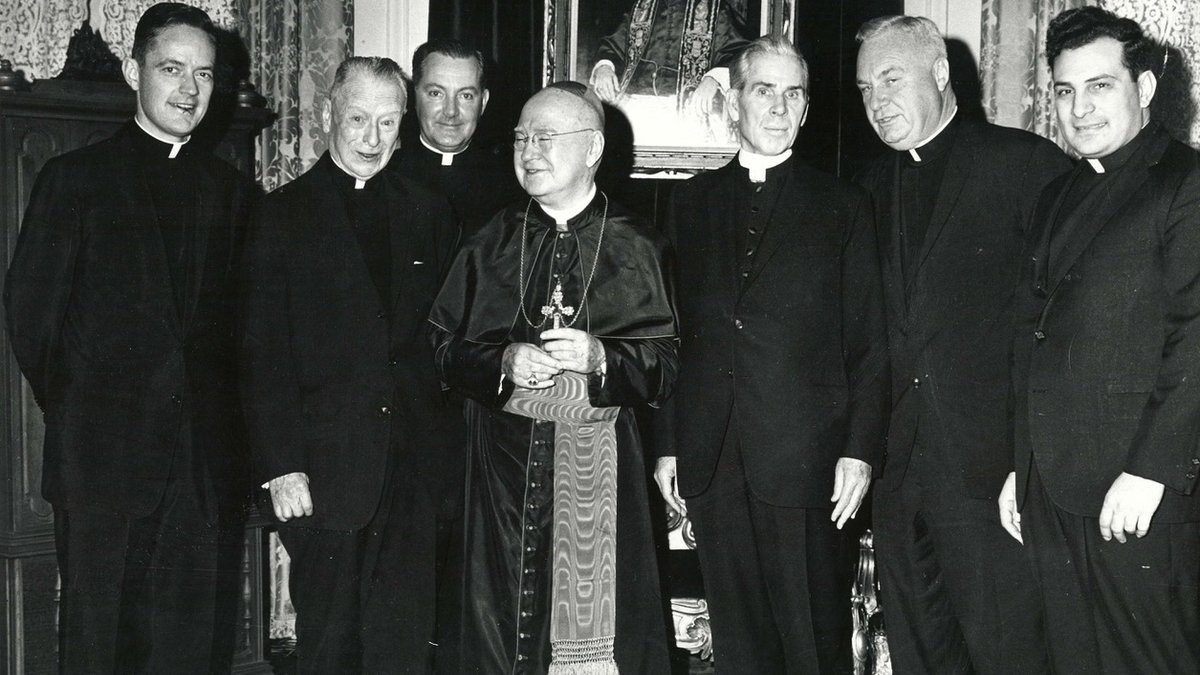
Around that time in the early years of my ministry, I read a book by Fulton Sheen called The Priest Is Not His Own. I’m not sure why I even had it on my bookshelf. I didn’t know who Fulton Sheen was or if the book was any good, but I was becoming more and more interested in the Catholic Church and thought it might be a good read.
Complete change
It’s not an exaggeration to say that Sheen’s book completely rearranged my conception of the priesthood. Up to that point, I thought of being a priest as something I did, not who I am. I knew I’d been given a special grace in order to accomplish a job, and that I’d made a vow (which I took quite seriously) to serve the Church. I worked hard at pastoring, but I hadn’t yet given myself entirely to the priesthood. I still thought of my off-time as my own. It was sort of like I thought I was clocking in and out of a job.
Fulton Sheen taught me that the priesthood is a new identity completely given over to the service of the Church. A priest is not his own. He belongs to another. Think of it like a two-story apartment, he writes. On the first floor is a suffering family. On the second is the home of the priest. If, occasionally, the priest descends to assist the family and then returns to the comforts of home, this is a nice thing to do but it isn’t the fullness of the priesthood. Following the example of Christ, the reality of the priesthood is that he goes down to the lower apartment where the suffering is and he stays there.
In his book, Sheen offers a series of helpful metaphors and analogies to understand the meaning of priesthood. A few, in particular, stood out to me.
1The priest is a victim
Sheen says that, when we offer Holy Mass, we die with Christ; “We cannot escape reproducing in our souls the mystery enacted on the altar.” If a priest does not consent to die with Christ at the altar, then he cannot become an agent for good. His ministry cannot produce life. If the priest is not first a victim at the Cross, he might still become effective at social work or counseling. Maybe he can be a good preacher or teacher. He may even run a parish quite well, but he is no longer a supernatural catalyst for eternity.
2The priest is a bridge
A priest is a man who has become more than himself. By grace, he has become a link between God and man. “Every priest is like another Jacob’s ladder,” writes Sheen. The priest as bridge to God fills me with hope. It means that the priesthood has both a vertical and a horizontal dimension. As a mere man with all my various flaws and inadequacies, the idea of being a pastor is overwhelmingly daunting. I wouldn’t be up to the task. Visiting the sick, caring for the dying, taking on the problems and burdens of others and trying to always be wise and give perfect advice -- it would eventually wear me down. I don’t have enough strength within me for the vocation to which I’ve been called. The priesthood doesn’t merely reach out, though, it also reaches up. This is where the strength of a priest comes from. Above. Christ is the great high priest who descends to assist all his priests to lift people up to God.
3Every priest has the same mother
“Every priest has two mothers,” writes Sheen. He has a natural mother and a spiritual mother. His natural mother is particular to him and his siblings, but every priest shares Our Lady as his spiritual mother. When I was Anglican, I used to think of the priesthood as a brotherhood but I didn’t understand that this meant we shared the same mother. It is Mary who binds us together in love. It is she to whom we belong. Sheen points out that a priest does not belong anymore to his family, friends, or even his parish. He belongs to Our Lady, which means he belongs to the universal Church. He serves the Church not as an employee but as a son.
Now that I’m a Catholic priest, these early insights into the priesthood that Fulton Sheen provided remain with me. I continue to take courage and comfort from his words. I know that I am equipped to face the challenge of my ministry, and that I don’t have to rely on my own strength alone. Christ is at work. Our Lady is at work. Priesthood is an identity that a man accepts entirely by grace. It is a revelation of the heart of God.