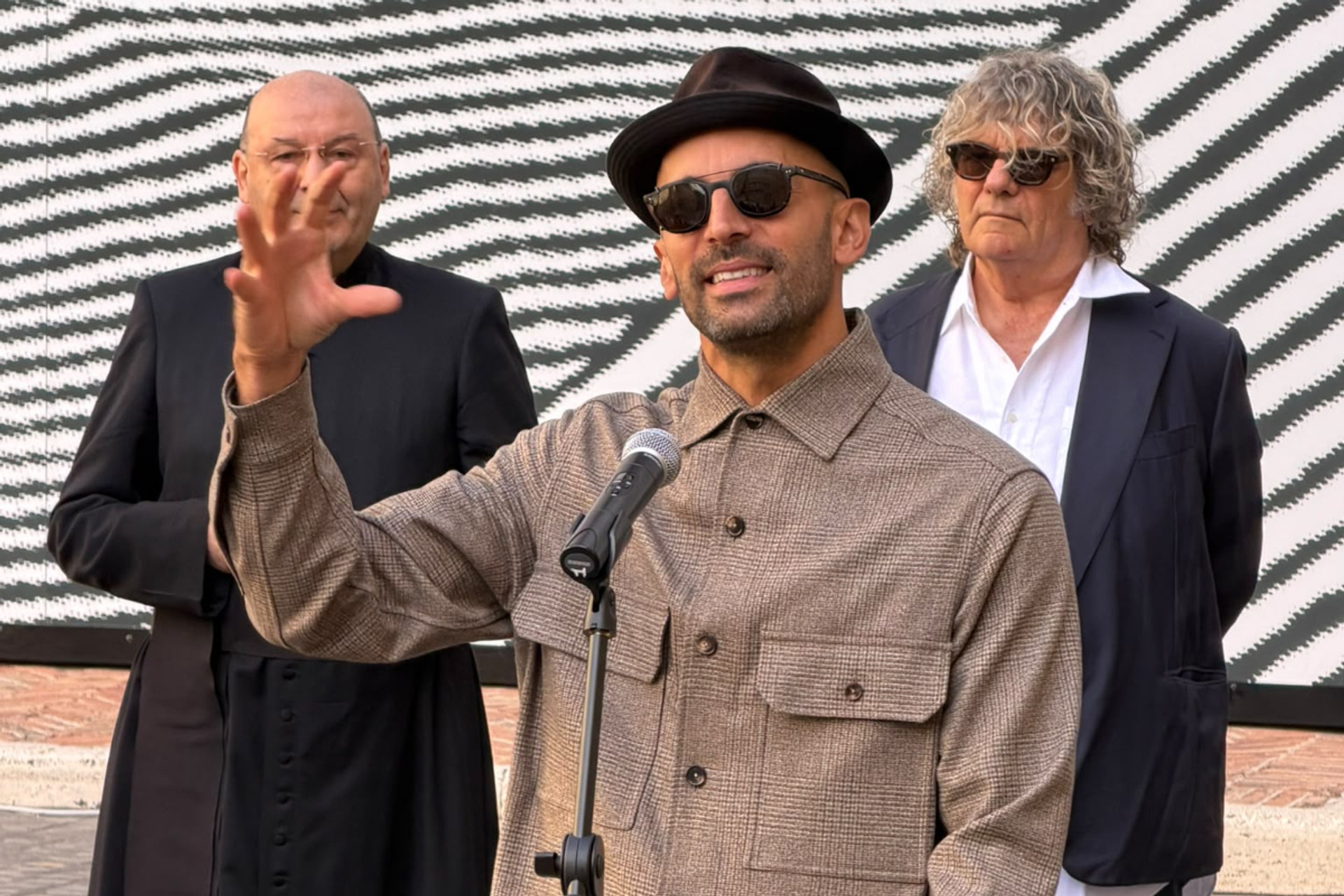
The wave immediately commands the visitor’s attention. It’s unusual to see such a monumental structure appear in the Belvedere Courtyard in the heart of the Vatican. Diluvium, a massive creation by contemporary artist JR, is mounted on the facade of the Vatican Apostolic Library, a 16th-century building. The piece depicts a wave measuring nearly 230 feet wide and 100 feet high.
For this first on-site contemporary art installation at the Vatican, the French photographer and director drew inspiration from an engraving of the biblical flood by the famous 19th-century French illustrator Gustave Doré. JR, who generally divides his time between New York and Paris, was in Rome in September.
A powerful wave
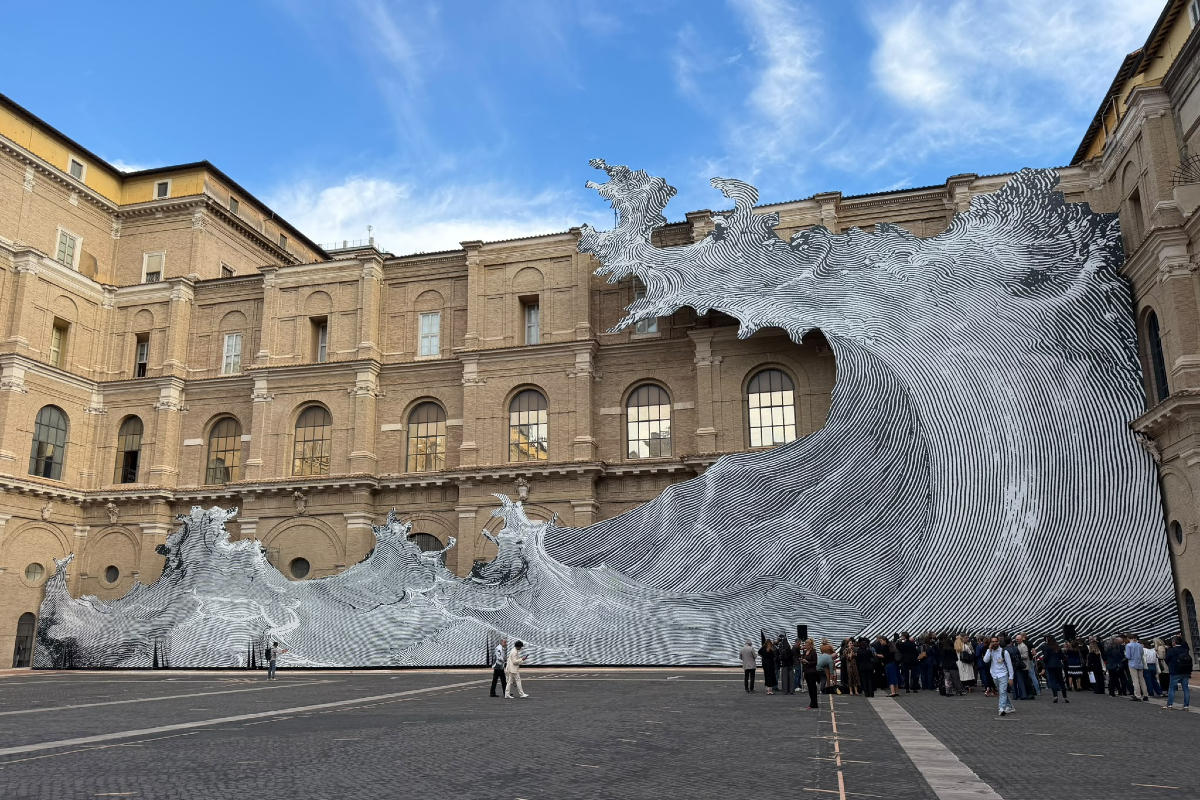
The 43-year-old artist, who became globally famous for his monumental outdoor photographic collages, says the work evokes several current concerns.
“This wave can make us think of actual waves of water like the one that just occurred in Nepal and Tibet, but also of heat waves, and the arrival of AI,” JR explains.
The artist views artificial intelligence as “a powerful wave.” He asks “what will become of our collective memory, which is kept today in libraries, in the face of changes that will call into question the way our civilization has preserved knowledge up to now.”
Amid these major upheavals, JR sees the Pope as a bridge builder and a transmitter of culture. He was glad to see Pope Leo XIV raising questions about how artificial intelligence is disrupting the world today. A few days before the pontiff's visit to France, the artist expressed his appreciation for the pope's defense of human relationships against the temptation of virtual isolation.
“My work as an artist is to raise these questions,” JR says. “I hope that we’ll find the answers, and I think it’s wonderful that the pope is so deeply engaged in these questions, because they concern all of humanity.”
Building bridges
For JR, the genesis of this monumental work is intimately linked to fear, but also to the desire to build unexpected connections between institutions, people, eras, and worlds that rarely cross paths.
The photographer notes that the area surrounding the Vatican was one of the places where he displayed some of his earliest street work in 2005, when he was just 22 years old.
“I think that a large part of my work consists of creating bridges, and this is precisely a place where, on the wall, one can see the inscription ‘Pontifex.’ It’s inscribed in the DNA of this place,” he observes.
He sees the Vatican as an ideal location to find “an infinity of ways to create bridges between institutions, between fear and hope, between ancient architecture and an ephemeral wave.”