France was responsible for significant advances in our world, including the recognition of human rights grounded in the nature of the human person ...
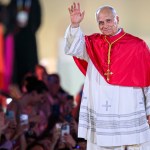
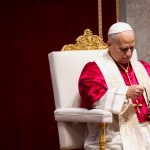
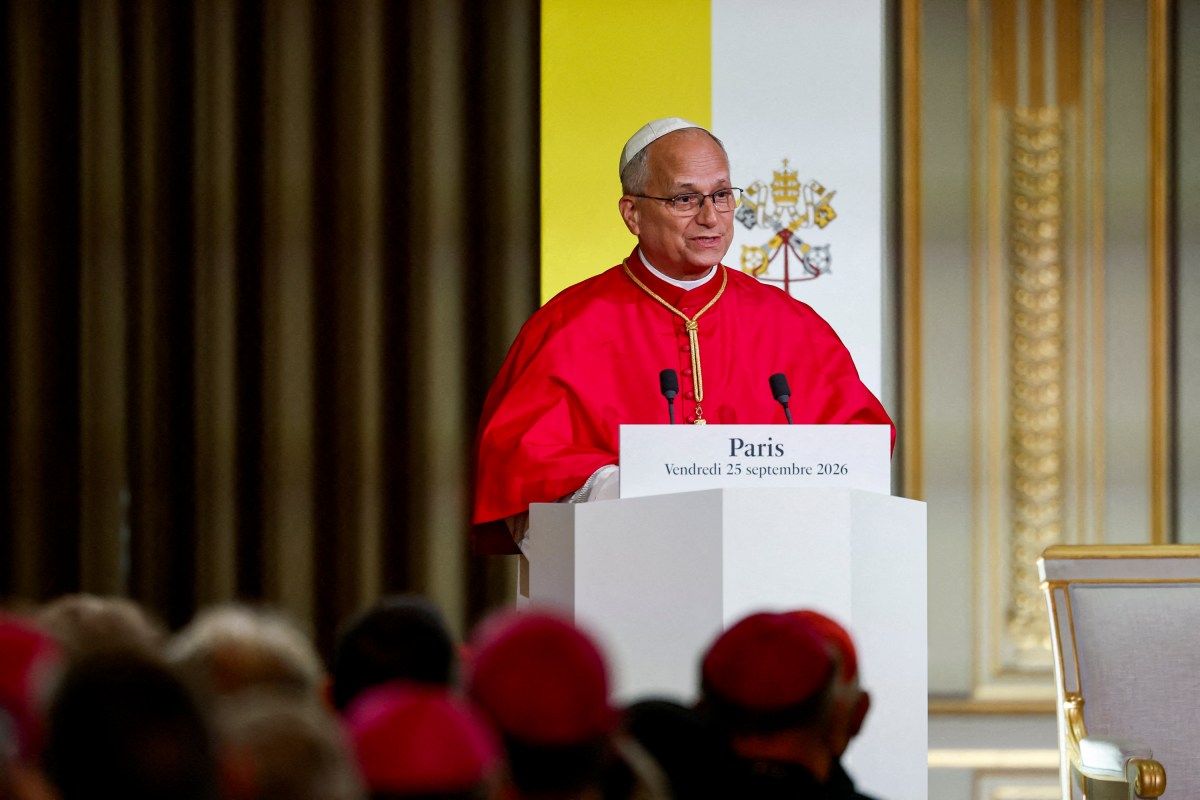
After a long private meeting with President Emmanuel Macron, the Pope, accompanied by his host, went to address nearly 500 representatives of political and religious authorities, civil society, and the diplomatic corps.
Macron began by welcoming the Pontiff, recalling the "unique bond" between France and the Catholic Church throughout its long history, and telling him that France's unique brand of secularism (laïcité) does not signify the negation of religions. Commending the Pope's commitment to peace, he pledged his diplomatic support in the face of conflicts and climate change, as well as the "resurgence" of attacks against religion in France, and the situation of AI. He expressed his hope that the Pope would encounter the "fervor" of a "France imbued with spirituality."
Leo gave his speech in French emphasizing the "deep Christian roots" of this country traditionally considered the "eldest daughter of the Church," a title gained because the baptism of King Clovis, which is believed to have taken place around 496, is considered the first conversion of a European monarch to Christianity. He also began noting his own ancestral roots in France.
I would assure you, Mr President, ladies and gentlemen, that France is frequently in the Pope’s prayers, as he has not forgotten his family’s origins in Normandy and Béarn.
A pope's address to his host nation's political representatives is generally one of the longest and weightiest of an apostolic visit. Leo's speech today touched on many themes -- from AI, to Catholic schools, to nuclear weapons -- offering praise for France while at the same time, delicately pointing out areas at odds with the Gospel. Three times he repeated a phrase taken from the Gospel of John: "that the world may have life."
Here are a few excerpts:
The many brilliant French scholars who were also faithful Catholics demonstrates clearly how the sciences and the arts, literature and philosophy, can contribute to the good of humanity when they are directed toward the pursuit of beauty, goodness and truth, that the world may have life. ...
France was responsible for significant advances in our world, including the recognition of human rights grounded in the nature of the human person, particularly religious freedom. ...
Nowadays there is a temptation to expect science to eliminate or alleviate every form of suffering. This often brings the risk of self-delusion. For when science and technology are not guided by a deeper wisdom, they can offer immediate solutions that apparently address people’s wishes and their pain, but can seriously divert them from the greater good to which they aspire. I am concerned at times by those trends in society that risk turning science and technology into profit-driven ventures promoting genetic manipulation, surrogacy, the trade in human organs, or the possibility of arranging one’s own death. Let us not forget that mutual respect and the protection of every human life is a duty incumbent upon each and every one of us. It is a duty that begins with the conversion of our minds and hearts, and requires a sincere and selfless commitment to the good of our brothers and sisters.
How can we fail to see such a commitment as an expression of the authentic “secularity” (laïcité) of the earthly city? A Christian engaged in public service and guided by the light of his or her conscience illumined by faith, cannot be considered a proselytizer or a threat to the unity of the nation. Indeed, authentic secularity does not exclude religion but is capable of valuing it as an educational resource. ...
I am also pleased to note that this same desire to assist all individuals, regardless of their origin, has for centuries inspired the cooperation existing between France and the Catholic Church in assisting the Christians of the Middle East. ...
The stockpiles of armaments built up in various countries must be reduced all round and simultaneously by the parties concerned. Nuclear weapons must be banned. ...
May France, faithful to its traditional values, work for a peace that is unarmed and disarming, and responsibly offer its unique contribution to that goal. May your liberty grow in constant concern for the common good. May your fraternity embrace the entire human family. And may the equality to which you aspire always be built upon the foundations of justice and charity — not by erasing the differences between people, but by allowing them to flourish harmoniously for the benefit of society as a whole. ...
Read the whole text here.
The Holy Father is in France through Monday. Follow the schedule here.