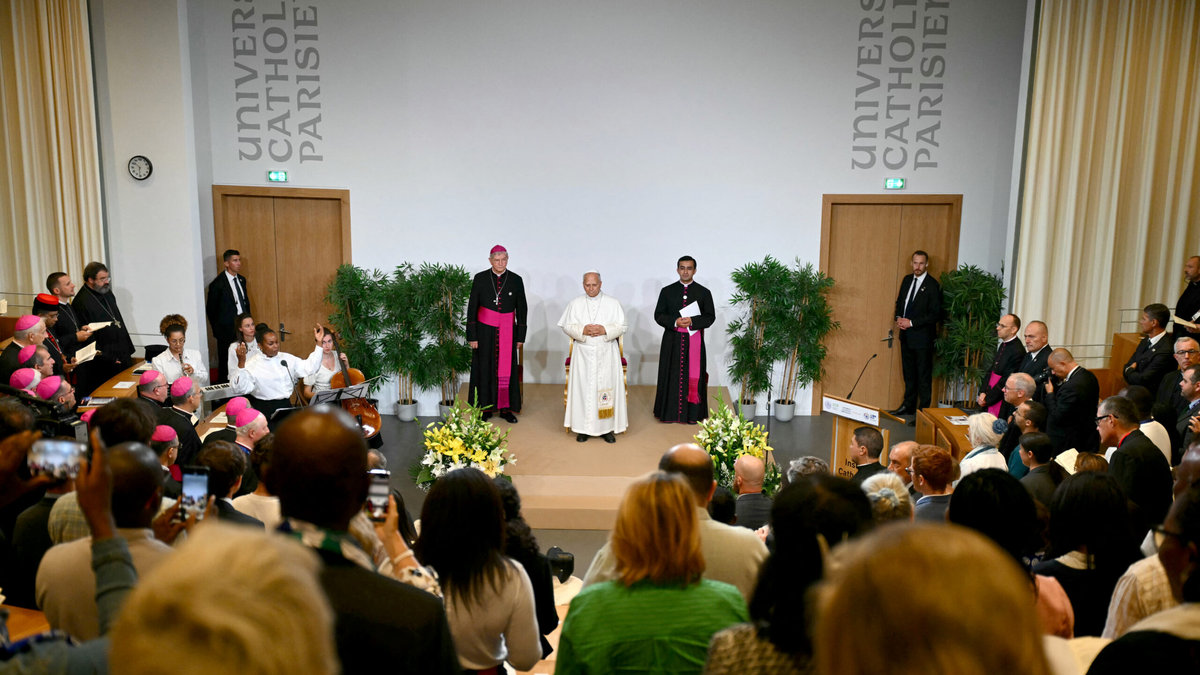
At the Institut Catholique de Paris, the Pope told catechumens and the synodal assembly that the growing number of adults seeking baptism is not a sociological curiosity but God’s work.
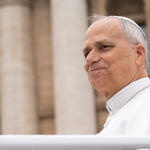
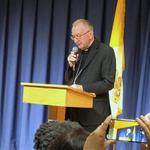
On Saturday morning, after his visit to Maison Bakhita, Pope Leo XIV traveled to the Institut Catholique de Paris — the largest French-speaking Catholic faculty in the world, which had not welcomed a pope in nearly 50 years — to address members of the Provincial Synodal Assembly of Île-de-France alongside catechumens and newly baptized Catholics. What he found there gave him, he said, reason for genuine hope.
“I am struck,” he told those gathered, “by the number of people returning to the threshold of the faith, and by the many adults seeking the sacraments of Christian initiation.”
This year, the Archdiocese of Paris expects around 13,200 adults and 8,200 adolescents to be baptized — up 28% and 10% respectively, even from 2025, which was already a year of growth. In 2022, the number to be baptized was only 4,278. In a country often described as among the most secularized in Europe, the figures are striking.
Leo refused to explain these numbers sociologically. The growing number of people rediscovering the Gospel, he said, may appear paradoxical in contemporary France, but should be recognized as “a tangible sign of the action of God’s grace” that goes beyond statistical analysis. He warned against both defeatism and complacency, recalling Pope Francis’s criticism of “sterile pessimism,” and urged the Church to recognize and protect “the small flame that the Holy Spirit has kindled in the darkness of the night” and “the tiny seed that strives to grow even amid the thorns.”
A Church in a state of initiation
The center of the address was a phrase Leo took from the French bishops themselves: the Church must become “a Church in a state of initiation.” Such a Church must offer those entering the faith “solid and steadfast guidance over time” — accompanying them before Baptism and, critically, after it. Leo pointed specifically to what one of the testimonies he had heard described as “post-baptismal emptiness” — the experience of being received into the Church and then left without support or community.
“Newly baptized Christians must be fully integrated into parish communities and prayer gatherings,” he said, “and receive comprehensive formation in Scripture, theology, doctrine and Christian moral life.”
Those approaching the faith should be welcomed with respect for their personal histories and spiritual experiences. This requires a particular style: “closeness, compassion and tenderness,” together with respect for each person’s pace. “It means adopting the style of ‘walking together,’” he said — a phrase that echoes both the synodal process initiated under Francis and the Augustinian tradition Leo XIV carries as his own.
The liturgy as teacher
Leo also addressed the relationship between catechesis and liturgy — making a point easily missed. The liturgy, he said, should not be viewed as something that comes “after” catechesis, merely applying what has already been learned. “It makes Christ’s Paschal Mystery present and can itself reveal the meaning of the Gospel and the life of God.” Its rhythms, language, and rites are part of the journey of conversion, not its graduation ceremony.
He applied the same logic to those who accompany others. Godparents need preparation. Pastoral workers need not only biblical, theological, and liturgical training but also the human qualities required to walk alongside people whose lives may include loneliness, suffering, and profound difficulty. Such accompaniment requires what Leo called a style of “closeness, compassion and tenderness” — and a willingness to let each person set the pace.
“A tiny seed”
For his closing image, Leo turned to the figure he knows best. “Saint Augustine was introduced to the faith by Saint Ambrose, and at the time of his Baptism his faith was still ‘a tiny seed.’ Yet that seed grew into a tree whose branches continue to offer shelter.” Looking at the catechumens and newly baptized gathered before him, the Augustinian pope saw both the work of the Holy Spirit and “the promise of fruitfulness for the Church in France.”
He closed with a direct challenge: “In turn, be missionaries of the Gospel in this society.” And with two names — Saint Thérèse of the Child Jesus and Saint Martin of Tours — as the tradition France can draw on. Thérèse, he said, teaches through her “little way” that trust opens the doors to grace. Martin represents sharing and fraternal charity. Together, they remind Christians that “mission is built today, above all, by remaining faithful to the Lord’s presence in daily life.”