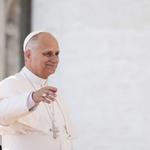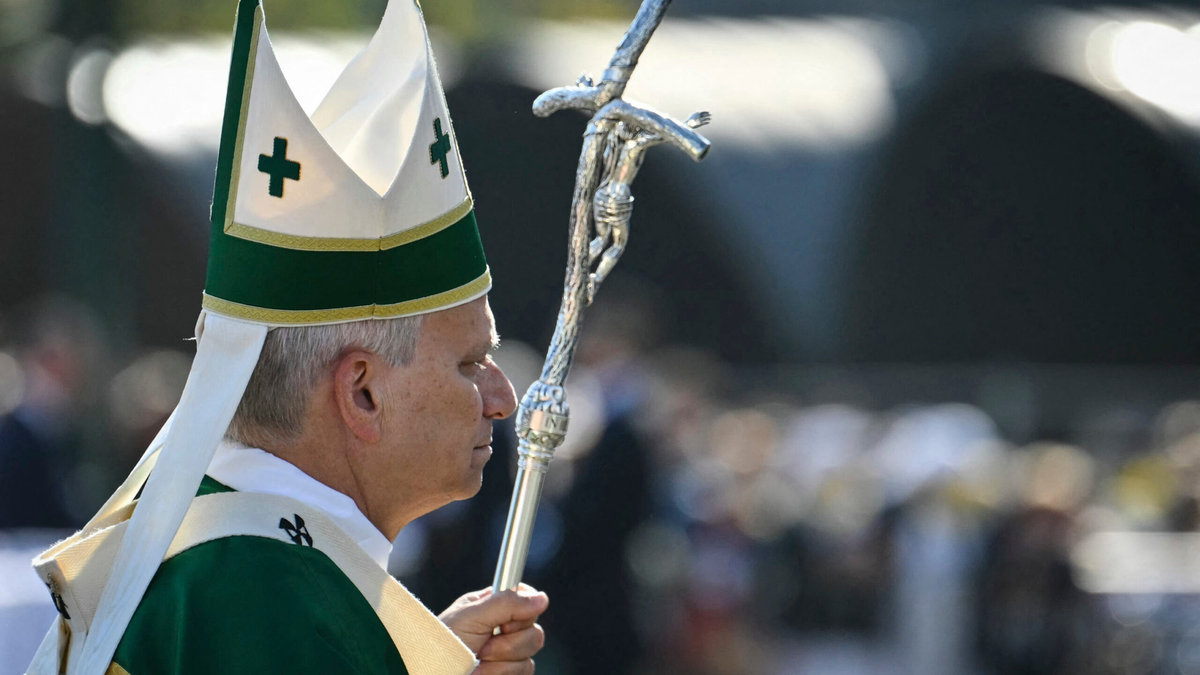
At Lourdes, the Pope addressed the French bishops with a wide-ranging challenge: defend the Church’s public voice, and never grow weary of proclaiming Christ.
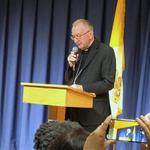
Pope Leo XIV met with the bishops of the French Episcopal Conference on Sunday morning at the Sainte-Bernadette auditorium of the Shrine of Our Lady of Lourdes — the site where the French bishops hold their plenary assemblies, and where Leo chose to deliver what is perhaps the most comprehensive address of his four-day visit to France. The speech covered education, vocations, the abuse crisis, the catechumenate, family life, Catholic schools, unity, and the Church’s public voice — and it opened with a rebuke of discouragement that set the tone for everything that followed.
“Rise up with hope”
The Pope began by acknowledging the weight of the history the French Church carries — both its glory and its failures. He called on the bishops to draw courage from that history rather than being paralyzed by it. “Do not be discouraged by the errors, inconsistencies or even falls that have marked the history of this pilgrim people,” he told them. “Always have the courage to acknowledge failings with a love of the truth and a determination to bind up wounds with the charity of the Good Shepherd, who knows his sheep and calls each of them by name. Rise up, then, with hope, and never grow weary of proclaiming the Gospel!”
The Church’s voice in the public square
On the relationship between Church and state, Leo was clear and unapologetic. “The voice of the Church has every right to be heard in the public square. By its nature, it possesses a prophetic authority. Even if it is not always understood, her voice is nonetheless needed. Even when her teaching is not followed, particularly on essential questions touching the foundations of civilization, it remains necessary. Do not doubt this.”
He acknowledged the specific form of French laïcité — “born of a turbulent history that is now more peaceful” — but warned that the gradual erosion of this hard-won balance must not produce surrender. “I urge you to remain vigilant in defending the freedom and rights of the Church to evangelize, to educate about true freedom, and to worship publicly, so that charity may be exercised visibly in the name of Jesus Christ.” He praised the bishops specifically for their “steadfastness and courage — as you showed clearly during the recent debates on end-of-life issues.”
The catechumenate and young people
Returning to the theme of his address at the Institut Catholique the previous day, Leo called the growing catechumenate “a grace and a joy for the whole People of God” and urged the bishops to nurture it carefully — especially by welcoming young adults “into living communities that practice charity and live in solidarity, and providing solid doctrinal formation rooted in the word of God, which will help them to answer their objections and doubts.”
He noted with particular warmth the aspirations of young people: “Concerned about the world being left to them and anxious about the future, they are ready to work with courage and generosity for all that is beautiful, true and good. Show them the way of the Gospel, the only sure path — even when it is demanding — which has already borne so much fruit in this land of France.”
Catholic education under pressure
On Catholic schools — whose distinctive character he noted is “currently being called into question” — Leo was direct. The generous welcome of Catholic schools to those who do not share the faith is commendable, he said, but it cannot come at the cost of the mission. “Catholic education can in no way renounce its educational mission, which is centered on Christ and directed towards the integral development of the human person in all his or her dimensions: spiritual, cultural, intellectual, moral and social. No one, therefore, should be surprised that every Catholic school offers opportunities to encounter Jesus Christ and hear his word. Still less should any pupils ever find themselves marginalized in the classroom simply because they believe in Jesus.”
The abuse crisis
Leo addressed the abuse crisis with the directness it requires. He thanked the bishops for the “courageous measures” they have taken — “listening, the search for truth, justice, forgiveness and making amends, and through a firm commitment to a culture of prevention and protection against these crimes” — while insisting the path must continue. “You must continue along the path you have begun, maintaining the greatest vigilance.”
In the same breath, he called for support for priests: “Your clergy need to be supported and encouraged. If priestly vocations are to flourish, priests must be eagerly wanted, welcomed and loved, and their identity as men configured to Christ should also be clearly understood by the People of God.”
Vocations and families
The Pope expressed sorrow at the closure of ancient monastic communities and the decline in contemplative vocations. The conditions for such vocations — “a special generosity, a deep-rooted faith, a sustained interior life” — are most often found in Christian families, which therefore deserve the greatest attention. “Deepening and strengthening the life of faith within families is certainly key to resolving many of the crises facing the Church and society. For it is within families that we learn how to live together, respect others, accept diversity, support one another, be generous, give of ourselves freely and embrace the spirit of sacrifice.”
Unity without uniformity
On the question of internal division — which the French Church has experienced acutely across the conservative-progressive spectrum — the Pope offered a precise formulation. Unity is essential, he said, but “not a flat uniformity.” It “allows every sensibility that is authentically Catholic to converge naturally in a common profession of faith, through obedience to the legitimate Pastors and especially to the Successor of Peter.” This unity is “enriched through reciprocal dialogue, rooted in faith and expressed in the synodal style that we have been seeking to deepen in recent times.”
One roadmap
The address closed with the simplest possible statement of what the Pope considers the Church’s irreducible task. “To renew hope and give fresh impetus to the Church’s mission in France, which I earnestly desire, there is only one ‘roadmap,’ which is always the same: to make Jesus Christ known and loved, authentically, passionately, again and again.”
He entrusted the assembly, the diocesan communities, and the nation to the maternal protection of Our Lady of Lourdes before imparting his Apostolic Blessing.