Beyond the crowds and official ceremonies, some delightful details revealed what happens when a Pope takes over the French capital.
The official record of a papal visit will tell you what Pope Leo said, whom he met, where he celebrated Mass, and how many people came to see him. It is less likely to mention the sight of priests hearing confessions on the Champs-Élysées, the extraordinary number of buses required to transport the faithful, or quite how many smiling nuns Paris can accommodate at once.
Yet those little details said almost as much about Pope Leo XIV's visit as the big moments, because for a couple of days, one of the world's busiest capitals looked and felt noticeably different.
The Champs-Élysées stopped shopping
On a normal Saturday, the Champs-Élysées is doing what the Champs-Élysées does best. Tourists photograph the Arc de Triomphe, Parisians attempt to get somewhere while avoiding the tourists, and an impressive number of people emerge from shops carrying bags containing things that cost considerably more than most of us would care to admit.
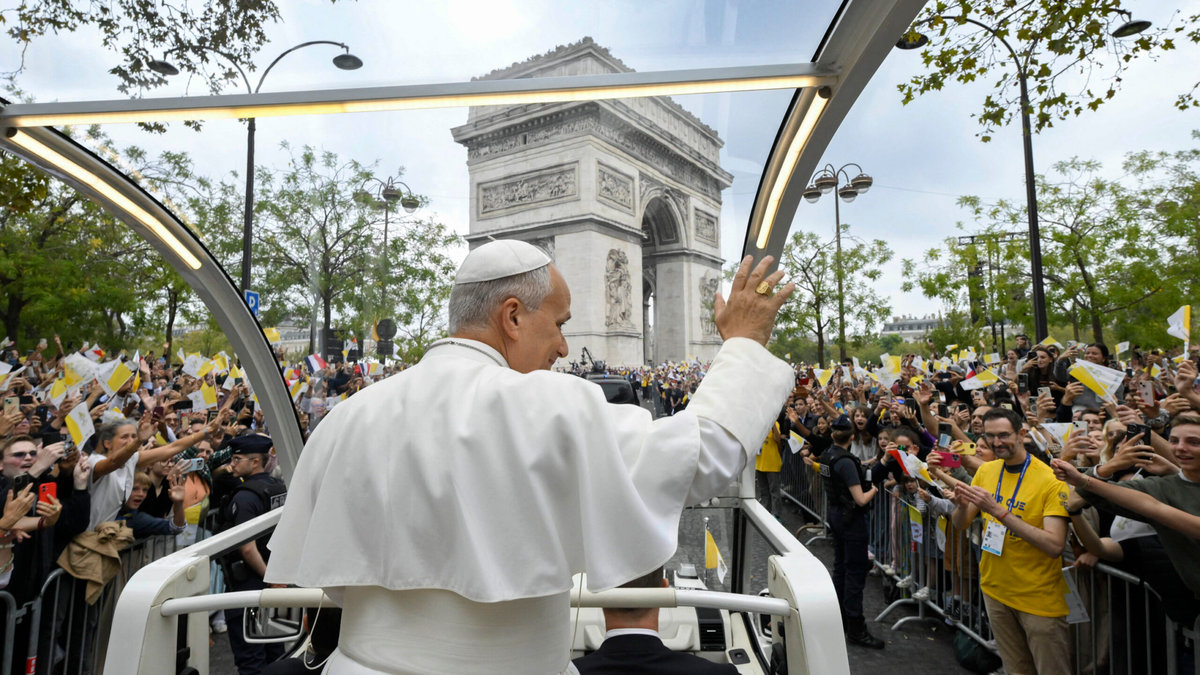
This Saturday was different, because one man had managed to close one of the world's most famous avenues.
That fact alone was fairly extraordinary. Paris on a Saturday does not surrender its roads easily, yet barriers were up, traffic was gone and the avenue had been handed over to people waiting for Pope Leo. Even the activity along it had changed, with priests hearing confessions as the faithful waited for the Pope to arrive.
The contrast was difficult to miss. On a street synonymous with luxury and consumption, people who might ordinarily have been queuing to buy an expensive bag were instead waiting to confess their sins, and for once the most important transaction taking place on the avenue didn't require a credit card.
Nobody warns you about the buses
The glamorous photographs of a papal visit rarely feature buses, which is unfair because the buses deserve their moment: They were everywhere.
Or, rather, they seemed to be everywhere, because huge tree-lined avenues surrounding the area cordoned off for the Mass, normally crammed with Parisian traffic, were suddenly lined with them. Bus after bus sat beneath the trees after delivering groups of pilgrims from across France and beyond, while pedestrians wandered freely through spaces normally surrendered to cars.
It was strangely glorious. Anyone familiar with Paris knows the pleasure of unexpectedly acquiring a road that normally belongs to traffic, and here were entire avenues available for walking. The horns had disappeared, people were ambling rather than dodging, and the great Parisian contest between pedestrian, bicycle, and motor vehicle had temporarily been called off.
The buses also offered a useful reminder of what enormous Catholic gatherings actually require. Every vehicle represented dozens of people who had organized themselves, got up extremely early, traveled for hours and arrived carrying food, flags, water bottles and whatever else is required to survive a day waiting for the Vicar of Christ.
Faith has its practical side, and sometimes it requires a very large parking space.
Paris dressed for Leo
Paris is, after all, a city that takes style seriously, and plenty of people had clearly decided that Pope Leo deserved the same consideration. Among the inevitable athletic shoes and backpacks were smart dresses, jackets, and carefully chosen outfits, with families who had obviously decided that if they were going to see the Pope, even from some distance away, they were going to make an effort.
It felt rather fitting. This is a city where people dress for dinner, exhibitions, weddings and any number of occasions considerably less rare than a papal visit, so why shouldn't Leo get the full Paris treatment, too?
The most noticeable change to the Parisian population, however, was surely the sheer number of religious. Priests, sisters, brothers and seminarians appeared everywhere. Habits were visible on Métro platforms, cassocks moved through the streets and groups belonging to religious communities threaded their way through the crowds. Paris is hardly unfamiliar with Catholic clergy and religious, but seeing so many together changed the complexion of the city.
More noticeable still was their mood. Smiles seemed almost compulsory, with the anticipation producing that peculiar friendliness of a major shared event in which complete strangers suddenly start talking because nobody needs to ask why the other person is there.
For a weekend, spotting a nun in central Paris was not particularly remarkable. Managing not to spot one was considerably more impressive.
The slight problem of actually getting anywhere
Naturally, temporarily handing large sections of central Paris over to the Pope and several hundred thousand visitors came with a minor inconvenience: everyone else still had places to go.
Key central Métro stations were closed, enormous boulevards became impassable and familiar routes ended abruptly at security barriers. Even seasoned Parisians could be seen consulting maps and phones after discovering that the journey they had made countless times before was simply not going to happen in quite the same way that day.
The security operation was impossible to miss. Police officers and gendarmes seemed to occupy every junction, entrance and barrier, yet the atmosphere around them was surprisingly relaxed. Considering the enormous responsibility involved in moving a Pope through a major European capital while managing crowds of this size, many appeared cheerful, chatting to people and patiently redirecting those who had discovered that their preferred route was now occupied by the Catholic Church.
There was confusion, certainly, and the occasional flash of panic from somebody who had just discovered that their Métro station had vanished from the day's possibilities, but remarkably little irritation. Paris had been thoroughly inconvenienced, and for once it seemed rather good-humored about it.
The great post-papal exodus
Once the Mass was over, hundreds of thousands of people did what people invariably do after spending hours standing, singing, cheering and concentrating: they went looking for somewhere to sit down and something to drink.
The crowds didn't simply disappear when the celebration finished. They spilled into parks and cafés, occupied terraces and patches of grass, opened bags of food and compared experiences of the morning. Groups carrying Vatican flags appeared at café tables, while priests and religious who had spent hours among the crowds finally sat down for a well-earned break.
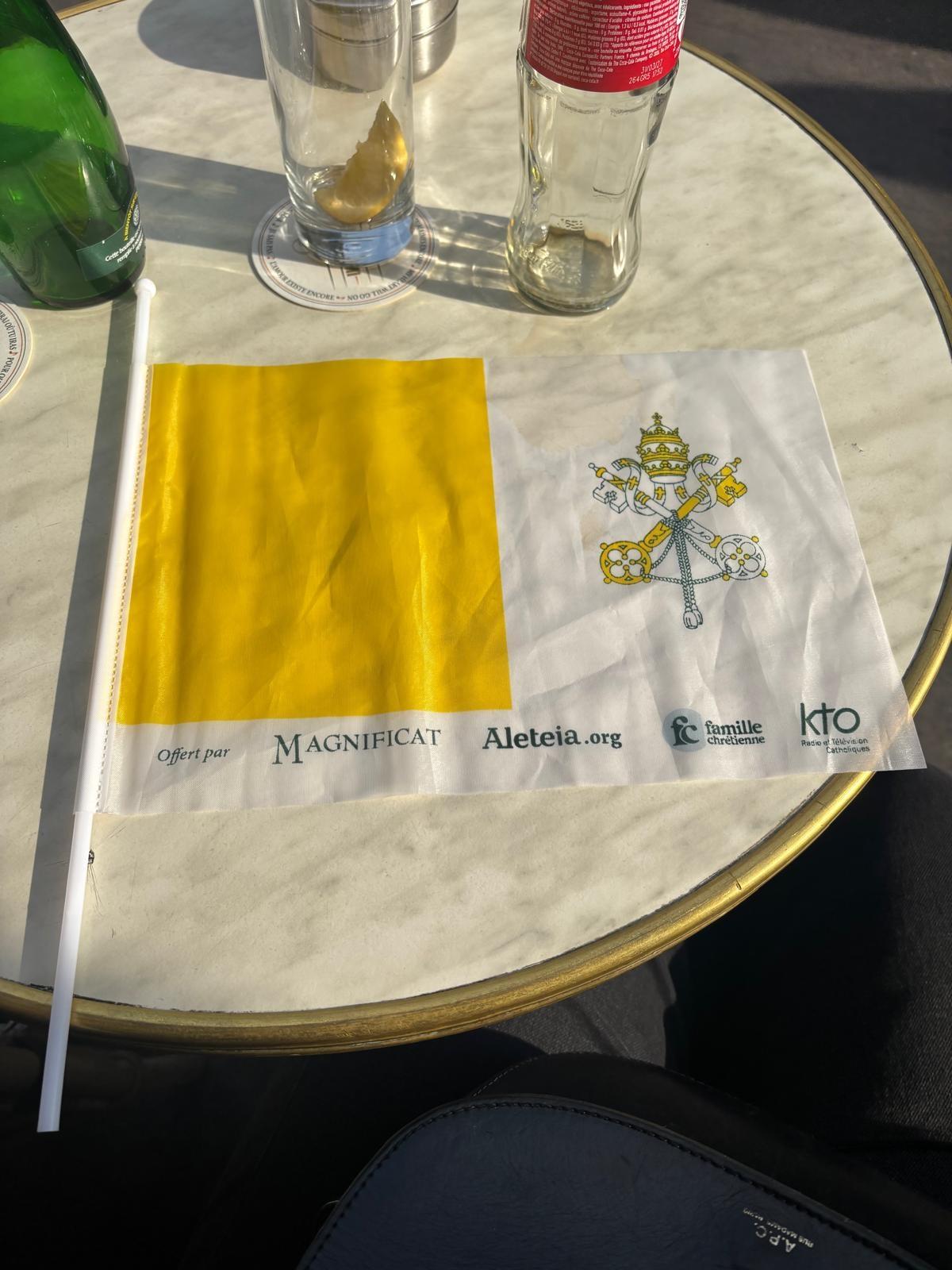
All that singing is thirsty work, after all, and there was something lovely about watching the great papal gathering gradually dissolve into thousands of much smaller ones.
Paris was returning to normal, but not immediately. For a while, the city seemed to be hosting one enormous post-Mass get-together.
For once, everyone was heading the same way
Perhaps the strangest sensation of the weekend came from the sheer number of people united by a single purpose.
Capital cities don't normally work like that. Paris contains millions of people pursuing millions of different plans at once: going to work, meeting friends, buying groceries, visiting museums, catching trains, walking dogs, shopping, arguing with delivery drivers and attempting to find somewhere serving coffee at precisely the moment it is required.
During Pope Leo's visit, hundreds of thousands of very different people had deliberately entered that confusion, but all united in exactly the same purpose.
They came from different generations, countries, dioceses and corners of Catholic life. Some had traveled hundreds of miles while others had only stepped out of their Paris apartments, but for a few hours their routes converged.
They wanted to see the Pope, and the scale of that shared intention was difficult to appreciate until standing among it.
And Leo's face was everywhere
Even when the Pope himself was nowhere in sight, his face was surprisingly difficult to escape. Posters and banners appeared throughout the city, while yellow and white flags brought Vatican colors to streets more accustomed to the branding of fashion houses and international companies.
And among all those little papal flags, one name kept appearing: Aleteia!
As a proud sponsor of the visit, Aleteia's name bobbed above the crowds on yellow-and-white flags throughout the weekend, turning up in hands, photographs and seemingly every direction one looked.
Perhaps those flags provided the final little visual detail of a weekend in which Paris temporarily acquired a different identity. The buses eventually left, the barriers came down, the Métro stations reopened and the Champs-Élysées returned to the considerably more familiar business of selling expensive things.
For a brief period, though, one man (well, more specifically, the God-Man he serves), had managed to alter the rhythm of an entire capital. Traffic gave way to pilgrims, shopping shared space with confession, priests and religious seemed to appear on every corner, and hundreds of thousands of people who would normally have been heading in every imaginable direction found themselves going the same way.