Serving before hundreds of thousands might daunt anyone, but these young men actually asked for the job -- and their youngest member helped make it happen.
Serving Mass can make even an experienced altar server a little nervous. There are movements to remember, objects to have in the right place at precisely the right moment, and the uncomfortable knowledge that any mistake tends to happen in full view of the congregation.
Now imagine replacing the usual parish congregation with nearly a million people, adding hundreds of fellow altar servers, thousands of clergy, television cameras and, just to keep everybody relaxed, the Pope.
It would have been a daunting assignment for the most seasoned server, yet among those who volunteered for the job at Pope Leo’s Mass in Paris were six young men with Down syndrome who very much wanted to be there.
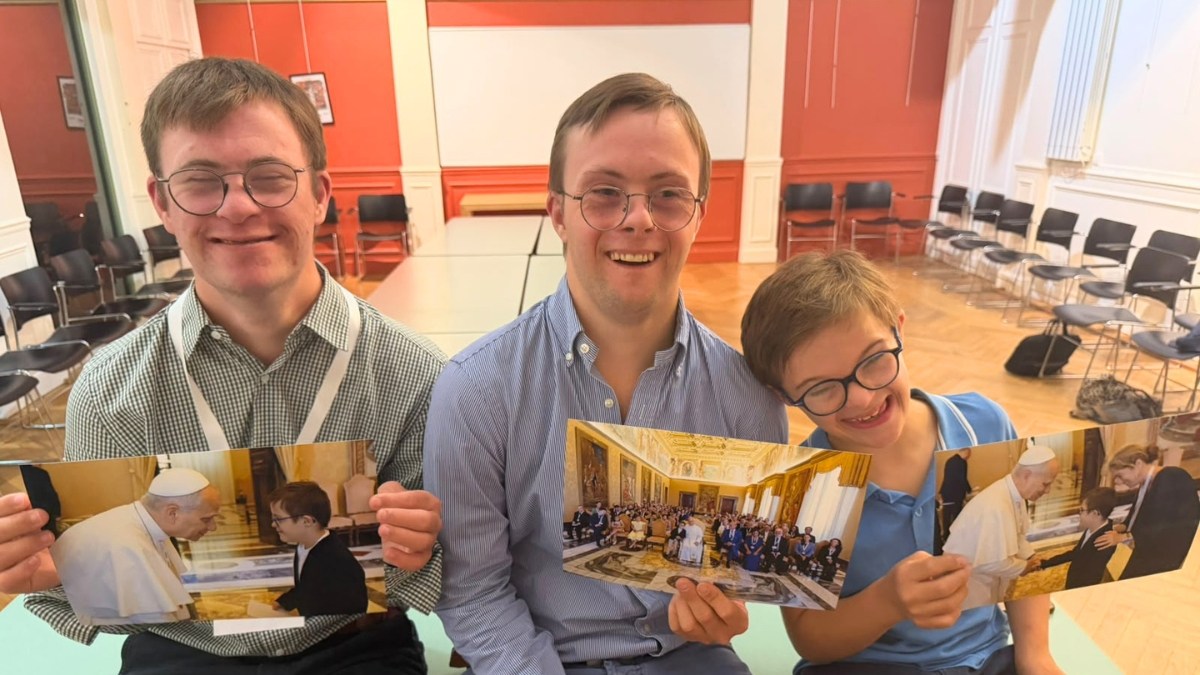
François, Théophile, Maxime, Foucauld, Timothée and Jérôme, aged between 11 and 28, are connected with the Fondation Jérôme Lejeune, which supports people with Down syndrome and other genetic intellectual disabilities. Serving at the altar was not something dreamed up especially for the papal visit, either. Maxime, 22, has served since his First Communion and now helps train younger altar servers in his parish, while François, 28, regularly serves at Saint-Augustin in Paris.
If there were nerves before the biggest assignment of their altar-serving lives, excitement seems to have won. François admitted beforehand that he was a little stressed, but described the prospect of being close to the Pope as a “rayon de soleil,” or ray of sunshine.
And then there was the small matter of how the six had managed to secure the assignment in the first place.
Sending in the youngest
When a representative was needed to take their request all the way to the top, the group apparently saw no reason to send its most senior member. Instead, the job fell to Théophile, who is 11.
During a Fondation Jérôme Lejeune audience at the Vatican in June, Théophile approached Pope Leo with a letter signed by all six asking whether they could serve his Mass when he came to Paris. Considering François is 28 and Maxime has 14 years of altar-serving experience behind him, allowing the youngest member of the group to handle papal negotiations seems both wonderfully trusting and, as it turned out, extremely effective.
Three months later, all six were pulling on their white albs at the Place de la Concorde and taking their places among some 400 altar servers.
There is an important detail in that story. Théophile and his friends had not asked for a special appearance at the Mass or a chance to meet the pope; they had asked if they could work. They knew how to serve at the altar, and they wanted to put that experience to use on what must surely have been the biggest assignment of their lives.
Maxime's description of his normal parish role makes the point rather wonderfully. As well as serving as a thurifer, he helps train the younger altar servers and proudly informed Aleteia France that he is the “manager of the altar servers.”
Anyone familiar with parish life can probably picture him immediately. Every group needs somebody who knows where everyone should be, what they should be carrying and whether they are doing it properly, and Maxime has clearly acquired enough experience to be the person helping others.
The joy of having something to give
People with Down syndrome are understandably often discussed in terms of the support, opportunities and welcome they should receive. The six altar servers in Paris offered another perspective, because belonging to a community also means having the opportunity to give something back to it.
That might mean training a younger altar server, turning up faithfully to serve Mass or being trusted with a responsibility on an important day. At the Place de la Concorde, it meant six young men taking their places alongside hundreds of other servers and getting on with a role they already knew.
Pope Leo did not single them out during his homily, but one of his observations that morning seemed particularly apt. Warning against reducing human beings to what can be counted or measured, the Pope reminded the congregation that “none of us is merely a number or an entry in a register, but a unique and irreplaceable person.”
The six young men around the altar did not need to prove that worth by being useful, of course, but their presence offered another reminder of what respecting human dignity can look like in practice. It is not simply a matter of making room for somebody; it is also noticing their talents, trusting them and sometimes allowing them to be the person who knows what to do.
François had his own much simpler way of looking at things. Speaking before the Mass, he acknowledged his disability without allowing it to define the limits of his life: “We are disabled,” he said, “but we must be proud, happy to be alive.”
That joy seems an appropriate way to remember the six amid all the spectacular images from Pope Leo’s Mass in Paris. They had volunteered for a role that could have unnerved even the most seasoned altar server, persuaded the pope to let them do it, and found themselves serving before one of the largest congregations they are ever likely to encounter.
For Théophile, François, Maxime, Foucauld, Timothée and Jérôme, it was undoubtedly an extraordinary day. Yet perhaps what made their presence so meaningful was something much more ordinary: they had something to offer their Church, and their Church gave them the chance to offer it.