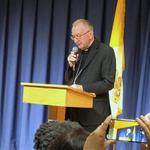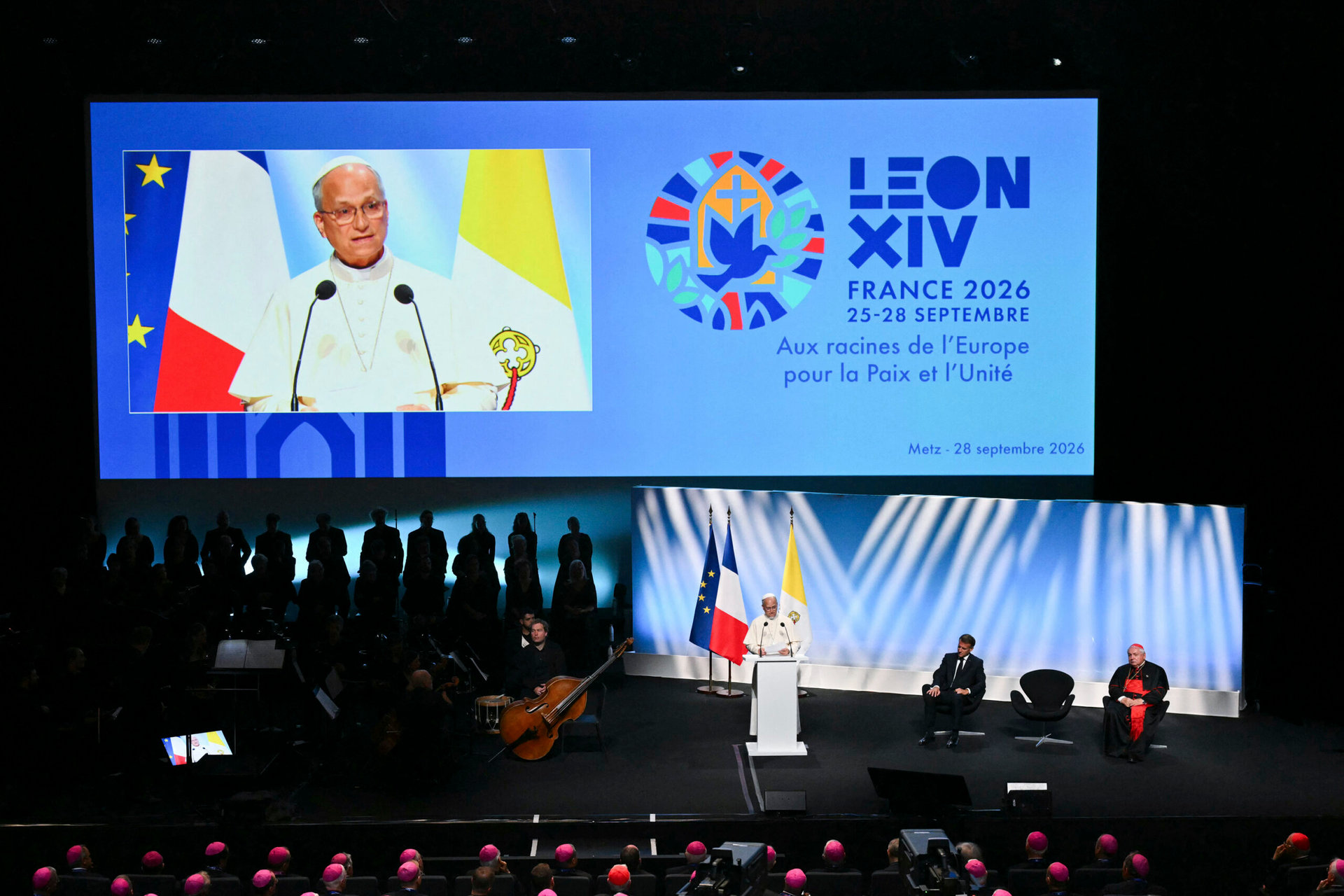
On Monday, September 28, the last day of his trip to France, Pope Leo XIV gave an address at the “Robert Schuman” Conference Center in Metz. The meeting was entitled “To the Roots of Europe, for Peace and Unity.”
He expounded on the Christian roots of Europe and the key values that underlie the concept of Europe today. Migration, a proper understanding of secularity, and building peace were themes that received special attention. Leo XIV also highlighted the example and ideas of Robert Schuman, one of the founding fathers of Europe, who has an open cause for canonization.
Europe as a cultural and historical reality
To start, the Holy Father traced the origins of Europe from Hellenistic civilization to the present day, as it grew, became Christian, and evolved to encompass more cultures and territories.
Europe “must therefore be understood as a cultural and historical reality before a geographical one,” the Pope said. The territory and countries considered to be part of Europe have increased and decreased over time.
“One constant however can be observed throughout its long and turbulent history,” he noted; “namely that Europe has flourished and progressed when it has been able to draw on the best aspects of its past and reinvent them in new and creative ways through encounters with others.” These encounters have sometimes been difficult but have made Europe what it is today.
Europe and Christianity
St. Benedict is a “founding father of Europe,” the Pope said. “Care for the poor, the sick and the elderly; education of children and universities; hospitals and medicine; architecture and engineering; the development of the sciences; law and the organization of cities and States themselves”—all stem “from the profound influence of St. Benedict and his monks!” Leo XIV exclaimed. Indeed, he said, “without this monastic tradition, European civilization as we know it would not exist.”
“We cannot speak of Europe, then, without mentioning Christianity,” the Holy Father concluded, citing both Robert Schuman and Alcide de Gasperi, “another founding father of Europe.”
Secularity and religious freedom
Although Christianity has been essential to the development of Europe, nearly all member states today are non-confessional, following “the principle of secularity (laïcité).” This principle requires separation, but not the exclusion of religion from the life of the nation.
Leo XIV cited Article 17 of the Treaty on the Functioning of the European Union, which explains that secularity “calls for ‘an open, transparent and regular dialogue with ... churches.’”
The Holy Father developed this point further, explaining that this vision of Europe “also presupposes genuine cooperation among all parties.” National and European authorities should respect “the autonomy of the Churches and the promotion of their freedom of organization, expression and worship.”
Universal values
Pope Leo XIV pointed out that this is only possible when the “values that underpin society” are upheld. The Preamble to the Treaty on the European Union lists them as “the universal values of the inviolable and inalienable rights of the human person, freedom, democracy, equality and the rule of law.”
Upholding the “universal character” of these values, the Pope explained, “requires both a rediscovery of Europe’s roots and an openness to dialogue with others.” Together, these can also “help us to restore a proper balance among the rights themselves and between rights and duties,” two realities that should not be separated.
Migration
Having discussed the Christian roots and foundations of Europe, he addressed a key issue in Europe and the world today: migration. The “arrival on the continent of so many men and women fleeing war and persecution or seeking a better life far from poverty and hardship” has led to a “new stage” in Europe’s long “history of encounters,” he recognized.
The same “human dignity” that underpins religious freedom also demands proper treatment of migrants and refugees. Citing one of his own speeches in Spain, Pope Leo emphasized that “human dignity demands legal and safe pathways, rescue and assistance, real cooperation against traffickers, effective protection for victims, serious processes of reception and integration, and policies that allow every person to live with dignity in their own land.”
Host countries should also integrate migrants and refugees into society as members of their own household. This includes providing them with the chance to develop “their gifts, abilities and sensibilities” and enter the life of the “household.”
Large-scale migration today represents “an unprecedented encounter between peoples and cultures.” In order to manage the situation, we must “rediscover our roots in new and creative ways.” However, we must also listen to others, the Pope warned.
“The universal character of Europe’s founding values assures us that this dialogue is possible and that it can provide a solid foundation for our societies, enabling us to work more effectively for peace and a reconciled world,” he assured his listeners.
Lessons from Robert Schuman
Robert Schuman and other leaders were aware of these values and challenges. In the wake of World War II, they sought to “overcome the opposition between cultural identities and to establish the European institutions,” Leo XIV said.
Schuman “lived through a time of constantly shifting borders,” and experienced the horrors of war. He also had a Christian formation that instilled in him the “value of equality, without distinction of race or social class, and the dignity of work,” the Holy Father said. He learned “the importance of international law and the value of keeping one’s word.”
This background helped him “lay the foundations of a Europe that was aware of the urgent need to tear down the walls that were dividing it.” He “committed himself to peace and fraternity among peoples who, after having been in conflict for so long, finally recognized their need for each other,” the Holy Father said.
Peace requires creativity and patience
Today, Schuman can teach Europe and the world “a deep desire for peace,” the Pope explained. This requires “patient dialogue,” “courage in negotiation,” and a willingness to compromise, Leo XIV said.
This is not the same thing as “a naïve form of pacifism,” however. Promoting peace is an “active task” that requires “constructive efforts” that are “commensurate with the dangers that threaten” world peace. At the same time, “we must also guard against the illusion that rearmament is the answer,” the Pope said. The answer lies in “creative efforts,” dialogue, and building bonds.
“International law and multilateralism” are characteristics of Europe that “emphasize the genuine equality of States in their relations,” Leo XIV said. This respect for the law and for other States “constitutes the best antidote to the desire for domination which lies at the root of every conflict.”
According to the Pope, continuing to make this idea of Europe a reality requires courage and realism, as Schuman’s example showed. It implies many successive “concrete achievements,” sometimes “small and almost unnoticed,” which create “de facto dependence” among the States.
Message to young people
The Pope ended his address with an appeal to young people, returning to themes he has emphasized in this and other addresses: working for peace, living with hope, and promoting and defending life “from the moment of conception to death.”
“May God sustain you in these commitments, and may he bless and protect all of Europe,” he concluded.