The Book of Daniel is one of the richest sources in the Hebrew Bible for angelic figures: it names the angel Gabriel and, separately, the chief of the heavenly host, Michael. Both appear as active characters, not just messengers in the abstract—Gabriel interprets Daniel’s visions, and Michael fights.
Daniel, the book’s namesake, is presented as an Israelite deported to Babylon after Nebuchadnezzar II’s conquest, one of the young nobles brought into the royal court (Dan 1:3–6). Tradition—following Josephus—places him specifically in the tribe of Judah and of royal descent; the text itself says more generally that he came from “the royal family and the nobles.” His skill at interpreting dreams and receiving visions is what distinguishes him in the narrative, and it’s during these visions that Gabriel and Michael appear.
Gabriel interprets the vision
Gabriel’s first appearance comes in chapter 8, sent to explain Daniel’s vision of the ram and the goat — a symbolic sequence representing the Medo-Persian and Greek empires:
“And I heard a man’s voice between the banks of the Ulai, and it called, ‘Gabriel, make this man understand the vision.’ So he came near where I stood, and when he came I was frightened and fell on my face. But he said to me, ‘Understand, son of man, that the vision is for the time of the end’” (Dan 8:16–17).
Gabriel functions here as a mediating figure—not delivering a message so much as decoding one. This is characteristic of the genre Daniel belongs to: apocalyptic literature works by symbolic vision plus angelic interpretation, a structure found throughout later Jewish and Christian apocalyptic writing, from 1 Enoch to Revelation.
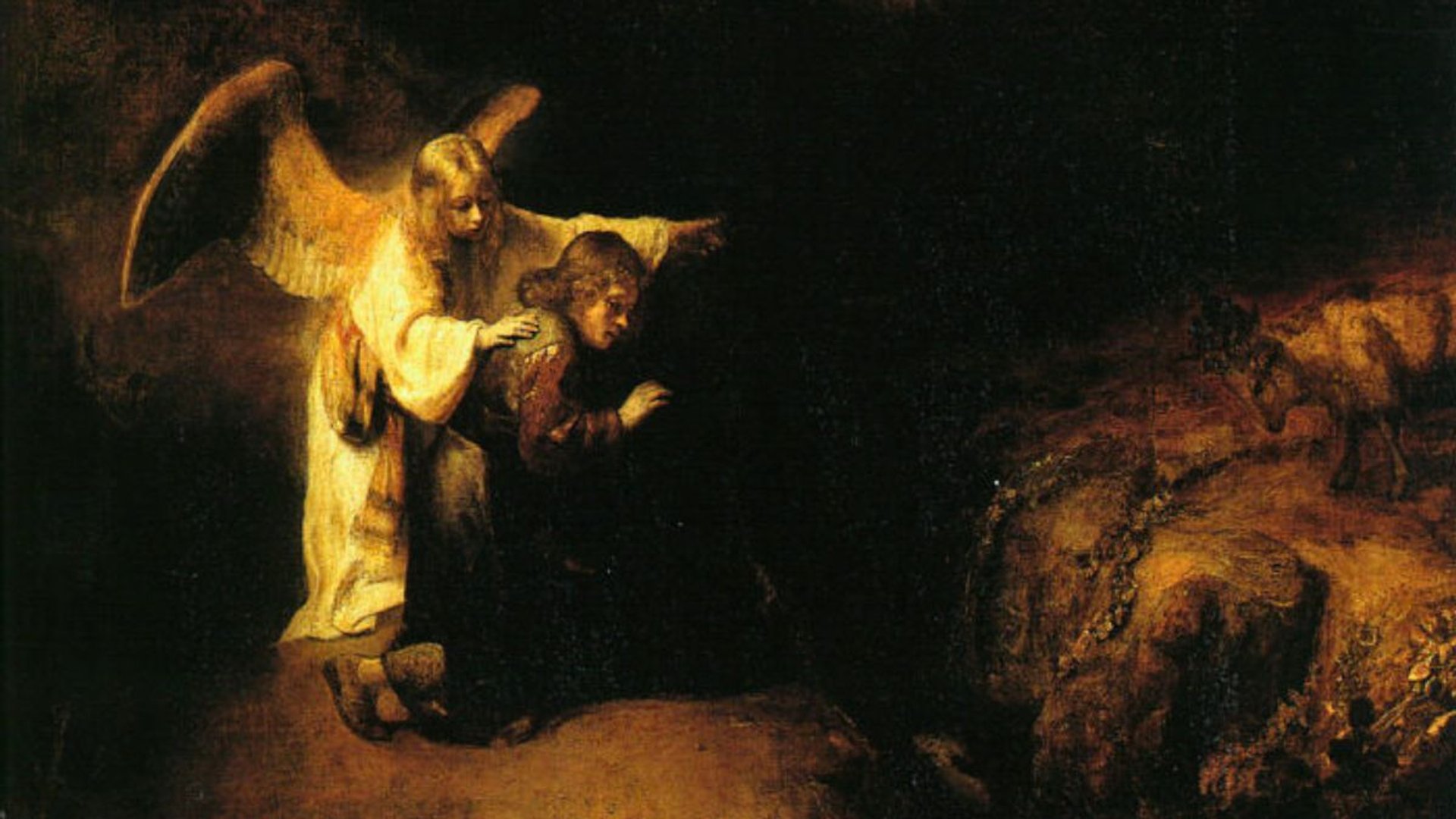
The Dutch painter Willem Drost, a pupil of Rembrandt, captured this scene in his 1650 canvas "The Vision of Daniel," rendered in heavy chiaroscuro, with Gabriel’s raised hand calming the startled young Daniel. Gabriel returns later in the book, in chapter 9, to explain the prophecy of the 70 weeks—the passage that lays out a timetable for the restoration of Jerusalem:
“While I was still speaking in prayer, Gabriel, the man I had seen in the earlier vision, came to me in swift flight at the time of the evening sacrifice. He explained it to me, saying: ‘Daniel, I have now come to give you understanding’” (Dan 9:21–22).
Michael, prince of the heavenly host
The second angelic figure in Daniel is Michael, introduced as a “great prince” fighting on Israel’s behalf against angelic powers aligned with rival empires (Dan 10:13, 20–21):
“At that time Michael, the great prince who protects your people, will arise. There will be a time of distress such as has not happened from the beginning of nations until then. But at that time your people — everyone whose name is found written in the book — will be delivered” (Dan 12:1).
This is one of the earliest texts to suggest a hierarchy among angelic beings, with Michael set above the rest as “prince” over his people. The fuller title of “archangel”—which the Church came to apply to both Michael and Gabriel—develops in the tradition that follows, drawing on this passage and on Michael’s single explicit appearance under that title elsewhere in Scripture (Jude 1:9).
Michael’s role as a celestial combatant is what Rubens captured in "The Fall of the Damned" (c. 1620, Alte Pinakothek, Munich)—a monumental, densely packed composition showing the mass of the damned hurled into the abyss by Michael and his angels. It’s a more direct illustration of Daniel’s Michael than it might first appear: not a single fallen angel, but the archangel enacting exactly the kind of cosmic separation—the saved inscribed in the book, the rest cast down—that Daniel 12 describes.
Why the angels matter here
Daniel’s angelology is tied closely to the book’s genre. Most scholars situate the visions of chapters 7–12 in the turbulent years of the 2nd century BC, under the persecution of Antiochus IV Epiphanes, using the symbolic idiom of apocalyptic writing to speak to a contemporary crisis through visions “explained” by angels. That’s why angels in Daniel do two things almost exclusively: they decode symbols (Gabriel) and they fight on behalf of God’s people caught between empires (Michael) — two roles that would go on to shape Jewish and Christian angelology for centuries afterward.