Metz is the French city where Venerable Robert Schuman built postwar Europe. Pope Leo XIV came to recall a politician who believed public service was a form of prayer.
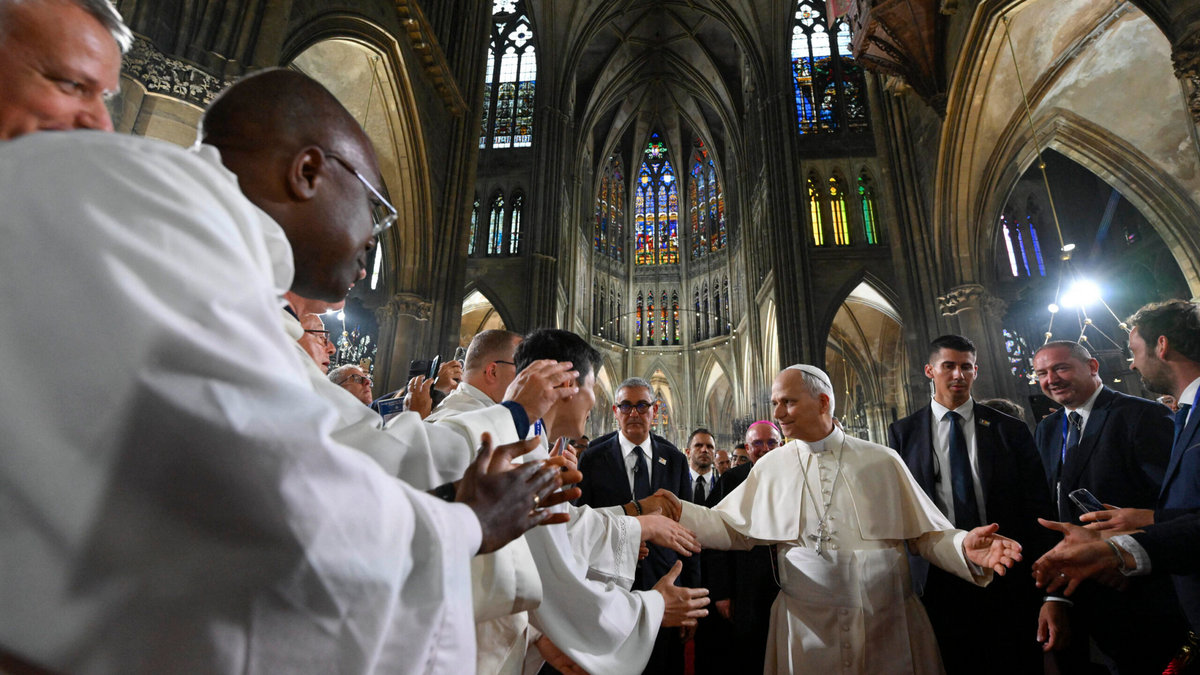
Pope Leo XIV ended his apostolic journey to France in the city of Metz — a border city in Lorraine, a few kilometers from Luxembourg, Germany, and Belgium. This is where Venerable Robert Schuman spent most of his adult life, practiced law, entered politics, and eventually helped design the architecture of postwar Europe.
As Isabella H. de Carvalho explains in her article for Vatican News, Jean Pirnay, a Franciscan Secular and member of the Institut Saint-Benoît — the organization of the Diocese of Metz that promotes Schuman’s beatification cause — framed this as “a visit from one Robert to another Robert. It’s not just the names that are similar. They have a lot of things in common: the respect of every human, wanting to lead people to Christ but without forcing them, humility and attention to the poor.”
A man from the borders
Schuman was born in Luxembourg City in 1886 to a Luxembourgish mother and a Lorrainer father — which gave him German citizenship at birth. He grew up speaking French, German, and Luxembourgish, studied across three countries, and settled in Metz after the First World War, when Lorraine returned to France and he received French citizenship. This layered biography was key to his politics.
“From the start, Robert Schuman learned from his parents that it was possible to be a man of reconciliation and of different national identities,” said Emmanuel Crampon, Secretary General of the Institut Saint-Benoît. “He was able to see beyond the borders, to see that there are ways to find a consensus.”
During his studies in Bonn he joined the Catholic student association Unitas and deepened his engagement with Catholic social teaching — particularly Leo XIII’s Rerum Novarum and the teaching of Saint Thomas Aquinas. “Schuman recognized that faith is not only an intellectual faith or just in one’s heart,” Pirnay noted. “It was also a social doctrine that had an impact on political and social life.”
He established a law practice in Metz in 1912 and entered French politics after the First World War. During the Second World War he was arrested by the Gestapo, escaped, and spent the rest of the conflict in hiding — often in monasteries. When he emerged, he held some of the highest offices in France: Minister of Finance, Prime Minister, Minister of Foreign Affairs, and eventually the first President of the European Parliamentary Assembly. Throughout, he attended Mass daily when possible.
“He did not consider politics incompatible with his Christian life and faith,” Crampon said. “He was gentle but not weak. Political charity, serving the common good, was really his main purpose. It was really a calling.”
The Declaration of May 9, 1950
The act for which Schuman is best remembered came on May 9, 1950. As French Foreign Minister, he presented what became the Schuman Declaration: a proposal to place French and German coal and steel production under a shared supranational authority. By pooling the industries that make weapons, France and Germany would make war between them, in the Declaration’s own words, “not merely unthinkable, but materially impossible.” Six nations adhered. The community they created eventually became the European Union.
The cause for Schuman’s beatification was opened by the Diocese of Metz in 1991. In June 2021, Pope Francis recognized that he had lived a life of heroic virtue and declared him Venerable. What is now awaited is a verified miracle attributed to his intercession.
For those promoting his cause, Leo XIV’s visit to Metz carries weight beyond the ceremonial. “In light of Pope Leo XIV’s encyclical Magnifica Humanitas,” Pirnay said, “it highlights a concrete example of a personality who knew how to build bridges.” Schuman himself wrote in his 1960 book For Europe that “serving humanity is a duty just like the one dictated to us by our loyalty to the nation.” He continued to believe, even in the shattered landscape of postwar Europe, that France and Germany could be friends. He continued to pray. He continued to hope.