It was when they were living in Los Angeles in early 1927 at the Ambassador Hotel—John Barrymore their neighbor—as Scott worked on the script for the unproduced film Lipstick.
One night they decided to duck into the local theatre to see Paramount’s cinematic recreation of The Great Gatsby, this classic American novel that some two decades later, during WWII, would soar in popularity, catalyzed by the novel’s distribution to American soldiers—continuing its ascendance in 1946 when the “American Dream” became central to post-war culture.
That evening, Scott and Zelda loathed what they saw flickering on the silver screen. It was all about the tawdry and the superficial—the glamour, the glitz and the scandal of the party scenes from that June 1922 at Gatsby’s mansion in “West Egg”*—the “new money” enclave of Long Island Sound—without reference to the deeper meaning of it all.
That meaning lay in the elusive quest for something enduring—for love—and the pointlessness of the insatiable appetite for wealth, as if it will bring happiness. It's at the heart of Jay Gatsby's move to “West Egg” to be near wealthy Daisy Fay Buchanan of Louisville, Kentucky, his true love, who lived in the old money bastion of “East Egg.”* He threw those lavish parties in hopes of reconnecting with Daisy, whom he failed to win five years earlier because “rich girls don’t marry poor boys.”
It’s the story of the lost, now found love, with all the ensuing complications, most notably Gatsby’s death—the finality of which brings the eternal versus the ephemeral into sharp focus.
As the narrator, Nick Carraway, opines at the very end of the book, envisioning a time when the first Dutch explorers looked out from the prow of their ship over the land that would make way for all the glittering mansions standing majestically over the Sound in 1922:
“(F)or a transitory enchanted moment man must have held his breath in the presence of this continent, compelled into an aesthetic contemplation he neither understood nor desired, face to face for the last time in history with something commensurate for his capacity for wonder.”
Nothing of that ineffable beauty was present in the silent film version the Fitzgeralds went to see (the roughly one minute of the film that has survived proves that). In a letter to their daughter, Frances “Scottie” Fitzgerald, and her nanny, Zelda wrote that it was “ROTTEN and awful and terrible and we left.”
Paramount, still retaining the rights, took another shot at adapting the story for film after the deaths of Scott and Zelda. And, while The Great Gatsby (1949) film adaptation, starring Alan Ladd and Betty Field, has its strengths, it too falls short. For starters, to vault over the “production code” strictures, the producers fabricated moralizing scenes at the beginning and end. In the opening scene Nick Carraway (Mcdonald Carey) and Jordan Baker (Ruth Hussey) stand by Gatsby’s gravesite. At the bottom of his headstone, the words “Proverbs 14:12” are etched: “There is a way that seems right to a man, but its end is the way of death.” Thus did Nick drive home the point of Gatsby’s wayward life, which, at the end of the film, Gatsby repents of—also fabricated for the film—in a brief chat with Nick just before he is gunned down.
The Great Gatsby (2013), Baz Luhrmann’s extravaganza, starring Leonardo DiCaprio and Carey Mulligan and netting some $250 million, also suffers from a somewhat garish portrayal not entirely accurate. The hyper-sexuality of the film was not Fitzgerald’s style at all, and it crafted out of whole cloth a new storyline about Nick Carraway, excluding the romance between Jordan and Nick while making the Gatsby-Daisy romance the story of a love that needed to happen. (Never mind that she was married, albeit to an unfaithful wealthy polo player who was off cheating the day she gave birth.) Still it has real strengths. Luhrmann told me when I interviewed him that “loving ‘Gatsby’ is all about ‘living Fitzgerald,’” and Charles Scribner III noted the film's “Zeffirellian vision and energy.”
Fitzgerald, after all, never violated what became the first rule of Screenwriting 101: show, don't tell. He showed and — not unlike Hemingway -- made you feel, rather than telling the story in a didactic way.
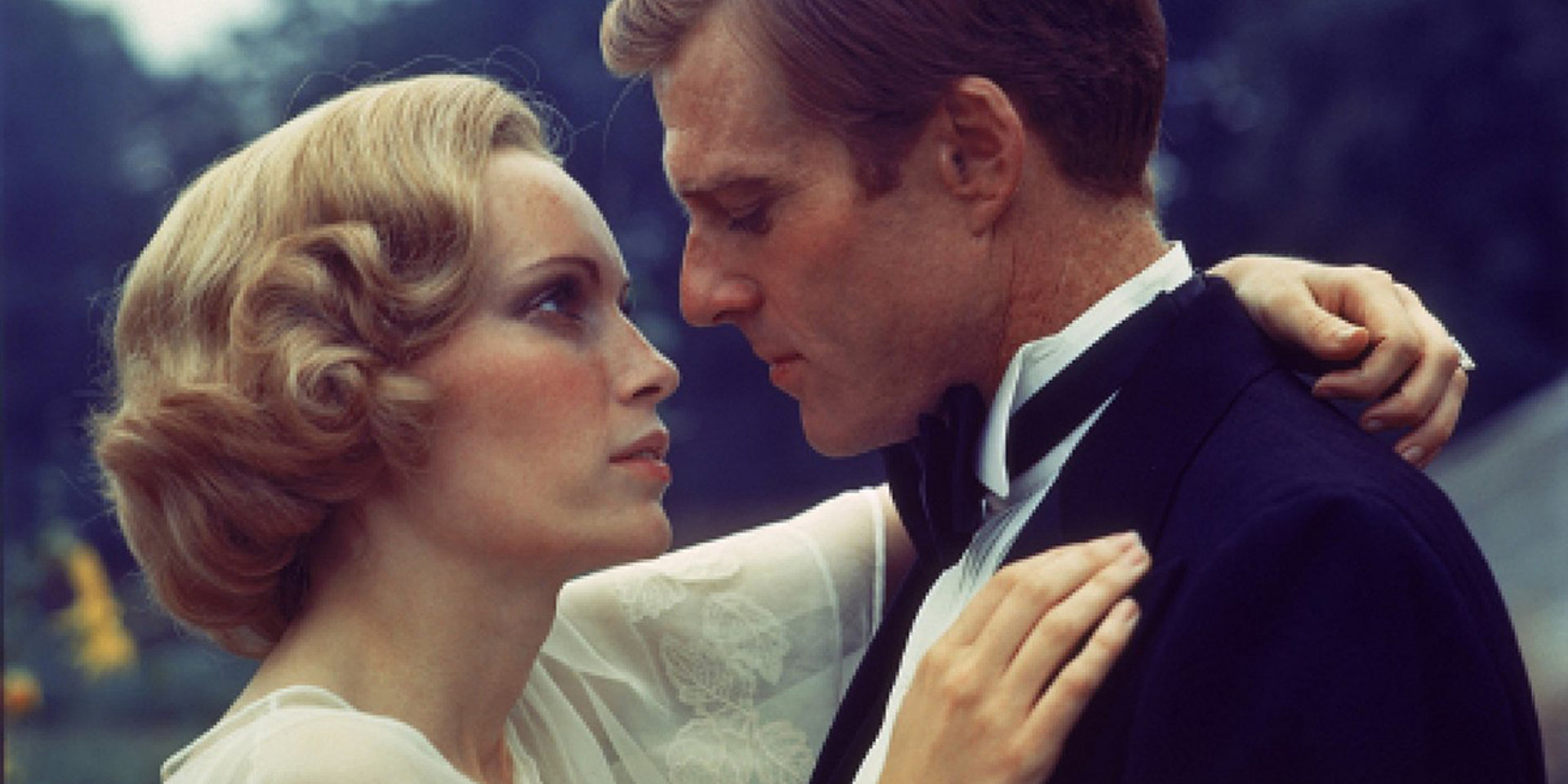
What great cinema is supposed to do. Which is why, of all the versions, The Great Gatsby (1974) film adaptation, also produced by Paramount, starring Robert Redford and Mia Farrow, is my favorite.
Fittingly, the screenplay was written by Francis Ford Coppola, considered one of the greats in the history of cinema. It shows. And, the film, which to Coppola’s dismay, did not entirely follow his screenplay, is a masterpiece.
It opens up with images including the home of heiress Daisy Buchanan. (The home of the fourth great grandfather of a dear friend of mine, Francis Colt deWolf III, he always tells me!) Everything it shows is brilliant, including the first time we see Gatsby, with the camera looking up to this God-like figure—imaging the fact that Gatsby has displaced God in making himself and his quest for Daisy the be all and end all.
You get the subtlety of what Fitzgerald was trying to achieve in showing the emptiness of moral decadence and that yearning for something deeper, more lasting. For love. And, that, in the end, God, not Gatsby, calls the shots. As George Wilson, the husband of Myrtle, the mistress of Daisy’s husband Tom, says just as the iconic, God-like image of Dr. T.J. Eckelberg peers out over the Valley of Ashes for the final time, “God sees everything.”
Fitzgerald had considered for the preamble his short story “Absolution” (1924)—the story of 11-year-old Rudolph Miller, living in Minnesota, who, when asked by overly strict Father Darcy if he has ever lied, improbably answers, ‘no’—thrusting him into a spiritual crisis—to show the early religious and spiritual alienation of Jay Gatsby (originally James Gatz), not unlike Fitzgerald himself. (Ironic, since Coppola was alienated by overly strict nuns.)
But, in the end, Fitzgerald decided to make Gatsby more of a mystery. A mystery that comes full circle in that famous, final line of this greatest novel of the twentieth century, etched onto Fitzgerald’s gravestone: “So we beat on boats against the current, borne back ceaselessly into the past.”
*The Fitzgeralds’ time in Westport, Connecticut in the summer of 1920 is the more likely template for Gatsby in West Egg, as Gatsby in Connecticut reveals, complete with a wealthy bootlegger who threw Gatsby-like parties—the Fitzgerald cottage positioned vis-à-vis the bootlegger’s mansion precisely as Nick Carraway’s was vis-à-vis Gatsby’s.