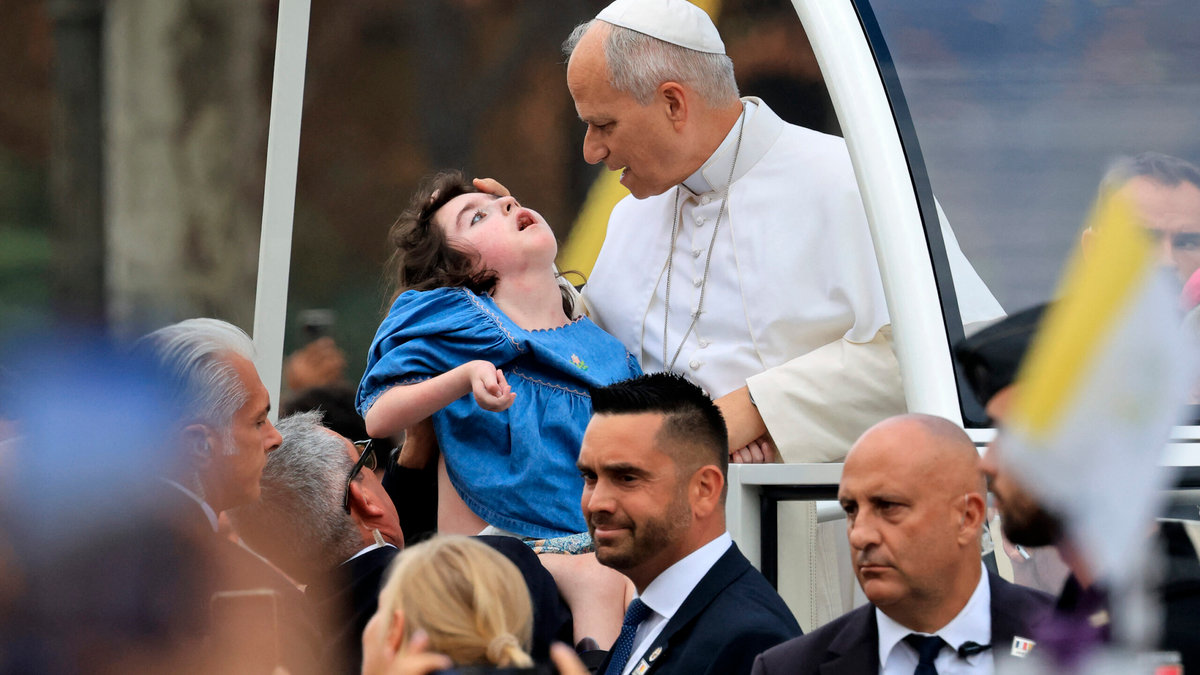
The photo of Marie-Garance with Pope Leo moved millions, but the story behind the little girl in blue is even more moving.
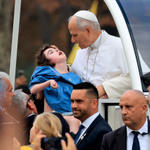
For anyone following Pope Leo XIV's visit to Paris, there's one photo that will probably be familiar by now: a little girl in a blue dress held above the crowds on the Champs-Élysées, looking directly at the Pope as he leans over to bless her forehead. It was one of those moments that needed no explanation to move people. But the little girl has a name, Marie-Garance, and once you know a little more about her, the photo tells an even bigger story.
Marie-Garance was born with schizoencephaly, a rare malformation of the brain, and West syndrome, a severe form of epilepsy. Her profound disabilities mean that she requires a great deal of medical care. After her biological parents entrusted her to state care, her first months included hospital stays, treatment, and all the uncertainty that comes with caring for a very sick baby. Then there was the question of finding her a family.
Clotilde Noël, who would eventually become Marie-Garance's mother, explained to Europe 1 that her medical file was considered so complex that it wasn't initially being shown even to families who had said they were willing to adopt a child with disabilities. The long list of everything that might lie ahead was one thing, yet taking responsibility for a real child with such extensive needs was quite another.
Thankfully, Marie-Garance's foster carer had an advantage over everyone studying that file. She actually knew her. She had taken the time to get to know the baby who smiled when someone cared for her, and she'd witnessed the little girl who tried to chatter when people spoke to her. And most importantly of all, she also knew that Marie-Garance deserved the chance to grow up in a family, and pushed for her to be considered for adoption.
Eventually, Marie-Garance came to Clotilde and Nicolas Noël, who already had six biological children as well as Marie, their adopted daughter with Down syndrome. Marie-Garance was around 16 months old when she joined them, and inevitably there was plenty to learn about caring for a child with such significant medical needs.
It's hard to imagine how daunting it must have been, trying to raise numerous children, all needing attention in their own special way. But there were also some wonderful things to discover.
When Nicolas tickled her, Marie-Garance laughed... and laughed. In fact, Clotilde shared:
“It was her laughter that saved her."
That one sentence is a lovely juxtaposition when you think of the official list of medical issues documented in her file. There were diagnoses, treatments, and predictions about what she might never do, but nobody could put down on paper what would happen when her dad tickled her.
Measuring what's important
It is clear that Clotilde has never brushed aside the reality of raising a child with profound disabilities. But she has written about the choice the family made early on not to spend their time measuring Marie-Garance against a list of things she might never achieve. They were able to look at what was already there: a child who smiled, responded, communicated in her own way and, as they had quickly discovered, had that wonderful laugh.
Now, years later, Clotilde found herself on the Champs-Élysées with Marie-Garance and her sister Pépa, who also has multiple disabilities, waiting with everyone else for a glimpse of Pope Leo. They hadn't been invited to meet him and there was no special arrangement waiting for the girls. With help, though, they had found a place in an area for people with reduced mobility, which in itself was a godsend.
Except, as the Pontiff came closer, something began to happen around them. People saw the girls and started encouraging Clotilde to move forward. She hesitated. There were other people waiting too, and she didn't want to presume that Marie-Garance had any more right to that precious spot near the Pope than anybody else. But the people around her thought otherwise, and one by one they made room.
So Marie-Garance moved through the crowd, helped along by people she had never met, until she reached the papal vehicle. A member of Vatican security took her and lifted her high enough for Leo to see her.
The now-famous photograph catches perfectly what happened next. Marie-Garance, tiny in her blue dress, gazed directly at the Pope while he placed his hand on her forehead. Around them were security guards, phones held aloft the great crowds of the Champs-Élysées, but for those few seconds the two seem to have found each other in the middle of it all and time was almost suspended. The fleeting moment was so remarkable that Clotilde later recalled a “shiver” passing through the crowd.
For a mother who had once been handed a medical file filled with all the things her child might never do, there must have been something affirming in seeing Marie-Garance up there, above the crowd, with everyone looking at her.
But Clotilde's thoughts afterward didn't stay on the Pope, or even on that photograph. She thought about all the other children living with profound disabilities who aren't seen by thousands of people, the children in hospitals, and the mothers and fathers whose lives are shaped by the relentless demands of caring for them.
And, as she shared with Aleteia France, she thought about Marie-Garance's first parents.
“I am thinking of her biological parents. They are the ones who gave her life. I have the easy role, but I'm only a bridge.”
Reducing herself to an architectural structure after such an overwhelming moment speaks volumes about a woman who chose to mother a child whose needs were more than most families could have taken on. And even with the world's attention suddenly fixed on Marie-Garance, Clotilde was thinking of the two people who weren't there on the Champs-Élysées and weren't in the photograph, but who had given her daughter life.
In fact, that photo invites us to look beyond what we initially see, and to discover just how many people have helped Marie-Garance along the way: the foster carer who knew the little girl rather than the medical file, the family who welcomed her, and finally the strangers who moved aside and helped her through the crowd towards Pope Leo.
And it all brings us back to the little girl who laughed when Nicolas tickled her. Faced with a medical file filled with reasons to worry, someone heard that laugh and saw Marie-Garance. Thank goodness they did!