He gave 129 catecheses with one central claim: the body is not a problem to be managed but a person to be read.
Between 1979 and 1984, Pope John Paul II delivered 129 Wednesday catecheses on the human body, sexuality, marriage, and celibacy. Compiled under the title Theology of the Body, they constitute one of the most ambitious works of theological anthropology produced in the 20th century — and one of the most consistently misunderstood. The misunderstanding usually runs in one of two directions: either the work is dismissed as a long papal document about sexual ethics, or it is treated as an esoteric system accessible only to specialists. Neither reading does it justice.
The central claim is simpler and more radical than either: the body is not incidental to the person but constitutive of it. What we do with our bodies, and what our bodies express, is theological. Here are the five ideas that anchor the whole:
1. The spousal meaning of the body
The body, John Paul argues, has a built-in language — a capacity to express self-gift. He calls this the nuptial or spousal meaning of the body: the fact that the human body is structured toward giving itself to another. This is visible most clearly in the conjugal union of husband and wife, but it underlies all authentic human love. The body does not merely carry the person; it speaks. What it speaks, in its deepest grammar, is the same thing the Trinity speaks in its innermost life: love as total self-donation.
This is why, in John Paul’s framework, sexual acts that contradict the logic of self-gift — that use the body’s language to say something the person does not mean — are a kind of lie told with the body.
2. Original solitude
Before the creation of Eve, Adam finds himself alone — and John Paul reads this solitude carefully. It is not plain loneliness but rather the discovery of a self: a being who stands apart from the rest of creation, who cannot find his counterpart among the animals, who is aware of his own interiority. Original solitude is the condition of selfhood — the recognition that the human being is a subject, not just an object in the world, and that this subjectivity is irreducible. Only a being capable of solitude is capable of genuine gift, because only such a being has a self to give.
3. Original unity
The creation of Eve and Adam’s recognition of her — “bone of my bones and flesh of my flesh” (Gen 2:23) — is the moment of original unity. John Paul dwells on the wonder in Adam’s exclamation: this is one of the first human speech acts, and it is an act of recognition and joy. Two different beings discover that they belong together, that their difference is ordered toward communion rather than conflict. Original unity does not erase the difference between man and woman; it fulfills it. The body’s sexual differentiation is, in this reading, a sign written into creation of the call to communion — a call that mirrors, at the creaturely level, the inner life of the Trinity.
4. Original nakedness
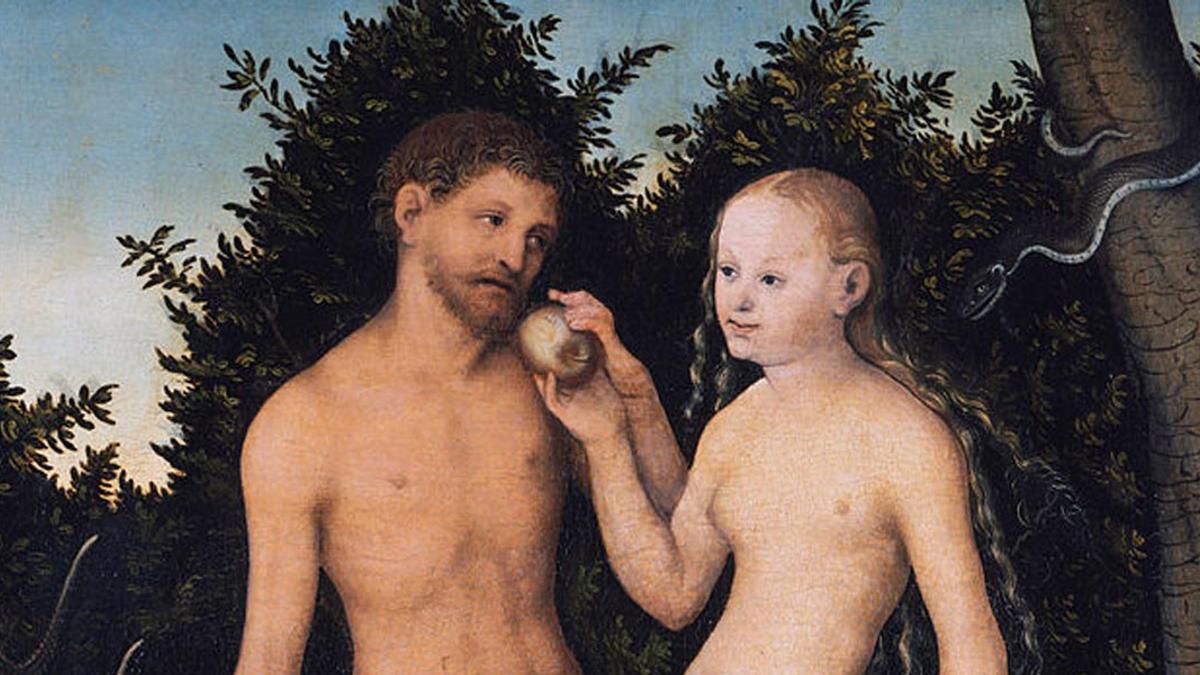
Adam and Eve were naked and felt no shame (Gen 2:25). The absence of shame is not naivety or ignorance. It is the condition of persons who see one another truly — as subjects, as persons — rather than as objects. Shame enters with sin, when the gaze of the other becomes threatening, when the body becomes something to be hidden rather than given. The recovery of the original experience of nakedness without shame is, in John Paul’s framework, the horizon of Christian life: the redemption of the body, made possible by grace, that allows persons to look at one another and see what God sees.
5. The redemption of the body
The fall does not destroy the spousal meaning of the body — it only obscures it. The whole of Christian life, in John Paul’s reading, is a process of recovering what was lost: learning to see the body as gift again, learning to give it truly, learning to receive the gift of another’s body without reducing it to an object. This is why the Theology of the Body is not primarily a document about sexual ethics — though it has implications for sexual ethics — but a document about what the Christian life is for. The redemption of the body is the redemption of the person. And it is, in John Paul’s reading, already underway in anyone who has received the grace of baptism and is willing to let it work.
The full text runs to over 600 pages in most editions. The five concepts above are but a door into it.