The Vatican’s secretary of state called for renewed multilateralism, dialogue, and respect for international law to help end conflicts.
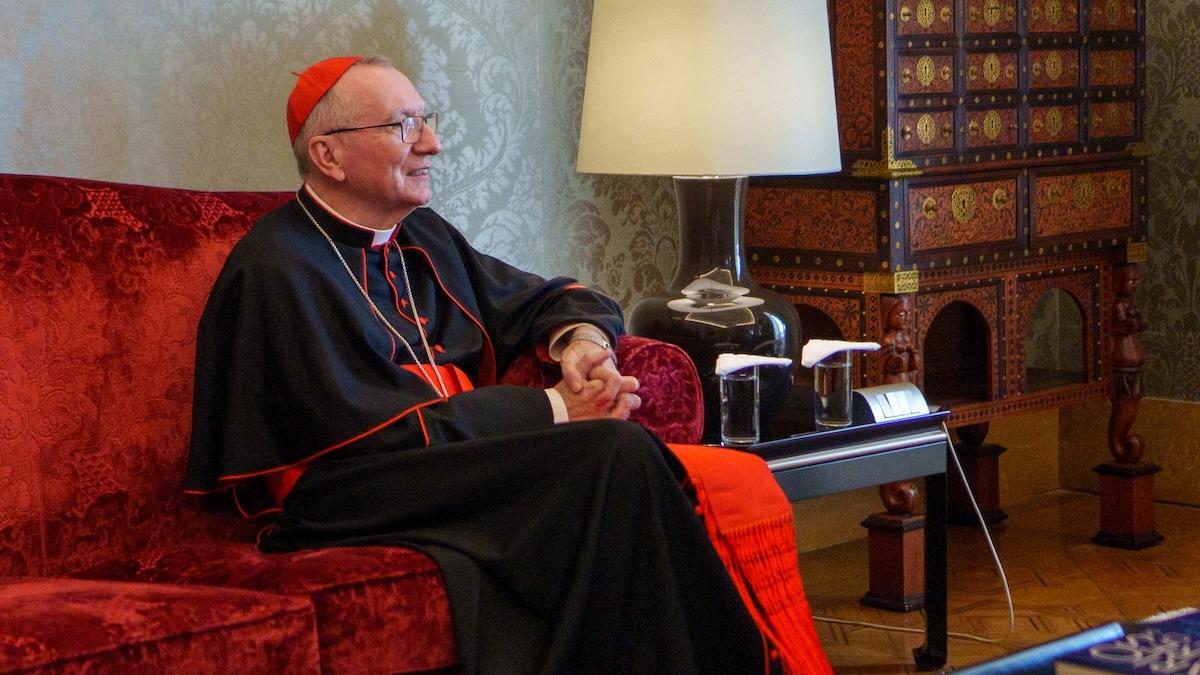
On October 4, Italian news outlet La Repubblica published an interview with the Holy See’s Secretary of State Cardinal Pietro Parolin. The cardinal had recently returned from the United Nations General Assembly in New York, and the interview focused on the ongoing conflicts in the Middle East and in Ukraine.
As the Holy See’s Secretary of State, Parolin is the pope’s chief diplomatic and administrative aide, often described as the Holy See’s second-in-command. Parolin has held this position since 2013, serving under both Pope Francis and Pope Leo XIV.
In the interview, he calls for a return to fundamental human values and respect for international law, and a renewed commitment to security and cooperation. These are among the “conditions that will allow peoples to live in a just and lasting peace, without fear of new aggression.”
A crisis of multilateralism and values
Reporter Paolo Mastrolilli started by asking Cardinal Parolin about the causes and possible solutions of the “profound instability and conflict” affecting the world. As a cause, the cardinal pointed to the crisis of multilateralism affecting international relations today. He noted that this crisis opens the door to a “widespread pessimism” which he has noted even at the United Nations.
Although the UN is an organization designed to give every country a voice, it seems to him that each country defends its own position without being willing to compromise or to be open to the positions of others.
Currently, there has been a “loss of mutual trust” that has led not only to the crisis of multilateralism but also to difficulties in organizing effective responses to humanitarian emergencies.
Updating international organizations for today’s world
On a positive note, he noted “insistent calls to return to the principles of international law.” These principles include “the prevention of war, the peaceful resolution of conflict through diplomacy and dialogue, the protection of human rights, the integral development of all people” and “the promotion of the common good.”
However, he believes that this return could only be achieved under two conditions. The first would be a return to fundamental human values; the second would be the renewal of the political will to work in this direction on the part of all the protagonists on the international stage.
At the General Assembly of the United Nations, Parolin noted various proposals to respond to this crisis. These were often focused on reforming the United Nations, entirely or in part.
He recognized that the world has “profoundly changed” since the international organizations such as the UN were created to avoid future wars. Not only has the balance of power changed; new technologies such as artificial intelligence offer us “unprecedented potential” while creating new challenges. “Large transnational companies” have also become important poles of influence.
As a result of all of this, a “process of continual reform” is necessary in order to create “renewed multilateralism” that is “adequate to face today’s geopolitical challenges.”
Conflicts in the Middle East
Regarding the conflicts in the Gulf region, the cardinal explained that “the Holy See tirelessly calls all the participants to prefer the path of dialogue and negotiation over that of force.”
However, “inequality, exclusion, the negation of fundamental rights” and the inability to “recognize the other as a brother and not as a rival” are among the underlying causes of conflicts, Parolin said. Consequently, we must leave behind the “logic of domination.”
Asked about Gaza, he recognized that the humanitarian situation “remains extremely difficult” for the Palestinians, who “are in need of everything.” The Holy See continues to propose a two-state solution, which would guarantee that both Israelis and Palestinians could “live in peace on their own land.” The Church desires to help “heal the wounds of war” and help rebuild “mutual trust.”
The war in Ukraine
The interviewer also asked Cardinal Parolin about the war in Ukraine. The cardinal laments the “real tragedy” of ongoing war and rising numbers of casualties. On one hand, he points out that Church doctrine clearly defends the right to self-defense. On the other hand, the Holy See emphasizes “the need to put an end to hostilities.” It encourages efforts to secure an immediate and comprehensive ceasefire that holds in practice, he said, and has offered to “help in any way” it can.
Amid attacks that kill civilians and damage civilian infrastructure, the Holy See also seeks “strict observance of international humanitarian law.” Speaking of humanitarian efforts, which can help promote peace, he mentioned prisoner exchanges and the return to Ukraine of children who have been taken to Russia—areas in which the Holy See has been, and continues to be, active.
Ultimately, “a long-term solution” must involve a “renewed commitment to security and cooperation in Europe.” This is part of rebuilding “the conditions that will allow peoples to live in a just and lasting peace, without fear of new aggression.”
See what else the cardinal was up to in New York:
~