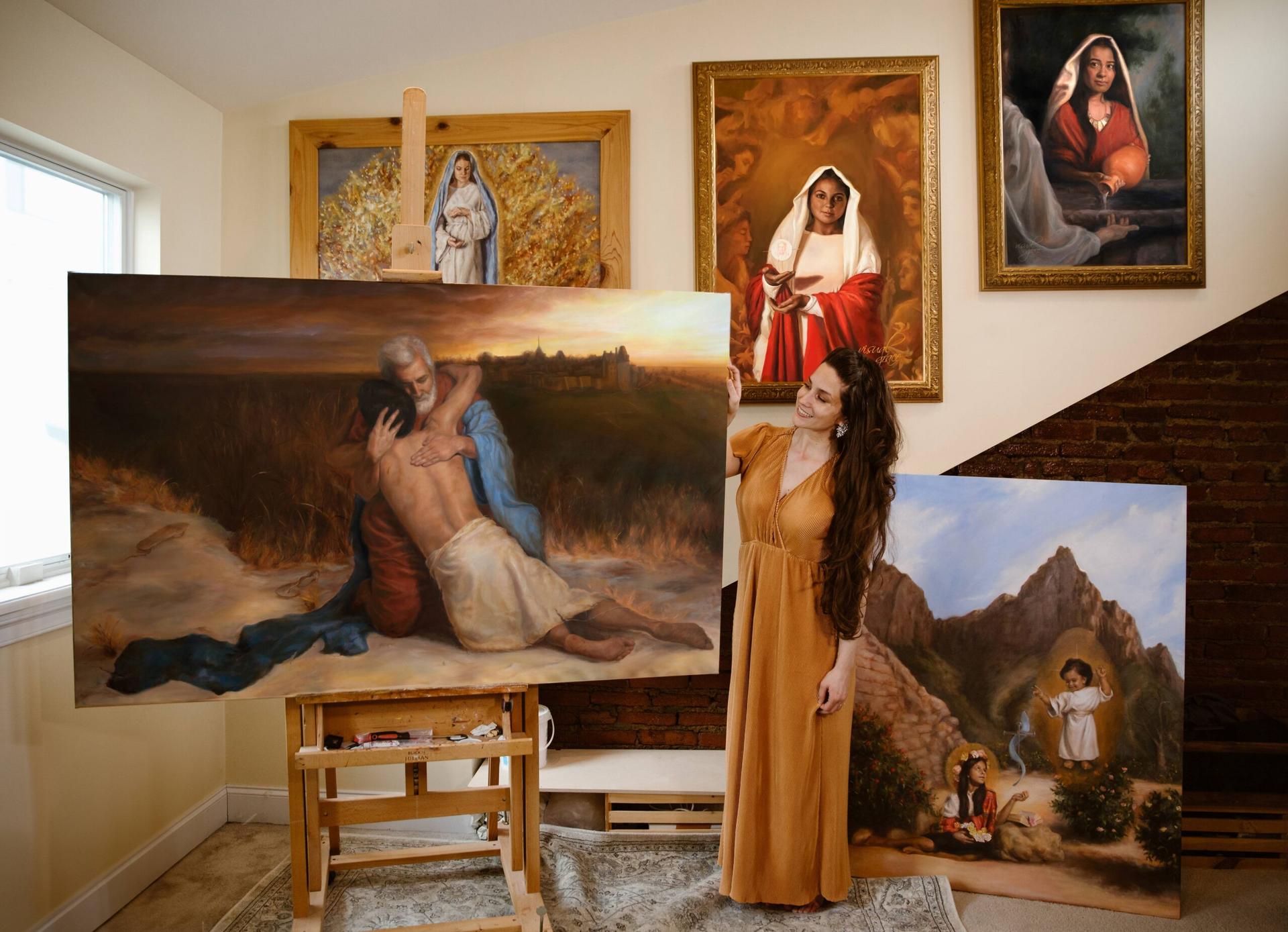
In a recent light-hearted social media post, artist Kate Capato joked that it takes exactly 910 chocolate chips to finish a sacred art painting -- 10 chocolate chips per painting session for about three months.
When asked, Capato says that yes, chocolate, rather than coffee or tea, is often her pick-me-up as she works. Even more essential, though, is inviting God into the process of her work.
From birthday cards to altar pieces
Today, Capato’s oil paintings are featured in churches, Newman centers, and private homes, but the road to becoming a professional sacred artist started as a young girl, making birthday cards and drawings as many kids do.
She increasingly focused on art beginning in high school, even taking college level courses at that time. Capato then served as a missionary with the Culture Project, sharing with young people the dignity of the human body. While seemingly unconnected with the art she was doing on the side, today Capato sees how that love for the Theology of the Body and the human person plays an integral role in her art. In her work, she explains, “I am subtly paying attention to what is being expressed through the body, highlighting femininity and masculinity and the beauty of those roles.”
Capato’s art was further formed by two years studying in Florence where she was particularly influenced by the masterpieces of the Italian Renaissance. When she returned to the United States, her professional work began in earnest; today she has been creating art on sacred themes for almost a decade.
The creative process
Despite art’s reputation for being the antithesis of business, Capato says that business expertise and an order to her work have been an essential part of her creative process. She credits her dad, a businessman, for teaching her a lot on the business side, and becoming a full-time professional artist has developed from that acumen, creative talent, and a collaborative process.
Capato is often working on several projects at one time that are moving simultaneously but are in different stages. In one week she might, for example, be meeting with potential clients about their desired projects, working on the conception phase of another project, and doing the actual painting of yet another.
And, of course, there is all the set-up -- finding talent to serve as models and garments for them to wear, as well as responding to business inquiries such as licensing her work to be used in books and other media.
God as the main artist
Between clients' initial desires and Capato’s hard work and artistry, there is, of course, a very human element to her work. But she says, “A big part of my process is praying and asking the Lord to be the main part of my composition.”
She often brings the ideas for projects to Adoration and asks Him for inspiration. “I’m always asking God to be the main artist and [for me] not to get in His way.”
Sacred art is certainly not always a simple process, and Capato turns to the Lord in prayer when she isn’t feeling inspired, and even when she needs the right contacts or materials. “Part of my own salvation story,” she says, “is learning to lean on Him.”
Part of a larger ministry
Capato shared that one project that she’s working on today is two altar pieces that will grace a parish named after St. Philip Neri. She shares that sometimes she paints saints with whom she is very familiar, and other times it is an opportunity to learn more about an aspect of a saint or our faith.
Capato’s physical art is one important part of a larger ministry at Visual Grace. Along with her musician husband and a small team, Capato brings beauty to parishes through a unique presentation whose purpose is to “reawaken hearts to wonder and bring stillness to aching souls.”
Along with a presentation of her artwork, Capato leads participants through a way of listening to God through contemplation of sacred art. The event truly aims to express beauty in a variety of ways. The website reads, “Beginning with an engaging presentation, events include original sacred art paintings, a time of Eucharistically focused prayer, live meditative prayer music, and sometimes a time to create or even to experience faith-filled dance, soaking the senses fully in truth through many types of Beauty.”