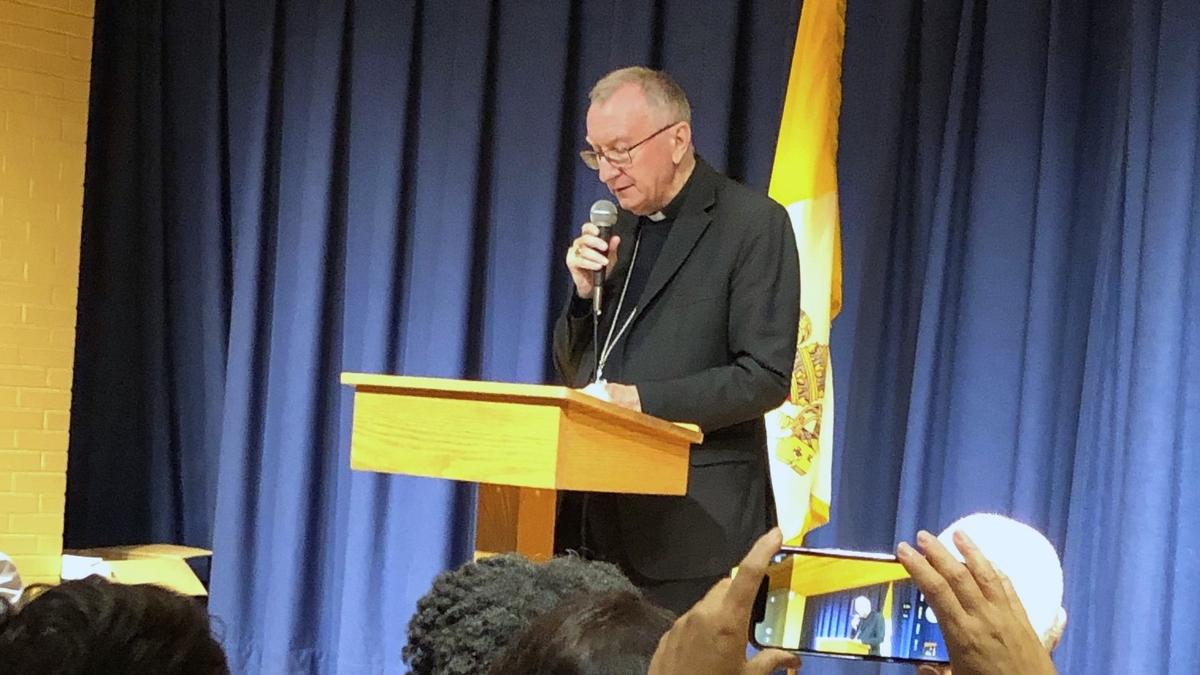
Cardinal Pietro Parolin indicated that the Holy See will make a statement on the issue, and noted that the head of the US bishops already had.
Speaking to journalists on the sidelines of an event in Rome dedicated to the Doctor of the Church and saint celebrated today, John Henry Newman, Cardinal Pietro Parolin indicated that the Holy See would make a statement about the US government's announcement that an execution later this year will be live-streamed.
The Pope's Secretary of State called the plan "incomprehensible" and said that it is "certainly unacceptable to turn death into a spectacle."
An announcement from what is now known as the US Department of War was made October 8. It said that the execution by firing squad of the man convicted of killing 13 people and injuring 32 at Fort Hood, Texas, in 2009, would be live-streamed. The execution of Major Nidal Malik Hasan by firing squad is currently set for December 3.
Cardinal Parolin noted that the president of the US conference of bishops has already spoken out about the decision and said that “there will be a statement from the Holy See.”
Cardinal Parolin said death should not be turned into a spectacle:
It is truly incomprehensible that anyone would want to use this method in this day and age. I do not know for what purpose. It is certainly unacceptable to turn death into a spectacle. However guilty the person may be, there are other ways.
The cardinal's comment points to Church teaching that the death penalty is inadmissible today.
"The Church’s position is one of total opposition to the death penalty," the Cardinal said, as reported by Vatican News. "It is incompatible with human dignity and does not serve as a deterrent."
Catechism of the Catholic Church
Today, however, there is an increasing awareness that the dignity of the person is not lost even after the commission of very serious crimes. In addition, a new understanding has emerged of the significance of penal sanctions imposed by the state. Lastly, more effective systems of detention have been developed, which ensure the due protection of citizens but, at the same time, do not definitively deprive the guilty of the possibility of redemption.
Consequently, the Church teaches, in the light of the Gospel, that “the death penalty is inadmissible because it is an attack on the inviolability and dignity of the person”, and she works with determination for its abolition worldwide.
US bishop: Shock and sorrow
Archbishop Paul S. Coakley, president of the U.S. Conference of Catholic Bishops, issued the following statement sharply condemning the decision of the U.S. government:
It is with shock and great sorrow that I have learned of the Department of War’s decision to publicly livestream the execution of Nidal Hassan. Our God is the God of life. In no way can Hassan’s actions be condoned but this decision is a barbaric promotion of a culture of death and must be reconsidered. The word of God exhorts us: ‘do not repay anyone evil for evil' (Romans 12:17). The public execution even of one who has done grave harm will only further undermine the moral fabric of our nation and be a blight on the conscience of its people.
I pray for the intercession of Our Lady of Good Counsel that we as a nation may always choose life even in the most trying times and circumstances.
Botched death penalty a few days ago
The death penalty in the United States is already at the forefront of public debate after a woman survived two attempts to kill her by lethal injection on September 30 in Tennessee. She had been on a ventilator since the failed attempt, but this week, her lawyers reported that she is now up and walking. She would have become the first woman executed in Tennessee in 200 years.
In the United States, there are both federal- and state-level death penalty practices, with just under half of the states having abolished use of the death penalty.