Why is it that Teresa experienced the fulfillment of desire so deeply that her very heart was pierced by the experience?
There’s a statue I was shown in art class many years ago back when I was an aspiring art student, The Ecstasy of Saint Teresa. It has made a permanent impression on me because of how emotionally charged it is and I still think about it.
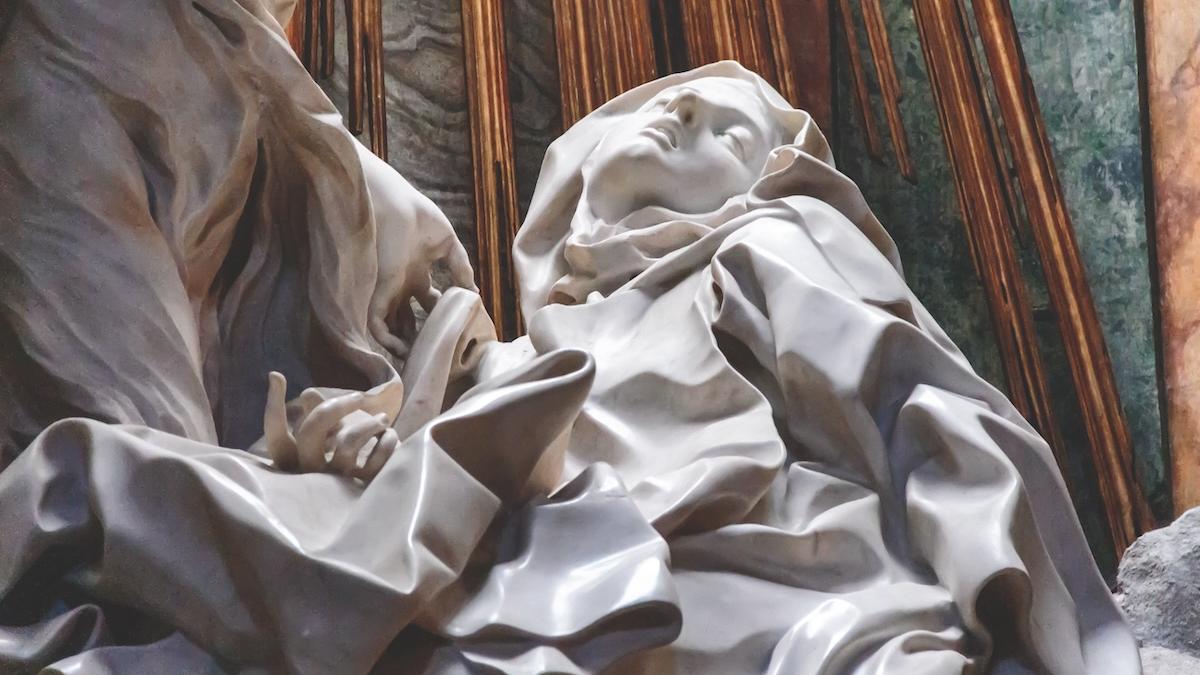
Created by Bernini in the 17th century, the sculpture depicts a mystical vision St. Teresa experienced, often referred to as her Transverberation (meaning "piercing through"). She later described the vision, writing in her autobiography that an angel pierced her heart repeatedly with a fire-tipped spear. The piercing allowed her to share the pain of Christ’s pierced heart and it left her “all on fire with a great love of God.” Years after her death, her incorrupt heart was exhumed and it still had the small wound caused by the spear. The vision, it turns out, was very real.
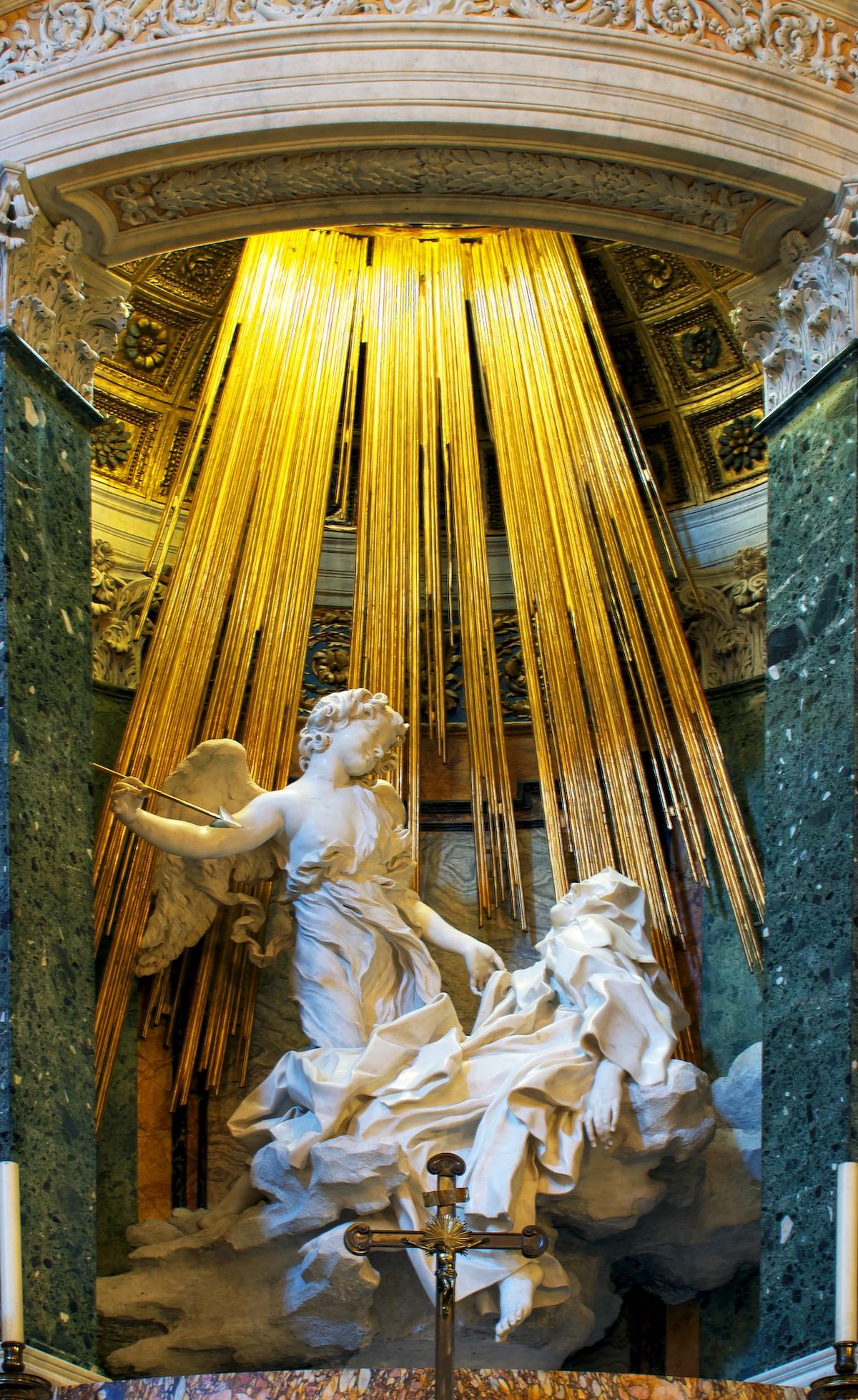
Bernini’s statue, once you see it, is hard to forget because it manages to move beyond the exterior forms and into the inner meaning of the Transverberation as the catalyst for an intense ecstasy. The look on St. Teresa’s face is one of pure rapture, such that one might see in the expression of a spiritual, nuptial union. Catholicism can be intense. Very intense. This is one of the examples. When the Church talks about the love of God shared with us like the love shared between a bridegroom and bride, it’s not a mere metaphor. The love is every bit as intense. In fact, we should reverse the way we think about it – it’s the love of God that is the more real and intense of the two. What is shared between a husband and wife in the nuptial union is closer to the metaphor. It’s a sign of a greater love; the very love written all over the face of St. Teresa. Whatever joy and happiness and unifying love there is in a marriage, spiritual union with God is more.
The Ecstasy is pure visualization of desire. When we think of religious sisters and monks, we probably picture people who are calm, prayerful, and meditative. Very chaste. Very reserved. What we overlook is the burning desire flaming hot and bright in them. Within their daily disciplines, the vows, the fasting, there is a love stronger than we can possibly imagine. This is why men and women are willing to abandon everything for the sake of a religious vocation – they’re plunging into the burning heart of desire.
Growing up as a teenager in the 90s with all the societal conditioning to which I was exposed - ranging from Hollywood and the music I liked, to television commercials, to the way all my classmates talked in high school – made it abundantly clear to me that, in order to be happy, I was supposed to follow my desires wherever they led - make a lot of money, consume, indulge. Today, that cultural insistence has become all-consuming. We are a people dedicated to chasing pleasure. In such an atmosphere, following every desire wherever it leads is, allegedly, the key to happiness. The only sin is to deny yourself.
How strange, then, is that expression on the face of St. Teresa. Why is it that this woman who denied all her desires except for the desire to love God, the woman who closed off so many avenues of desire and instead shut herself up in a convent, why is it that she experienced the fulfillment of desire so deeply that her very heart was pierced by the experience?
Circe and Teresa
A friend recently showed me a poem by Richard Wilbur about St. Teresa. In it, he compares her to the goddess Circe from the Odyssey. In the Homeric epic, Circe is an enchantress of desire, embodying the opposite of chastity. Instead, she encourages complete immersion in pleasure. When Odysseus and his men arrive at her island, she is busy weaving a tapestry but soon enough, the men are gluttonously gorging themselves at a feast she lays out. The food is secretly poisoned and turns the men into pigs.
The name Circe means “The Encircler.” Think of her as a circling hawk looking for prey. It turns out that she was weaving a trap, offering to fulfill unchaste desire but using those very same desires to degrade the men who gave in to them. Their desires made pigs of them.
Circe and Saint Teresa are opposites. Wilbur mentions “the spear which drew / A bridal outcry” from St. Teresa. It was a pain of love which healed and led to the fulfillment of desire. She bound herself to God. She vowed her life to a higher order of love. That desire, rightly ordered and chastened, set her free.
The men on Circe’s island are “made to squeal and cry ... captives in the witch’s sty,” but St. Teresa, on the other hand, was “quickened” to run. She fairly flew across the rocks of Spain, writes Wilbur, because her ecstasy grew and grew until it lifted her soul to pure joy. The more she disciplined herself, the more her joy increased.
If unbridled desire circles round and traps us, it is properly disciplined desire that grows into true love. When we – depending on our state in life - bind ourselves to marriage vows, commitment to family, to Holy Mass, to vocation and prayer, to tempering our desires and disciplining ourselves to seek out that which is good and true and noble, we stoke the inner fire of ecstasy. This is how we learn to love. This is how we learn to live free and happy.