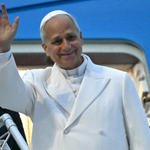
Leo XIV told the Greek-Melkite Synod: “I am with you” — and backed the words with a concrete commitment.
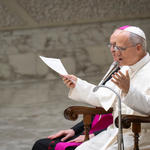
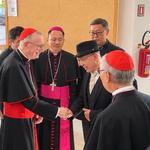
Pope Leo XIV received the Synod of Bishops of the Greek-Melkite Church of Antioch on October 10, offering words of solidarity with a community that has lived for decades under the weight of war, religious extremism, forced migration, and economic collapse. “I am with you,” he told the bishops — and through them, the priests, religious, seminarians, and faithful scattered across the Middle East and throughout a vast diaspora.
The address was an act of ecclesial solidarity with one of the oldest Christian communities in the world, whose roots reach back to the city where, as Leo recalled, the followers of Jesus were first called “Christians.”
Remaining in the land
The most concrete announcement in the speech concerned the material conditions that make Christian life in the region possible at all. Emigration — driven by insecurity, poverty, and the absence of opportunity — has steadily hollowed out Christian communities across Syria, Lebanon, the broader Holy Land, and Iraq for decades. Leo named the problem directly and attached a response to it:
“For its part — and thanks to the generosity of so many — the Apostolic See is ensuring that there are scholarships available for the faithful in Syria, Lebanon, and Iraq to receive a Catholic education. Our goal is to support young people, so that Christian families will have the assistance required to remain in the Middle East and maintain a Christian presence.”
The logic is clear: a family that can educate its children without leaving does not need to leave, or at the very least, has one fewer reason to do so. Scholarships are not a political intervention in a region of extraordinary complexity. They are a bet on the next generation — and on the idea that a Christian presence in the land where Christianity was born is worth protecting by practical means.
Seeds of communion
Leo framed the Melkite vocation in terms drawn from the Church’s oldest language of witness. Christians living amid conflict and hardship are, in his words, “seeds of communion” — a presence that speaks, by its very survival, of reconciliation and peace in lands that have known very little of either.
The address also touched on the internal life of the synod itself. Drawing on his Apostolic Letter Mutua Concordia, Leo reminded the bishops that synodal authority is ordered toward service, not power. He warned against seeking “personal success” or “profit” over pastoral care — a pointed reminder that the credibility of the Church’s witness abroad depends on the integrity of its governance at home.
Antioch and its weight
The choice to invoke Antioch was not incidental. For the Melkite Church, whose full name is the Greek-Melkite Catholic Church of Antioch, Alexandria, and Jerusalem, the city carries the weight of origin. It was from Antioch that Paul and Barnabas set out on their missionary journeys. It was in Antioch that the Church first learned to exist beyond the boundaries of Judaism. That history is not archaeology for the Melkites. It is the ground on which they still stand — or try to.
Leo closed by entrusting the synod to the intercession of the Theotokos, the title by which Eastern Christianity has called Mary since the Council of Ephesus in 431. The gesture was fitting: a Latin pope addressing an Eastern church in its own theological idiom, the shared language of a communion that precedes the divisions of centuries.