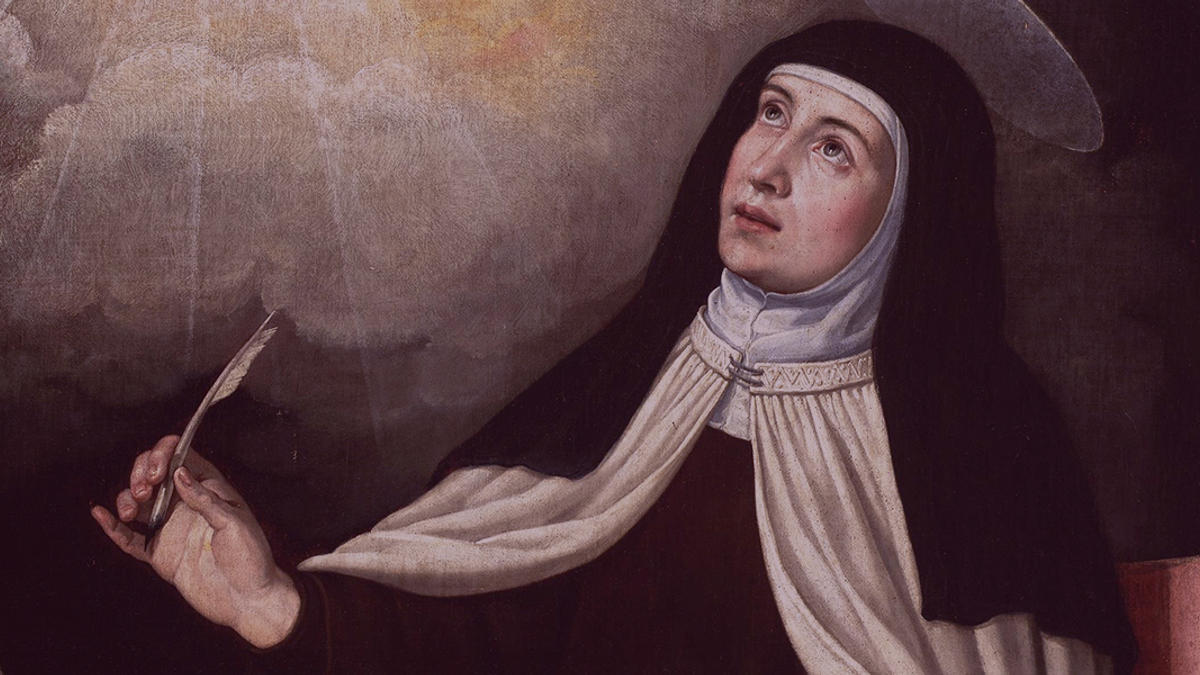
St. Teresa's father made the decision to send her away to live at an Augustinian convent where she was educated with other girls her age.
Before St. Teresa of Avila entered a Carmelite convent, she was a lively young girl, who loved to gossip, wear fine clothes, and flirt with boys.
Part of this was due to the influence of a relative, which she explains in her autobiography:
[F]rom a relative whom we often had in the house I learned every kind of evil. This person was so frivolous in her conversation that my mother had tried very hard to prevent her from coming to the house, realizing what harm she might do me, but there were so many reasons for her coming that she was powerless. I became very fond of meeting this woman. I talked and gossiped with her frequently; she joined me in all my favorite pastimes; and she also introduced me to other pastimes and talked to me about all her conversations and vanities.
This negative influence was difficult to manage and so her father devised a plan that would at least isolate St. Teresa from worldly temptations.
He decided to send her to a nearby Augustinian convent (the same religious order as Pope Leo XIV), in hopes that she would learn from the nuns there and lead a holier life.
Living with Augustinian nuns
This proved to be a turning point in her life, as she recounts:
For the first week I suffered a great deal, though not so much from being in a convent as from the suspicion that everyone knew about my vanity. For I had already become tired of the life I had been leading; and even when I offended God I never ceased to be sorely afraid of Him and I tried to make my confessions as soon as possible after falling into sin. At first I was very restless; but within a week, perhaps even earlier, I was much happier than I had been in my father's house.
Initially St. Teresa was not interested in becoming a nun, but the holy examples of the women there had an impact on her. They were very virtuous and she eventually desired to imitate them.
She explains how, "By the end of my time there, I was much more reconciled to being a nun -- though not in that house, because of the very virtuous practices which I had come to hear that they observed and which seemed to me altogether excessive."
St. Teresa lived with the Augustinians for about a year and a half, but had to leave because of poor health. She returned home and gradually felt a desire to enter a Carmelite convent, which she did without her father's permission when she was 21 years old.
She would go on to become one of the most influential Carmelites of all time and one of the most famous mystics of the Church.
In many ways it all started when she was sent away to an Augustinian convent.