After Pope Leo XIV's surgery for lung cancer, Vatican staff are concerned but relatively calm as the Church's work continues.
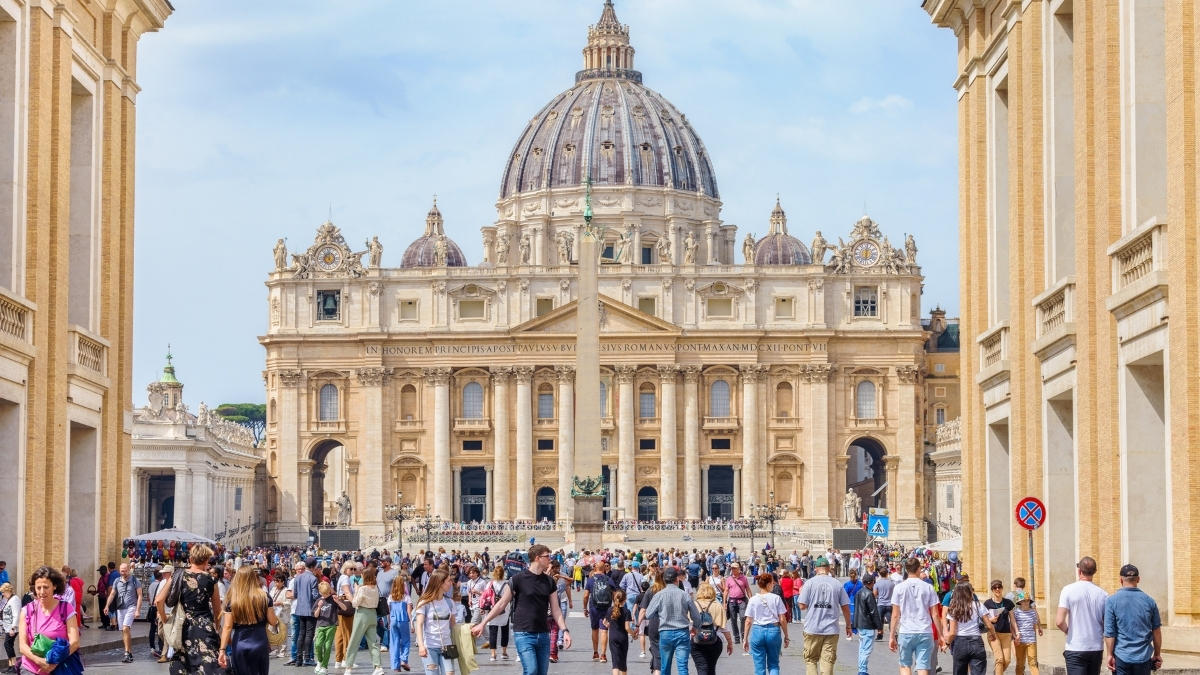
Swiss Guards, diplomats, cardinals of the Roman Curia, Eastern Catholic patriarchs in full liturgical vestments, and bishops representing nearly every country in the world: Everything about the protocol and ceremony in St. Peter's Square on Wednesday, October 14, was ready for a papal Mass. Even the liturgical booklet listed the Santo Padre ("Holy Father") as presider.
But the Pope wasn’t there. Instead, Cardinal Luis Antonio Tagle of the Philippines, the new dean of the College of Cardinals, presided on his behalf. The Mass concluded a weeklong Vatican gathering on the challenges facing families, held 10 years after Pope Francis published his apostolic exhortation Amoris Laetitia.
"It's wonderful that this Mass could take place today, just hours after the Pope's cancer diagnosis was officially confirmed," said an employee of the Roman Curia. "With representatives of bishops' conferences from around the world here, the whole Church will be praying for the Pope's health and showing him its support."
The woman is fairly confident that the 71-year-old pontiff will recover. She also recalls St. John Paul II's years of suffering and his devotion to Our Lady of Fatima. With that in mind, she wonders whether the choice of October 13 for Leo XIV's surgery might have been more than a coincidence. That date marks the final apparition of Our Lady of Fatima in 1917, although the liturgical feast is celebrated on May 13, the anniversary of the first apparition.
An "American-style" openness
After the Mass, conversations on the steps of St. Peter's Basilica turned to the Pope's recent trip to France.
It's difficult to know whether Leo XIV was already aware in late September that he would need surgery. Still, it's possible that a sense of his own vulnerability contributed to the strong emotions he displayed, particularly in Paris and Lourdes.
Meanwhile, his direct, "American-style" announcement of his illness, without euphemisms, seems to have reassured Vatican staff. So has the detailed medical information provided directly by his doctors.
Rather than seeing these developments as signs of a pontificate in decline, some regard them as an expression of a new beginning. They also see the Pope's openness as a model of honest communication that institutions and families alike can follow.
"By doing this, he's setting an example. He's completely fulfilling his role as Pope," said a young woman who attended the gathering on the family.
Prayer and business as usual
Within Vatican institutions, the Pope's hospitalization has only strengthened an already close bond with him.
"We gather every day at noon for the Angelus, joining him in prayer. And these days, we're also praying for his recovery," said another employee of the Roman Curia. She noted that nothing has changed on her dicastery's calendar. All meetings and international trips are going ahead as planned.
There is, however, some uncertainty about the rest of the Pope's schedule for 2026. One major question concerns his ambitious November trip to three Latin American countries: Uruguay, Argentina, and Peru.
"He really wants to go. It's very important to him, but also to millions of people there, many of whom have surely already invested a great deal in preparing to welcome him," said a woman familiar with papal trips.
"But I also think he has a scientific, rational mind. If his doctors advise him to slow down, skip certain stops on the trip, or postpone it until 2027, he'll follow their advice," she added.
A light in the Apostolic Palace
One symbol remains particularly meaningful: the light shining from the windows of the papal apartments.
"I often look at the lights in the Apostolic Palace in the evening as I cross St. Peter's Square," said a woman who frequently visits the area.
"I'd noticed that the light in the window of his private chapel had stayed on later than usual during the two days before he announced his hospitalization. I thought he must be preparing to make an important announcement."
It's a reminder that the Pope's very presence, even when he's silent and has a reduced schedule, can reassure the people of Rome. They now await his return to the Vatican with confidence.