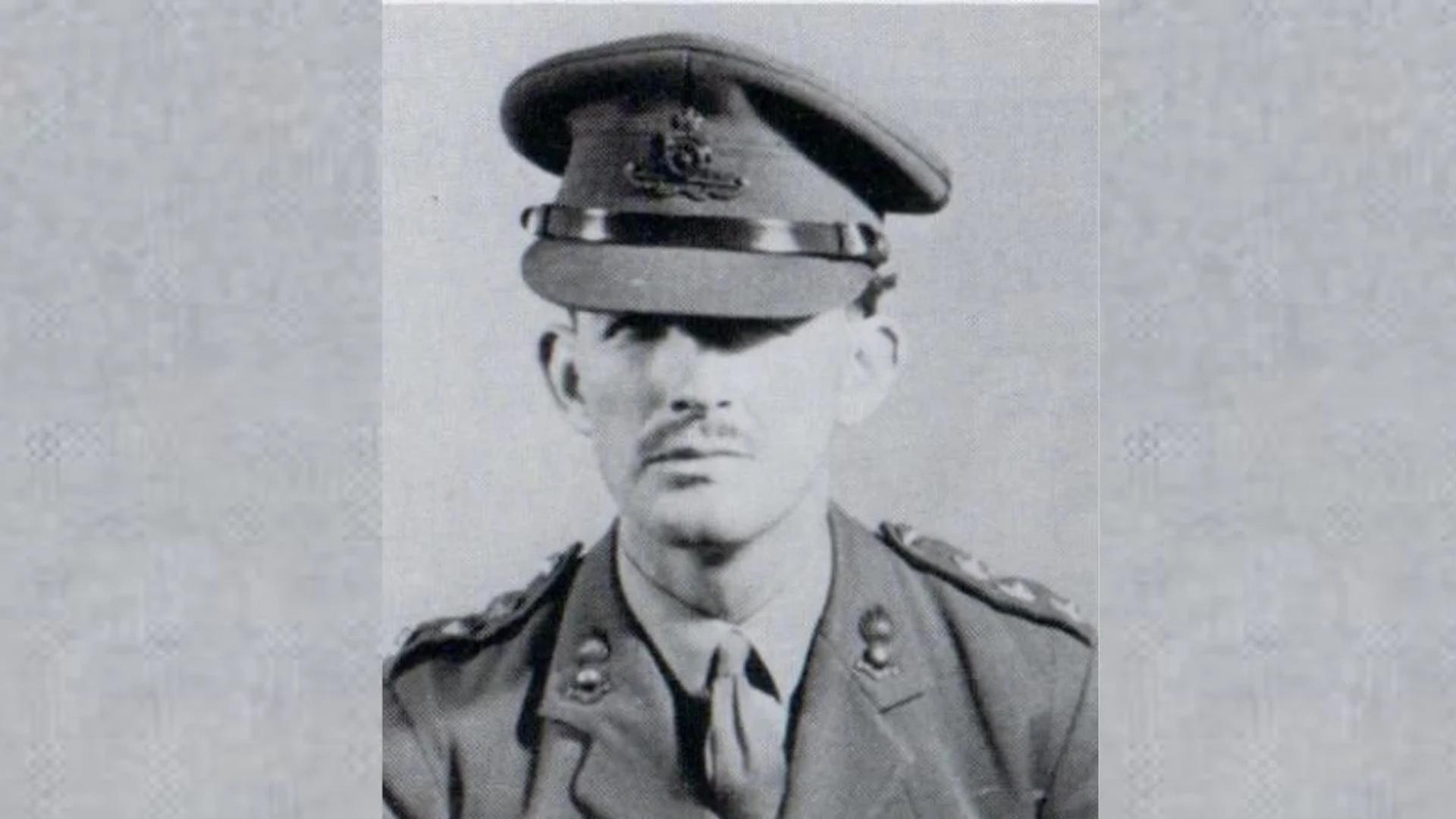
On the night of September 12–13, 1942, a daring British commando raid known as Operation Aquatint was underway. In the dark of a Normandy night, a small unit of Allied commandos made its way to the German-occupied French coast near Sainte-Honorine-des-Pertes. But nothing went as planned.
The small group landed on the beach but immediately came under heavy German fire. Gustavus Henry March-Phillipps, known as “Gus,” risked everything but was killed during the fighting. He was 34 years old.
An extraordinary officer, novelist, sailor, horseman, and devout Catholic, he left behind an elite commando unit and a track record of successful covert operations. Yet, even today, he remains largely unknown to the general public.
Gus March-Phillpps was an unconventional figure for his time, both an irreverent poet and a swashbuckling soldier. Born in 1908, he entered the abbey school of Ampleforth in Yorkshire in 1917. Run by Benedictines, it is one of England’s great Catholic boarding schools, where faith is taught and lived daily.
He didn't particularly distinguish himself academically or in sports, but developed a reputation for recklessness, according to his obituary in the Ampleforth Journal (PDF). Nevertheless, the seeds of a solid faith and a chivalric ideal were undeniably planted.
A man who didn't fit the mold
After leaving Ampleforth in 1926, he entered the Royal Military Academy, Woolwich, and was commissioned as a second lieutenant in the Royal Artillery. He spent his early years in the regular army in England, followed by a three-year stint in India.
His obituary in the Ampleforth Journal describes him as a “rather wild and irresponsible subaltern.” However, this was likely just the impatience of a man too big for ordinary frameworks.
The obituary offers a memorable portrait of his personality:
“But Gus March-Phillipps was indeed a remarkable young man, not only for what he did but more especially for his peculiarly attractive and fine qualities. […] But those of his friends who knew nothing of his exploits will remember him for his qualities, his courage, his nobility, his independence, his love of England and particularly the English countryside and English traditions, his impatience for action, his Catholic Faith, his love of the sea and of horses, and most of all for his ability to inspire his followers, his natural genius for leadership.
“What he loved most was to be in a situation where he knew that only by his own skill, determination and leadership could he avert disaster from himself and his companions. Few of his friends and none of his officers and men would have refused to follow him on whatever crazy adventure he might have proposed.”
“A curious mixture of conflicting impulses”
In short, he seemed straight out of an adventure novel, a “curious mixture of conflicting impulses.” He wasn’t an intellectual dreaming of action, nor was he a soldier scribbling verses out of boredom; he was both.
He had resigned from the regular army to devote himself to writing, but the Munich crisis of 1938 pulled him out of his literary retirement. He applied to rejoin the military and was called up the following year.
The Small Scale Raiding Force
March-Phillipps had a precise idea of what he could and wanted to do. Confident in his abilities, he joined the British Expeditionary Force (BEF) as an intelligence officer, serving first at the 2nd Corps headquarters and then at General Headquarters from September 1939 until the evacuation of Dunkirk.
Back in England, he refused to sit idle. He hounded his friends, acquaintances, and superiors until he received permission to implement his own ideas on how to fight the enemy.
Alongside his friend Lt. Geoffrey Appleyard, he formed a secret unit under the aegis of the Special Operations Executive (SOE). This unit officially became No. 62 Commando, also known as the Small Scale Raiding Force (SSRF). Some of its members later helped establish the 2nd Special Air Service (SAS).
It would take a novel to cover all of his unit’s exploits. In January 1942, he led Operation Postmaster. In the dead of night on the Spanish island of Fernando Po, his men seized three enemy vessels without firing a shot and brought them to Nigeria. This audacious success cemented the SOE’s reputation.
Returning to England as a newly promoted major, he launched a series of nighttime raids along the German-occupied coastline. These included capturing German prisoners at the Casquets lighthouse (Operation Dryad) and fighting German troops during a raid targeting a radar installation and antiaircraft positions in France (Operation Barricade).
His military service earned him several honors, including the Distinguished Service Order and a mention in despatches.
A fateful mission in Normandy
The night of September 12–13, 1942, proved fatal. As his 11-man detachment landed on the beach at Saint-Laurent-sur-Mer — nearly 21 months before the D-Day landings on that same stretch of coastline — the current had carried their vessel several miles west of its intended destination.
Barely ashore, the commandos came under German fire. Unable to return to their landing boat, they found themselves trapped on the beach. Their supporting vessel attempted to recover them but eventually had to withdraw when German patrol boats opened fire.
Major March-Phillipps was killed during the fighting. He died alongside Sgt. Allen Michael Williams, 22, and Pvt. Richard Lehniger, 42.
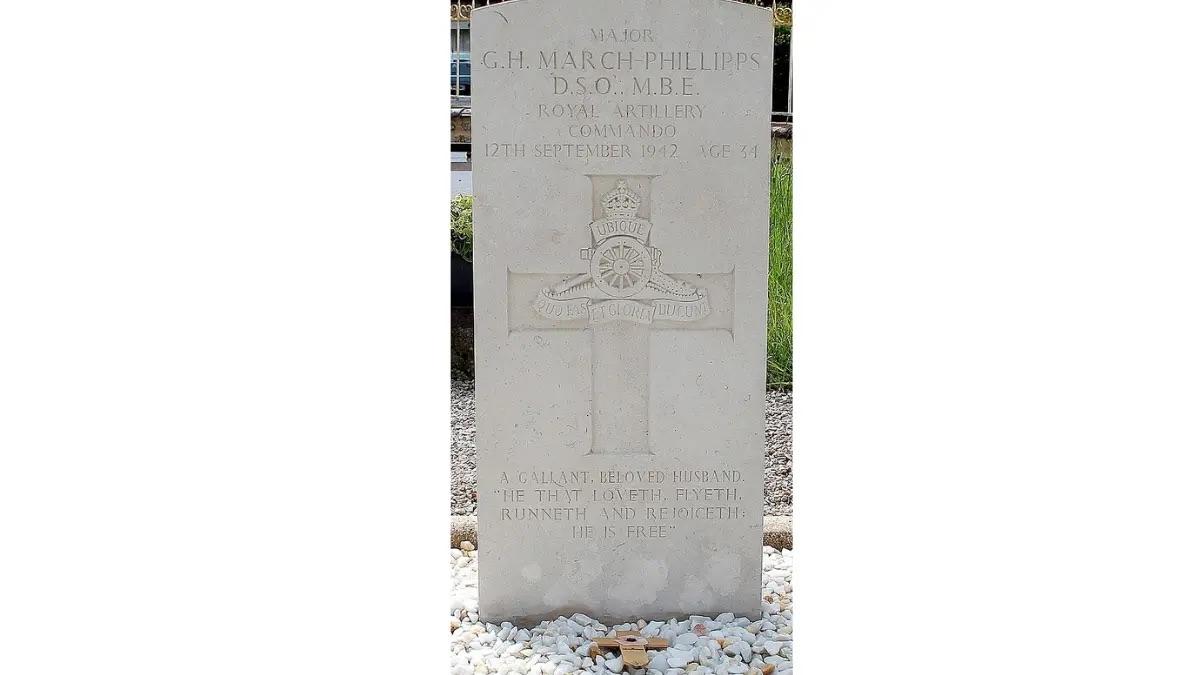
He was buried with them in the church cemetery at Saint-Laurent-sur-Mer, on the very Normandy coast where he drew his last breath. His tombstone bears a famous quote from Thomas à Kempis’ spiritual classic, The Imitation of Christ: “He that loveth, flyeth, runneth and rejoiceth; he is free.”
Although relatively unknown today, March-Phillipps has been cited as one of the possible inspirations for James Bond. Ian Fleming, who created the famous character, also worked in British intelligence during the war.
In 2024, director Guy Ritchie brought a highly romanticized version of their story to the big screen in The Ministry of Ungentlemanly Warfare, starring Henry Cavill as Gus.
“If I must die”
A year before his death, Major March-Phillipps penned a prayer in the form of a poem. Rather than asking God for protection, he prayed for the grace to face death with simplicity, unwavering faith, courage, and joy.
The author of his obituary in the Ampleforth Journal wrote, “He was, I know, granted this.”
IF I MUST DIE
If I must die in this great war
when so much seems in vain,
And man in huge unthinking hordes
is slain as sheep are slain,
But with less thought: then do I seek
One last good grace to gain.
Let me die, Oh Lord, as I learned to live
when the world seemed young and gay,
And “Honor bright” was a phrase they used
that they do not use to-day,
And faith was something alive and warm
When we gathered round to pray.
Let me be simple and sure once more,
Oh Lord, if I must die,
Let the mad unreason of reasoned doubt,
Unreasoning, pass me by,
And the mass mind, and the mercenary,
And the everlasting “why.”
Let me be brave and gay again,
Oh Lord, when my time is near
Let the good in me rise up and break
The stranglehold of fear;
Say that I die for Thee and the King,
And what I hold most dear.
— G. March-Phillipps
December 1941