Published by Scribner's 100 years ago, this deeply spiritual novel crystallized “the Lost Generation”
After the cataclysm of World War I (1914-17), claiming some 20 million lives, the shellshocked and dazed “Lost Generation” flocked to Paris, where literary and artistic freedom flourished.
The dollar was strong, enabling Americans to live comfortably in Paris for $100 a month and, soon, they were steaming across the Atlantic “in search of their own artistic voices. A Lost Generation unsure of their future but certain it somehow lay in Paris.”
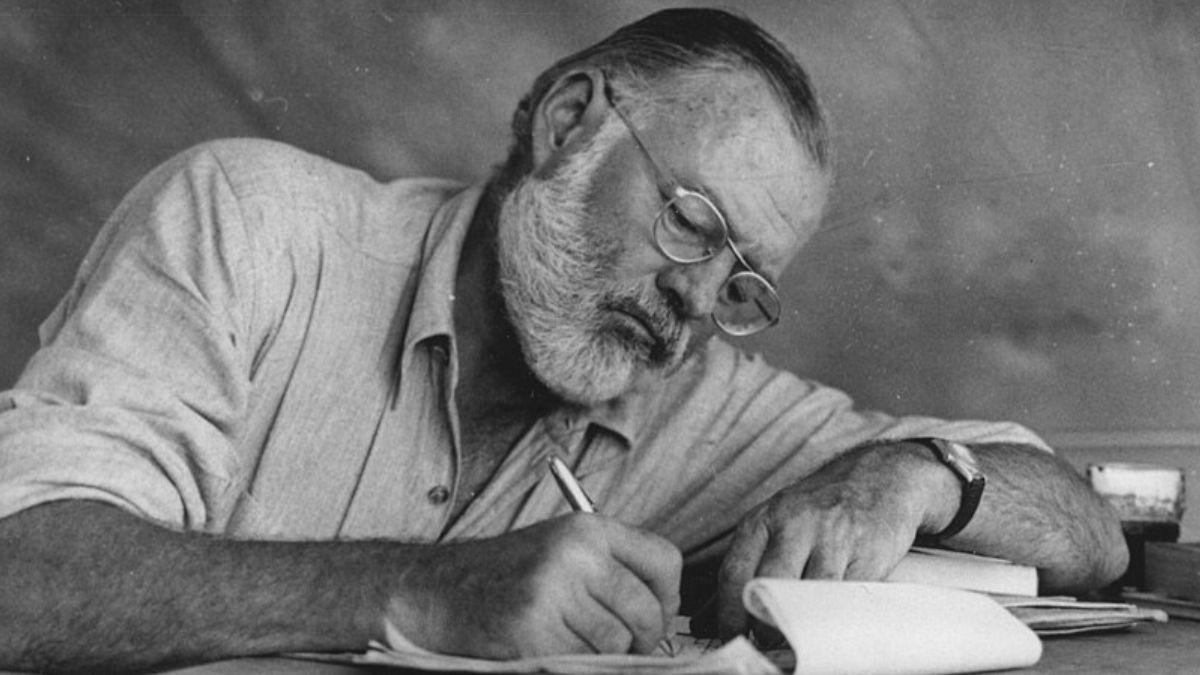
One such pilgrim was young Ernest Hemingway, who, joined by his wife Hadley, arrived just before Christmas 1921.
He was “the great star of Paris,” literary critic Malcolm Cowley told HR Stoneback, the premier scholar of Hemingway’s Catholicism.
As Cowley said, he had an “essential mystery as if Paris belonged to him” and what he most desired was “to give Paris to you as a precious and personal gift.”
Hemingway got it.
And, what a gift. A gift he immersed himself in upon arriving in Paris—reading Paris (1900) by Hilaire Belloc who wrote about how France became Catholic. It was the first book Hemingway bought after settling in at Hôtel Jacob, near the Seine, that cold December day.
Quite simply, as Belloc wrote, Queen Clotilde was unflagging in schooling her husband, King Clovis (466-511), leader of the Salian Franks, about the one true God, encouraging him to convert to Catholicism. A wifely, loving nagging that reshaped medieval Europe!
Finally Clovis vowed during the desperate Battle of Tobiac c. 496 against the Alemanni that he would convert to Catholicism if he won—which he did, and was thereupon baptized by St. Remigius (Remi) at a chapel in Reims, now the site of Notre-Dame de Reims (Reims Cathedral), joined by some 3,000 of his troops. Because Clovis became a Nicene Catholic, loyal to Rome, rather than adopting Arianism, which cast doubt on the Holy Trinity, practiced by rival Germanic tribal rulers, he gained the immediate backing of the native Gallo-Roman population and the wealthy Church hierarchy. This alliance laid the groundwork for the Merovingian Empire and the unification of Gaul—Clovis’ military expansions now viewed as “wars of liberation.” He was, said Charles DeGaulle, “the first king of what would become France.”
After King Clovis defeated the Visigoths in 508 at the Battle Vouillé, he established Paris as the capital of France, given its strategic position and the trade advantages of the crystalline Seine encircling the city. Together with Clotilde, their friend St. Genevieve guiding them, the couple began transforming the city from a former Roman outpost into a Christian center, founding the Basilica of the Holy Apostles (later known as the Church or Abbey of St. Genevieve) on the Left Bank.
Yes, Hemingway, got it.
After writing his miniatures, as he called his short stories, to which he devoted himself entirely after leaving journalism in late 1923, he met F. Scott Fitzgerald two weeks after publication of The Great Gatsby in April 1925. After reading it, Hemingway knew he had read a masterpiece and that, he too, must write a novel.
Scott introduced him to Charles Scribner’s Sons, and Hemingway was soon writing his own masterpiece centered on Paris and Pamplona and the deepest longings of “the Lost Generation,” aided by Scott who suggested he pare down the first 17 pages, considering them too didactic. Hemingway simply lopped them off entirely while embedding rich Catholicism into this, his debut novel The Sun Also Rises—like glistening gems, infusing it with deep meaning.
It was published on October 22, 1926.
At the novel’s outset Jake Barnes, the protagonist, who considers himself a “rotten Catholic,” albeit clearly struggling—praying at the cathedral and ducking into confession—is dining with Robert Cohn, his Jewish tennis buddy, and Cohn’s girlfriend.
He suggests they might go to Strasbourg and “walk up to St. Odile” for a weekend trip.
Quite a hike to St. Odile! Forty-one kilometers one way (some 25 miles), the last six steeply uphill.
It was, wrote Stoneback in Reading Hemingway’s The Sun Also Rises, “one of the most important sites of Christendom and a famous place of pilgrimage”—dedicated to this 7th-century saint, born blind, who recovered when she was bathed in the waters of baptism.
Underlying that “tip” is the novel’s essence—the iceberg of blindness and bathing, suffering and expiation.
Indeed, the novel has myriad references to being “blind drunk,” notably in Pamplona at the Fiesta of San Fermin and the Running of the Bulls, when after all that imbibing, drunken fights break out—Cohn having stepped on Jake’s romantic turf given his affair with Lady Brett Ashley, whom Jake loves.
“I was blind, unforgivingly jealous of what had happened to (Cohn),” says Jake.
Then, too, Cohn is “nearsighted.”
By the Fiesta’s end, Jake’s friend Bill Gorton asks, “Are you blind? I was blind myself.”
“I was blind myself,” says Jake.
Ah, but there’s plenty of light.
Shortly after Bill arrives in Paris, he and Jake dine on the Ile Saint Louis, named after King St. Louis IX, who brought relics of Christ’s Crown of Thorns and the True Cross from the Holy Land, placing them in the ball under the cross atop Notre Dame.
After dinner, they walked around the island.
“Down the river was Notre Dame squatting against the night sky. We ... stopped on the bridge and looked down the river at Notre Dame.”
Notre Dame! France’s spiritual and cultural center, from which all distances are measured in that blessed, now suffering, land— “eldest daughter of the Church.”
The west end of the square, the place du Parvis-Notre-Dame, begins the rue Saint-Jacques, the ancient pilgrimage road south—“El Camino”—that Jake and Bill would journey en route to Pamplona, that ends at Santiago de Compostela—pilgrimage big in Hemingway world and an obvious theme of the book.
Shortly before they decamp for Pamplona, Jake refers to “the rigid north and south of the rue saint-Jacques.”
Nothing rigid about it, wrote Stoneback, who surmised he was, instead, referencing the hidden sin and expiation theme.
In the next breath, Jake notes they “then walked south, passed Val-de-Grace.”
Healing grace! Sin and expiation! Indeed, as Hemingway said, the novel was intended as a “tract against promiscuity.”
Jake and Bill take a 12-minute walk uphill from the river along rue du Cardinal-Lemoine, which crosses rue Monge leading to the ancient Roman amphitheater where bullfights were once held.
Soon, they pass, to their left, the site of the massacre of some 77 priests at the Séminaire de Saint-Firmin (home of “refractory” priests who forswore the oath of the Civil Constitution of the Clergy), on September 2–3, 1792, during the September Massacres of the French Revolution—mirroring the martyrdom of the seminary’s namesake, St. Firmin, who was beheaded on September 25, 303, in Amiens, France, during the Diocletian Persecution of Christians—the Pamplona Fiesta’s bloodletting symbolically imaging both.
The next street over is rue de Navarre—Pamplona being the capital city of Navarre.
When they finally head out to Spain, they stay in Bayonne, where pilgrims begin “El Camino de Santiago.”
Nearby Roncesvalles, considered “the spiritual capital of Europe,” gets a big Hemingway shout out, including Nuestra Señora de Roncesvalles, known as the “Queen of the Pyrenees.”
They are there to go fishing in Burguete (Auritz) in the Navarre region of the Spanish Pyrenees, the center of which is the Irati River.
Not the most convenient place to fish.
Unless you are fishing for spiritual gold.
Roncevaux is where Charlemagne’s rear guard under Roland’s command was routed in the bloody Battle of Roncevaux Pass on August 15, 788, by Saracens in league with Basques. “Charlemagne”—Charles the Great -- as leader of the Carolingian Dynasty, succeeded King Clovis’ dynasty, and was crowned by Pope Saint Leo III Holy Roman Emperor in Rome in the year 800.
It was a signal moment. As Pope St. John Paul II wrote, “Charlemagne’s great contribution to the continent’s formation” was “the grand synthesis of the culture of classical antiquity, mainly Roman, and that of the Germanic and Celtic peoples ... based on the Gospel of Jesus Christ.” Europe, he wrote, “was not a geographically defined unit.” Its continental cohesion only came through acceptance of the Christian faith, which it spread “to almost every other part of the world for the good of humanity.”
Roland was known for his loyalty, chastity and courage—his joy and suffering—the rigid north south—mirroring Jake’s situation in which his love for Brett is unconsummatable given his war wound rendering him impotent. Thus, his love becomes a more spiritual love.
After the fiesta, and all the bathing by Brett and Jake, too—Jake goes to San Sebastian and bathes in the hotel pool, imaging the baptismal healing of St. Odile.
Then comes Brett’s SOS telegram.
Jakes makes a beeline for Madrid, and passes by Avila—home of St. Teresa, author of The Interior Castle, a Hemingway favorite.
He arrives in Madrid and takes a taxi.
“(W)e climbed up through the gardens, by the empty palace and the unfinished church on the edge of the cliff,” says Jake, “and on up until we were in the high, hot, modern town. The taxi coasted down a smooth street to the Puerta del Sol. . .”
The Puerta “commanded a view of the rising sun,” Baedeker’s travel guide notes. “The sun,” writes Stoneback, is an “emblem” of the Son of God.
“Some people have God ... quite a lot,” Jake tells Brett as the story ends. And, some novels do too, if only we know where to look.
A gift Hemingway gave to the “Lost” and succeeding generations.