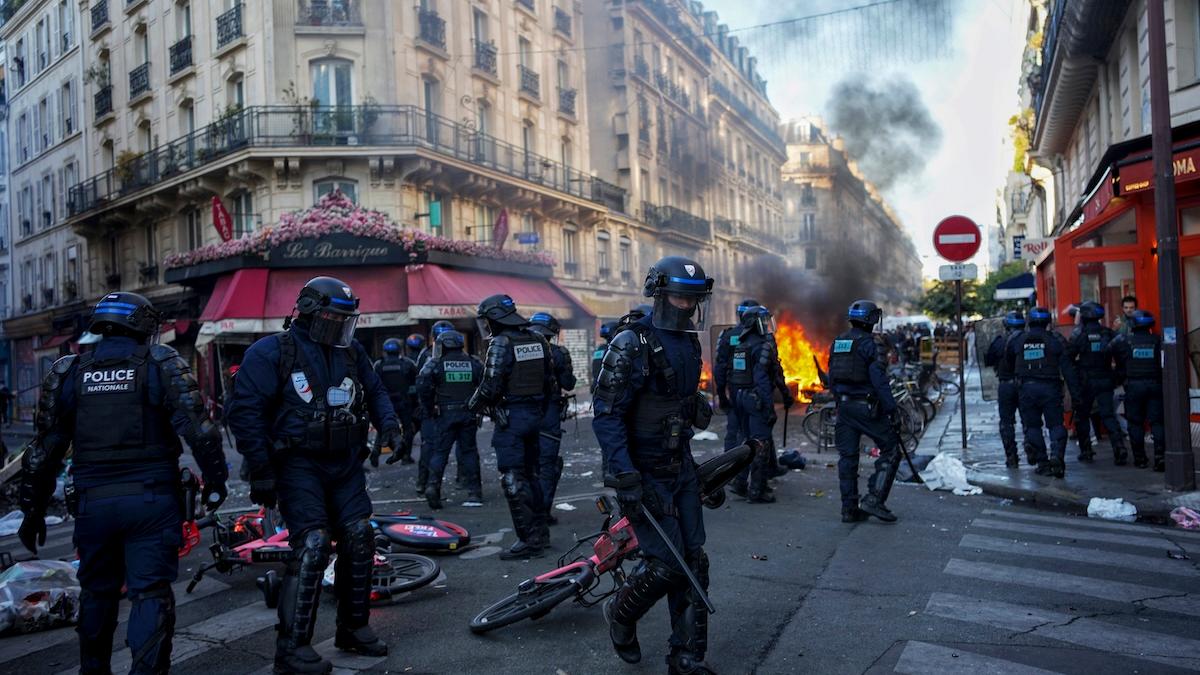
Protests, fires, cyberattacks, and helicopters overhead: No wonder our young adults are starting to fear the worst.
My children are becoming increasingly convinced that the apocalypse is on its way. I'm exaggerating, obviously, but perhaps not as much as I'd like.
Yesterday, Orange's mobile network went down across France. After the initial horror in our house at the lack of internet -- priorities, please -- my kids confidently announced that France had been hacked.
“Don't be silly,” was roughly my response, except it turned out not to be entirely ridiculous. Orange was indeed suffering what it called a “major technical incident,” with no suggestion that a cyberattack was responsible. But at almost exactly the same time, French government websites really were being taken offline because of a serious cybersecurity threat. And that, more or less, sums up the mood here rather well.
Last Saturday, around 550,000 people took to the streets of France. Most were peaceful, but the violence that broke out around the demonstrations was horrific: fires, looting, smashed shops, and running battles with police. The French newspaper Le Monde reported nearly 120 members of the security forces were injured and more than 1,200 people were taken into custody on that one day.
My children are young adults and their feelings about all this are complicated. In part, they are actually proud of their protesting peers. They love the fact that people their age care enough about the cost of living, their schools, and their future to get out onto the streets and make some noise. But underneath their temporary rebellion, they're frightened as well.
And this week, although I can't say I've been frightened, I have felt anxious. And actually, really sad, too. There have been curfews in parts of Paris and other cities, police everywhere, and helicopters overhead. Now we're waiting for “Act II” this Saturday, with the government promising a huge security deployment after admitting that it badly underestimated what happened last weekend.
When everything starts to feel connected
So when my children look at their phones and see France apparently in flames, followed by news of cyberattacks, extreme weather, wars, political turmoil and whatever else has gone horribly wrong before lunchtime, I'm finding it harder to respond with my usual maternal confidence that everything is going to be fine.
What I can say is: Hang on. Do we actually know that?
Because yesterday was a perfect example. The Orange network really did go down. Government websites really were taken offline. There really was a cyber threat. But those three facts did not add up to “France has been hacked.”
When one burning car becomes six
The same thing happens with the images we're seeing from the demonstrations. One burning car can appear on a phone from six different angles. The footage is real, but see it often enough and it begins to feel as though six cars are burning. Then it gets shared around the world, thousands of people comment on it, somebody announces that France is descending into chaos and suddenly one horrible incident has acquired an enormous and terrifying life of its own.
There is evidence that this affects us more than we might imagine. Psychologist Roxane Cohen Silver has spent years studying people's responses to traumatic events and found that:
“When you see repeatedly the event, online or on TV, you are effectively reliving it over and over again.”
After the Boston Marathon bombings, her research found that people who consumed six or more hours of related media coverage each day reported more acute stress than some people who had actually been there.
Well, that stopped me in my tracks.
I don't want my children to stop caring about what's happening around them, and I'm not going to tell them that the images they're seeing aren't real. They are. There were fires, shops were smashed, and people were hurt, and some of what happened was genuinely frightening.
What the camera doesn't show
But those images aren't the whole story either. Hundreds of thousands of people took part in demonstrations across France, most of them peacefully, yet unsurprisingly that's not the footage racing around the world. Nobody is endlessly reposting the protesters who walked, shouted, waved a placard, and went home again. It's the burning car, the smashed window, and the line of riot police that we see again and again, from different angles and on different accounts, until the most dramatic moments begin to feel like the entire event.
The camera doesn't show much of what is happening a few streets away either. While one part of a city may be frightening and chaotic, elsewhere people are still sitting down to eat, bottles of wine are being opened and, this being France, there will undoubtedly be some extremely heated arguments over exactly who is to blame for the current state of the country. Children will still need picking up, somebody will still have forgotten to buy the bread, and tomorrow morning the cafés will put their chairs back out.
None of that makes the violence less serious. It simply belongs in the picture too. And that's perhaps what I've been trying to give my children over the past few weeks: not reassurance that nothing bad is happening, because they can see perfectly well that it is, but a little sense of proportion when the worst moments begin to swallow everything else.
Another day of demonstrations is coming on Saturday, there will be an enormous police presence and I know we'll all be more alert to every siren and helicopter we hear. If things turn violent again, the images will be on our phones within minutes and, before long, all over the world.
I'll be watching too. I'll worry, because I'm a mother and apparently that particular job doesn't end when your children become adults. But I'll also try to remember what is happening beyond the camera's frame: people eating, talking, arguing, laughing, and getting on with their lives.
France may look as though it's in flames on our phones. Thankfully, that's not the whole country.