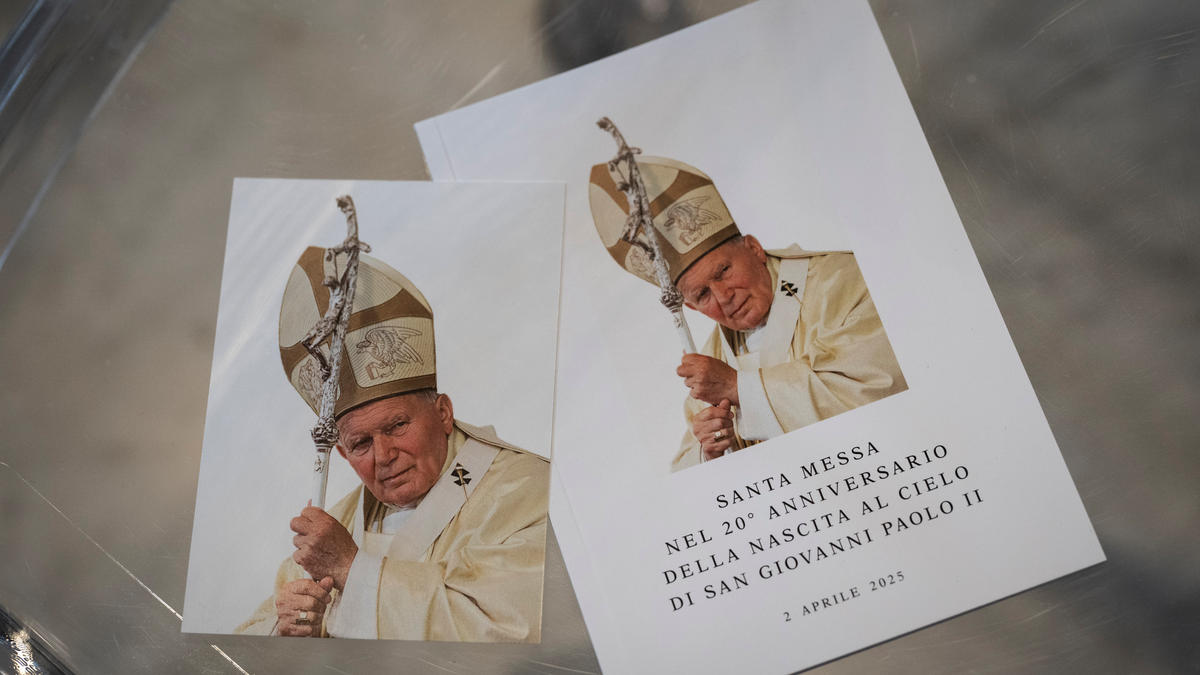
When Pope Francis canonized his predecessor, he called him “the pope of the family.”
When Pope John Paul II was canonized on April 27, 2014, Divine Mercy Sunday, Pope Francis called his predecessor “the pope of the family.” He mentioned that John Paul II himself once said he wanted to be remembered with this designation.
The title doesn’t need much justification, given that even the young Fr. Karol Wojtyla dedicated himself as a pastor, philosopher, and playwright to themes and issues surrounding marriage and family life.
Among his plays on the theme, the most famous is “The Jeweler’s Shop.” The second-to-last written (in 1960), it was adapted for film in 1988. Others were “Job” and “Jeremiah,” both written in 1940 during the Nazi occupation of Poland. “Our God’s Brother” was written between 1944 and 1950.
Karol Wojtyla’s last play, a psychological and metaphysical drama again with the theme of family, “The Radiation of Fatherhood,” was finished during the Polish bishop’s participation in the Second Vatican Council (1962-1965).
Elected and installed as pope in October 1978, one of John Paul II’s farthest-reaching legacies is his “Theology of the Body” – teachings given as the catecheses during his early papal audiences. In total, this “Theology” was delivered as 129 individual addresses between September 1979 and November 1984. Many are aware that they were based on his earlier work and writings, particularly “Love and Responsibility,” 1960, and “Person and Act,” 1969.
In 1980, he convened the Synod on the Family. Almost fifty years later, that synod is still bearing and ripening fruits. Direct results from this synod were: Pope John Paul II’s post-synodal apostolic exhortation presented in November 1981; the Charter of Rights of the Family, published in 1983; the creation of the Pontifical Council for the Family (which merged with the formation of the Dicastery for the Laity, Family and Life under Pope Francis in 2016); and the establishment of an institute for studies on marriage and family in Rome.
History you probably haven’t heard
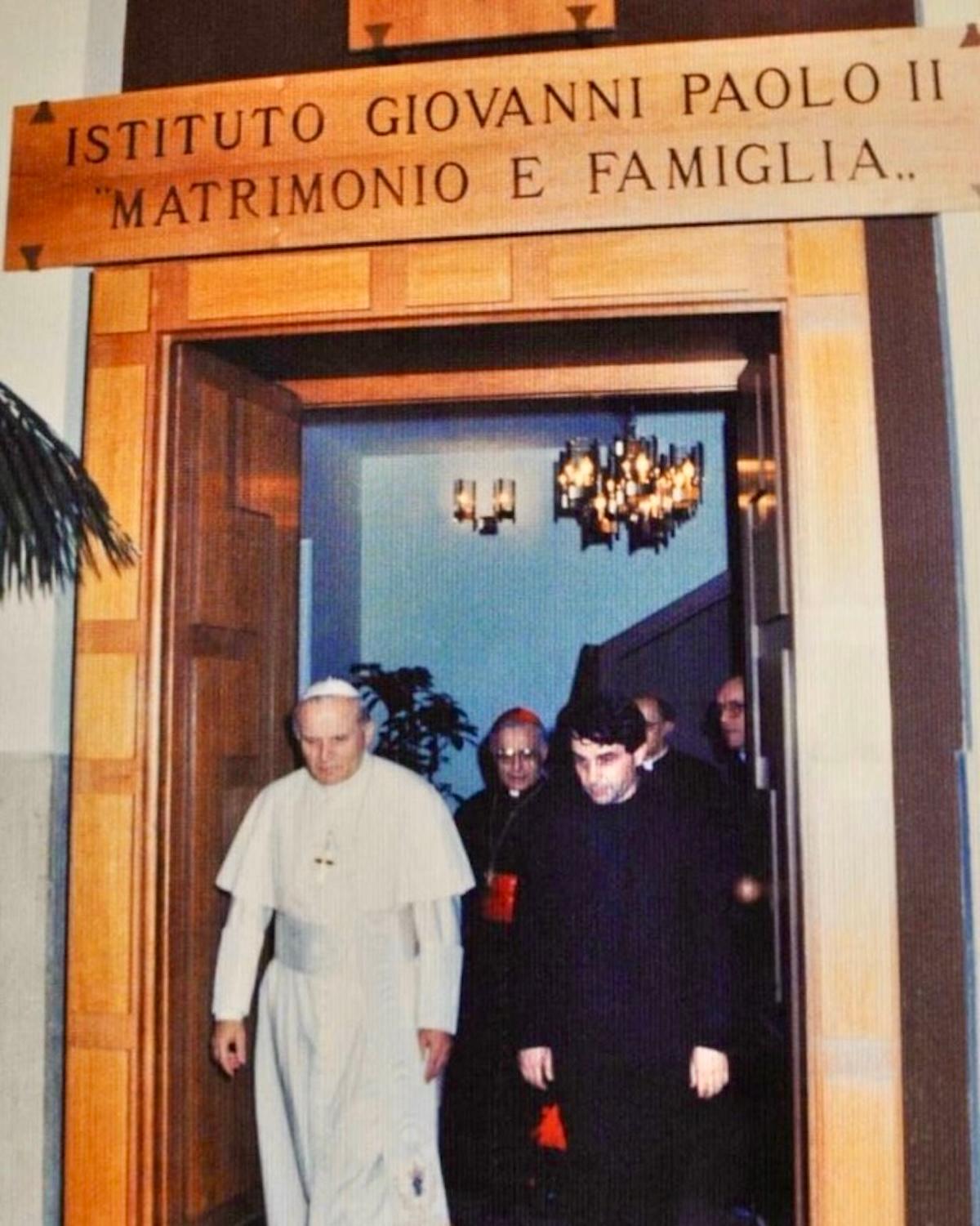
The Pontifical John Paul II Institute for Studies on Marriage and Family was conceptualized from direct recommendations of the 1980 synod. The assembled bishops had called for academic centers to specialize in studying and promoting Catholic teaching on marriage and family life.
The announcement for the initial foundation was planned for May 13, 1981, feast of Our Lady of Fatima, but God’s providence had other plans. As stated on the John Paul II Institute at the Catholic University of America’s website,
“because of the attempted assassination that day, the Institute’s Apostolic Constitution, Magnum Matrimonii Sacramentum, was instead given on October 7, 1982, the Feast of Our Lady of the Rosary. On that occasion the Institute was entrusted in a special way to the care of the most Blessed Virgin Mary under her title Our Lady of Fatima.”
After the formal establishment of the Rome site, or “session,” the first international session was founded in Washington, DC, in 1988.
It is not well known that the Knights of Columbus played a vital role in the U.S. session’s foundation. Then-Supreme Knight Virgil Dechant and Washington, D.C. archbishop Cardinal James Hickey petitioned the Vatican for an English-language campus in 1987 with the Knights providing the financial backing. The organization has continued their monetary support for necessary renovations and operational costs ever since.
Knight of Columbus Carl Anderson, a lawyer with a career in government and public policy, had been teaching as a visiting professor at the Rome location since 1983 and became founding vice-president and first dean of the D.C. session.
Anderson, who remains a Professor of Family Law there, later served as Supreme Knight from 2000-2021. Under his leadership, the Knights of Columbus not only modernized membership and outreach, he strengthened the organization’s initiatives in support of the family. He has written multiple bestselling books on the intersection of faith, family, and culture and was appointed to multiple roles with pontifical academies and councils under Popes John Paul II, Benedict XIV, and Francis.
Continuity you need to know
During the Francis pontificate, changes to leadership and programming for Rome’s JPII Institute were considered by some a shift away from the Polish Pope's original concept for theological and philosophical study of marriage and family in light of 20th- and 21st-century threats.
The D.C.’s session Vice President and Provost, Fr. Antonio López, FSCB, told Aleteia the changes had raised some “delicate questions.” But, he said, “It’s not the case that whatever has happened in Rome has happened everywhere else.”
The American iteration, in response to continuing demand for their programs in the early 2000s, pursued civil accreditation, which was achieved in 2011. They are considered a dual-structure institute granting ecclesiastical degrees as authorized by the Vatican’s Dicastery for Culture and Education, and licensed by the District of Columbia’s Higher Education Licensure Commission and civilly accredited by the Middle States Commission on Higher Education.
Fr. López, who has led the institution since 2010, noted that this status allowed them the freedom to continue doing what they have been doing from the beginning.
With only a Licentiate in Sacred Theology as the first degree offered, an American-style Master of Theological Studies in “Marriage and Family” was added in 1989 under Dean Anderson. Continued lay interest led Dr. David Schindler (Provost/Dean from 2000-2010) to inaugurate a non-ecclesiastical PhD in Theology with Specialization in Marriage and Family in 2004. He also introduced a “Biotechnology and Ethics” track to the M.T.S. program.
Current Dean Dr David Crawford shared with Aleteia,
Recent years were tumultuous and, in many ways, a confusing time. It is indeed also true that there was a change of leadership and faculty in Rome. Some potential applicants to Washington have been confused by this, or even a little wary.
“However, our leadership in Washington remains what it was. We remain dedicated to our mission, as reflected on our website, and our faculty remains the same.
Fr. López added, “To me, it’s important for people to hear that we are offering a very sound theology, moral and systematic … Emphasizing what we do speaks for itself.”
He shared that when graduates apply for jobs, their degree’s curriculum continues to be respected. “We are trying to do a humble, quiet work in which we just do our teaching and formation, and then our graduates will communicate what we do” in their own lives and ministries.
“Most importantly,” Dr. Crawford said,
we continue to believe that issues regarding marriage, family, and the person are inherently questions for theological and philosophical anthropology, before they can be sociological, economic, or psychological questions. Indeed, today’s cultural confusions have only intensified the need for this more fundamental approach. The question, for example, of whether men and women truly exist or are mutable places on an evolving spectrum cannot be resolved by social science. The question is fundamental, indeed metaphysical.
Theology and pastoral care that integrate love and truth
Dr. Crawford, a graduate of the Institute himself — as well as having prior English and Law degrees at respected universities — emphasized that the academic study of theology should be integrated with pastoral care.
This goal is original and basic to the mission of the Institute, both as conceived by John Paul II and as emphasized by his successors all the way up to Pope Leo XIV. Indeed, many of our graduates, whether priests, religious, or lay, devote their lives to pastoral care, and their formation at the Institute is central to their ability to do so.
However, pastoral care implies not only listening, but also imparting what has been given to us. It involves both love and truth. We cannot love except in truth. We believe that adequate pastoral care is therefore downstream from the fundamental questions addressed by theology and philosophy.
Hence, we stand firm in our dedication to the whole tradition of the faith and the Church’s intellectual life down through the ages, particularly with the inspiration of and light shed by John Paul II.
Reaping fruits far and wide
With a student body that is predominantly made up of laypeople, many graduates serve in parish and diocesan marriage and family ministry, with some in that capacity working for the U.S. Catholic Bishops Conference.
Others have put their degree to work through educational initiatives and pastoral passion projects. A few examples are:
- Valor Education exists to educate the whole person in authentic communities for a full human life. They lead a group of five, tuition-free K-12 classical charter schools and the Valor Institute for Studies in Person and Community to promote human flourishing.
- Life-Giving Wounds is a peer-led ministry whose mission is to help young adults and adults with divorced and separated parents give voice to their pain and find transformatitve healing in Christ.
- Springs in the Desert accompanies those struggling with infertility, offering a place for shared experiences and advocates for a broader understanding of what it means to be life-giving.
- The Humanum Project walks with youth and young adults to discover and live God’s design for identity, sexuality and relationships through a podcast, online courses and in-person events.
Given the importance of education — as a public institution and in the family — the American John Paul II Institute recently launched a new civil degree program. The Master of Arts in Catholic Liberal Education will enrich and prepare current and future teachers and academic leaders.
“Our MA in Catholic Education is designed, not just to give educators the tools they need to help children reclaim this inheritance, but also to ask the question, what is education? What is its anthropological meaning? Where and how does it occur, and in what forms? What is the educator’s basic vocation?" Dr. Crawford explained. "Our ideal candidate therefore is someone who truly cares about the faith, loves his or her students, and is eager to help them reclaim their inheritance.”
While the Institute is committed to the pedagogy of education that prioritizes presence and community, Dr. Crawford affirmed, “We try to realize our mission not only in our formal degree programs and academic work, but also in our many other events, such as conferences, lectures, continuing education courses -- some of which are held during the summer and others that are hybrid online and in-person."
Pope Leo XIV’s homily to close the recent meeting on the 10th anniversary of Amoris Laetitia calls for a steadfast and enduring love to be “the foundation of our families.” Pope Leo reflected on how marriage preparation courses are insufficient and quoted Pope Francis in saying that “for every couple, marriage preparation begins at birth” and that everything a young person experiences within the family should help to make that person capable of “a full and definitive commitment.”
For the thousands of men and women who want to heed this call but are unable to commit to graduate study in the nation’s capital, two particular resources can help:
Humanum Review: Issues in Family, Culture, and Science, is an online journal that addresses an annual theme, published quarterly as a free and accessible resource.
Fr. Lopez called the journal “beautiful and wonderfully done … We bring to bear the theological anthropology we teach to the main questions people have — what is a child, what is a home, how can parents deal with technology, what is play, what is work, what is power and authority.”
Art, music and movie reviews have been incorporated in recent years, “to help people look at things, to see what is the reality and then give criteria to judge those things.”
Historic writings entrusted to JPII at CUA
The Spanish priest also expressed his satisfaction that the Institute has acquired the copyright to the entirety of Karol Wojtyla/John Paul II’s works, including all the material from archives in Poland, both published and unpublished.
The English Critical Edition of the works of the beloved Polish Pope so far has three volumes available. The most recent, published in May 2026, is “Ethics and Its Sources in Nature and Revelation.”
Both Fr. Lopez and Dr. Crawford are on the editorial board, along with Carl Anderson, Nicholas Healy and Grzegorz Ignatik as Editor of Manuscripts. The Knights of Columbus are also supporters of this initiative, which is a partnership with the Catholic University of America as publisher.
The first part is a comprehensive English translation of Wojytla’s works, most of which were originally composed in Polish, with the hope of making available to a wider readership "what Wojtyła wrote and said as a philosopher, teacher, priest, and bishop before being elected pope.”
The second part will offer an English translation of St. John Paul II’s papal texts deemed most important from a theological or philosophical perspective. It will be organized thematically across a projected 15 volumes with each volume gathering all relevant texts regarding a topic such as Christology, marriage and family, the priesthood, the nature of the Church, or theological anthropology.
The future of humanity still passes by way of the family
As Pope John Paul II concluded in “Familiaris Consortio,” presented on the Solemnity of Christ the King, 1981,
It is therefore indispensable and urgent that every person of good will should endeavor to save and foster the values and requirements of the family. I feel that I must ask for a particular effort in this field from the sons and daughters of the Church …
“Christians also have the mission of proclaiming with joy and conviction the Good News about the family, for the family absolutely needs to hear ever anew and to understand ever more deeply the authentic words that reveal its identity, its inner resources and the importance of its mission in the City of God and in that of man …
John Paul II called on “all Christians to collaborate cordially and courageously with all people of good will who are serving the family in accordance with their responsibilities,” and invoked the Holy Family of Nazareth’s protection over the Christian family.
[This article is brought to you with the support of the Pontifical John Paul II Institute for Studies on Marriage and Family.]