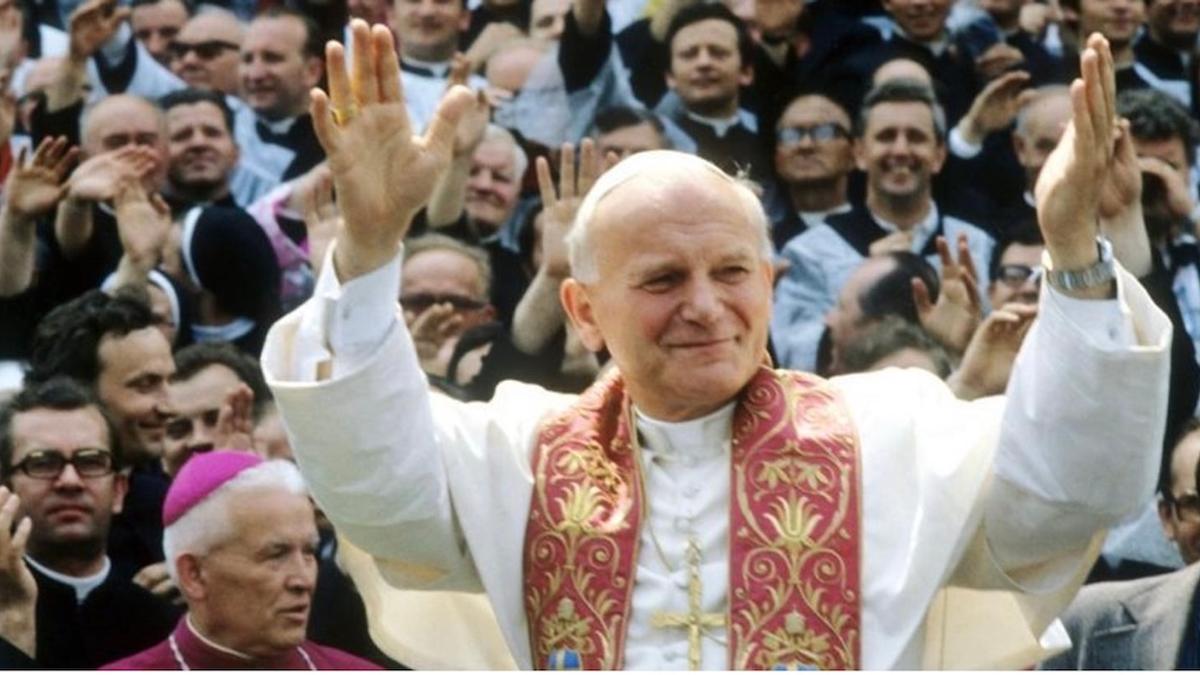
A few days after his inauguration on October 22, St. John Paul II held his first general audience, during which he spoke about the virtue of prudence.
Whenever a pope is elected, the whole world tunes in to see what he will say, especially during the first few days of his pontificate.
When St. John Paul II was elected, he spoke one of his most iconic lines during the Mass for his inauguration on October 22, 1978:
Do not be afraid. Open wide the doors for Christ. To his saving power open the boundaries of States, economic and political systems, the vast fields of culture, civilization and development. Do not be afraid. Christ knows "what is in man." He alone knows it.
He would return again and again to those two themes, encouraging people to "Be not afraid," and encouraging youth around the world to "Open wide the doors for Christ." He wanted everyone to be receptive to God's presence in their lives.
Virtue of prudence
A few days after his inauguration Mass, St. John Paul II held his very first general audience in St. Peter's Square. St. John Paul II's general audiences would become a focal part of his pontificate, especially when he later delivered a long series that would later become known as the "Theology of the Body."
What's interesting is that he spent his first audience continuing a series that was started by Pope John Paul I:
Today we must speak of another virtue, since I have learned from the notes of the late Pontiff that it was his intention to speak not only of the three theological virtues, faith, hope and charity, but also of the four so-called cardinal virtues. John Paul I wished to speak of the "seven lamps" of the Christian life, as Pope John XXIII called them. Well, today I wish to continue this plan, which the late Pope had prepared, and to speak briefly of the virtue of prudence.
He then proceeded to explain the virtue of prudence according to ancient philosophy as well as to St. Thomas Aquinas.
St. John Paul II then turned to those who were present at the general audience and invited them to reflect on whether or not they have led prudent lives:
I pray in order that, in this light, those who are listening to me will think now of their own lives. Am I prudent? Do I live consistently and responsibly? Does the program I am realizing serve the real good? Does it serve the salvation that Christ and the Church want for us? If a boy or girl student, a son or a daughter, is listening to me today, let such a person look in this light at the homework, reading, interests, pastimes, the circle of friends, boys and girls. If a father or a mother of a family is listening to me, let such a person think a little of the conjugal and parental commitments.
He then turned the question upon himself, reflecting on whether or not he is prudent as pope:
I, too, who am speaking to you, I the Pope, what must I do to act prudently?....What, then, must the new Pope do in order to operate prudently?
Prudence is an important virtue that we all need to reflect on, considering whether or not we are being careful about our actions, choosing those things that benefit our neighbor and the common good of all.