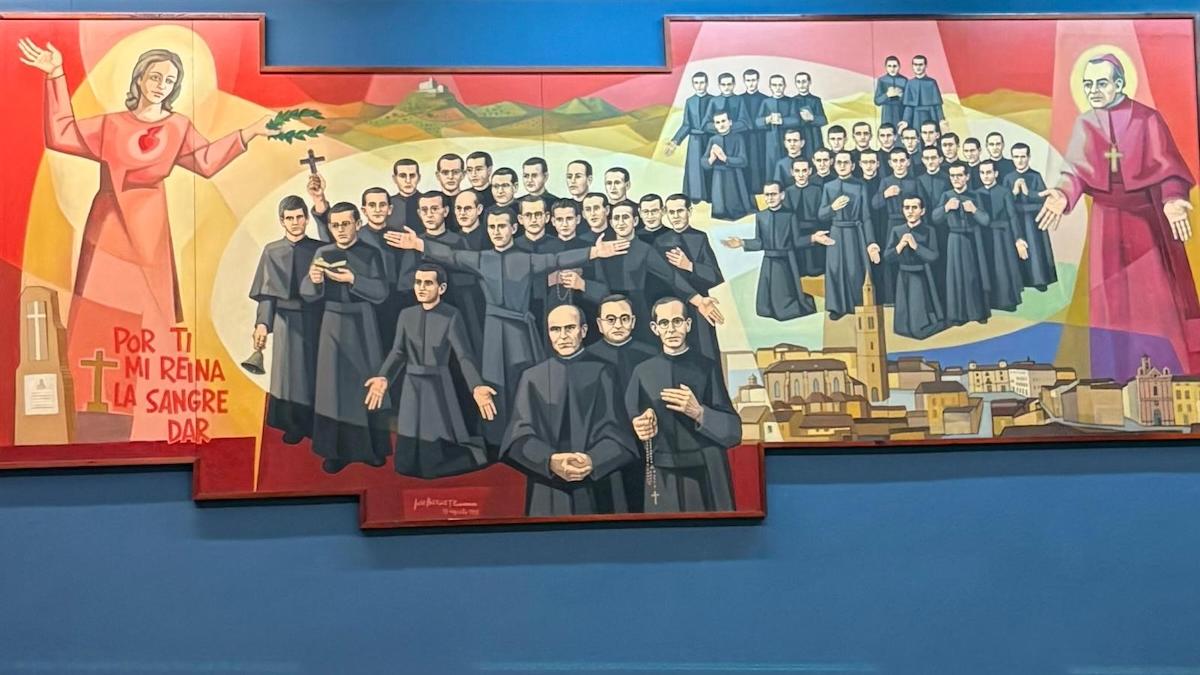
The Spanish Civil War alone accounts for hundreds of martyrs recognized by Rome in the past decade, alongside victims of Nazism and other persecutions.
When speaking about the saints, it's clear the word can mean several things (and we're not even talking about sports teams!) A saint is anyone in heaven -- even, by some usages, the angels. A saint is all of us in the Communion of Saints, and a saint is a soul in heaven who has gone through a process of examination of his or her earthly life and death, and is held up as an example for us all. For that last group, Saint becomes part of their official title, like St. Francis and St. Thérèse.
Among the saints are many, many martyrs. For the Catholic Church, a martyr is someone who bears witness to Christ by dying rather than renouncing the faith. Martyrs were particularly numerous in the first centuries of Christianity, when believers faced persecution under the Roman Empire. They became models of faith who helped shape the modern understanding of sainthood and continue to inspire the faithful today.
Over the centuries, the Church developed formal procedures for recognizing saints, and martyrdom is no longer the main way to be recognized as a canonized saint. Today, candidates for sainthood undergo a process that can lead to their recognition as venerable, blessed, and finally saints.
In the case of martyrs, recognition that they were killed out of hatred for the faith makes beatification possible without recognition of a miracle. Canonization ordinarily requires a miracle attributed to the blessed martyr’s intercession, although exceptions are possible.
Martyrs far outnumber other candidates
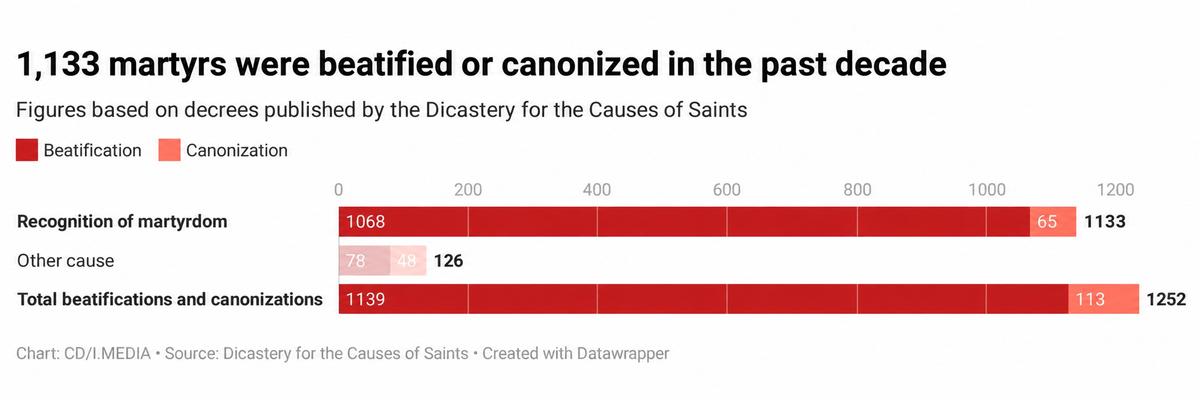
The Dicastery for the Causes of Saints is the body within the Holy See in charge of overseeing this process. Over the past decade, it has approved causes involving 1,068 martyrs.
By comparison, there have been just 78 beatifications in other causes, involving the recognition of a miracle, sometimes in the special category of the “offering of life.” This refers to a voluntary sacrifice made in keeping with the Gospel, but unlike martyrdom, it doesn't require the person to have been killed out of hatred for the faith.
There have also been 65 cases of canonization involving martyrs over the same period. Overall, martyrs account for roughly 10 times as many beatifications and canonizations as other causes.
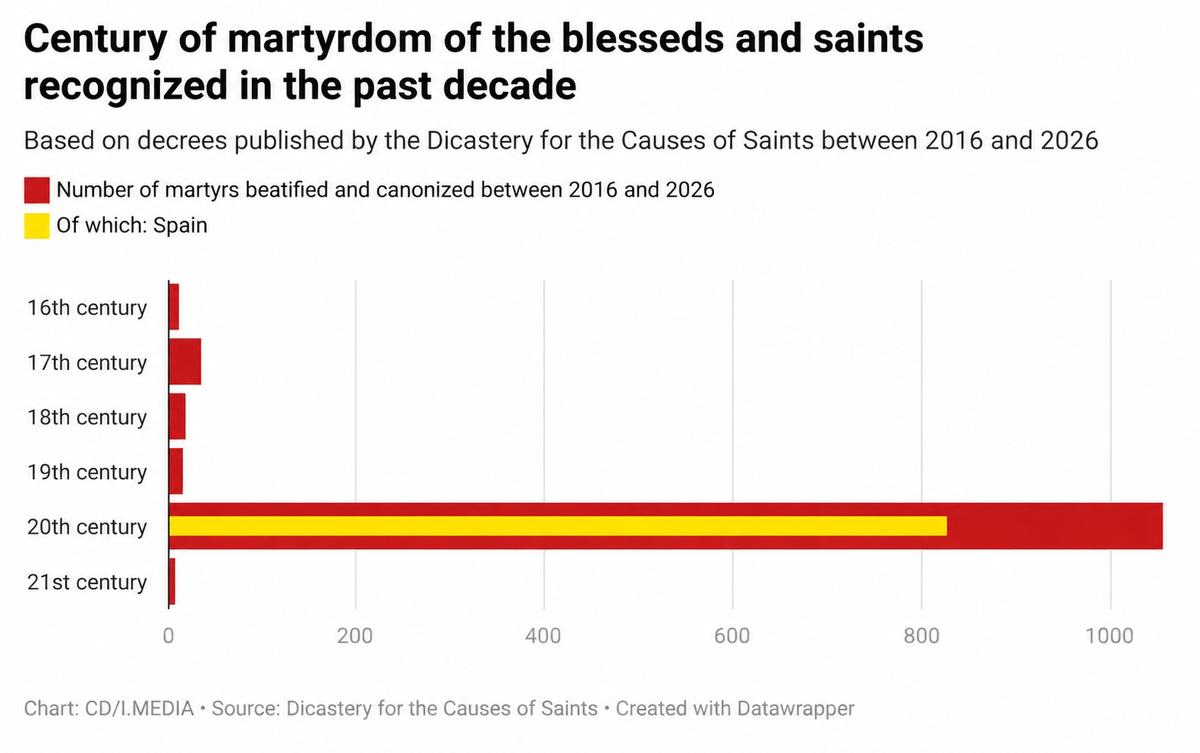
The explanation lies in the fact that some of the bloodiest periods of Church history are actually recent history, particularly the 20th century. World War II and the Cold War produced numerous martyrs. Nonetheless, the greatest number of those recognized came from the massacres carried out by Republican forces during the Spanish Civil War, which began in 1936.
Over the past 10 years alone, the Spanish Civil War accounts for 821 martyrdom cases approved by Rome for beatification, although none of these martyrs has yet been canonized. The causes are submitted gradually by the dioceses and religious orders concerned, often in groups that include more than 100 people.
The martyrs of the 20th century
Even excluding Spain, the Dicastery for the Causes of Saints has approved the causes of 228 martyrs from the 20th century over the past decade, again often in groups. They include victims of Nazism, communism, and conflicts surrounding decolonization, such as the martyrs of Algeria, among them the Trappist monks of Tibhirine.
The Holy See has also recognized 71 cases involving martyrs from earlier centuries. These include victims of the religious wars of the 16th century, the French Revolution in the 18th century, and persecution during the 19th century.
Three other cases concern martyrs killed around the beginning of the new millennium: Italian missionary Fr. Nazareno Lanciotti, murdered in Brazil in 2001; Congolese layman Floribert Bwana Chui, killed in Goma in 2007; and Sr. Maria Laura Mainetti, murdered in Italy in 2000.
Martyrs from every continent
Over the past decade, Rome has beatified or canonized martyrs from around the world. Oceania is represented by St. Peter To Rot, a catechist from Papua New Guinea killed by Japanese occupying forces in 1945 and canonized in 2025. Eastern Europe is particularly well represented, especially Albania and Poland, where Christians suffered persecution under communist regimes during the Cold War. France accounts for 76 martyrs, including the 16 Carmelite nuns of Compiègne, guillotined during the French Revolution and canonized in 2024, and 50 Catholics who died as a result of Nazi persecution.
During Pope Francis’ pontificate, the Church also recognized numerous martyrs who suffered under authoritarian regimes in Latin America. One of the most prominent was St. Óscar Romero of El Salvador, canonized in 2018.
Other causes involved missionaries killed in Asia and victims of Islamist violence, including the martyrs of Algeria.
In 2023, Pope Francis also announced that the 21 Coptic Orthodox Christians murdered by ISIS in Libya in 2015 would be included in the Roman Martyrology, the Catholic Church’s official list of saints and blesseds. Although they belonged to another Christian Church, their recognition represented a powerful gesture of ecumenism.