The five Spanish martyrs who lost their lives ministering to the Guale people will be beatified on October 31. Here's how to visit their mission today.
The story of the Georgia Martyrs has only recently begun to receive widespread attention. Long before the English established their colonies along the Atlantic seaboard, and nearly two centuries before the founding of the United States, Spanish Franciscan missionaries brought the Gospel to the native Guale people along what is today the Georgia coast.
In September 1597, five of these friars gave their lives for their faith. Today, they are remembered as the Georgia Martyrs.
Although I was born and raised in suburban Atlanta and entered the Catholic Church in 1995, I had heard virtually nothing about the Georgia Martyrs until recently. Curious to learn more, I recently traveled to the coast to retrace their footsteps, experience the landscape they encountered, and discover what, if anything, remains of their early Catholic missions.
A unique landscape
As one approaches Savannah, it is impossible not to be struck by how different coastal Georgia is from the rest of the state. Georgia, roughly the size of England and Wales combined, is remarkably diverse. To the north rise the southern reaches of the Appalachian Mountains, while Atlanta lies in the rolling hills of the Piedmont. Central Georgia is characterized by gently rolling farmland, pine forests, and broad river valleys. Farther south, the land gradually flattens into the vast Atlantic Coastal Plain.
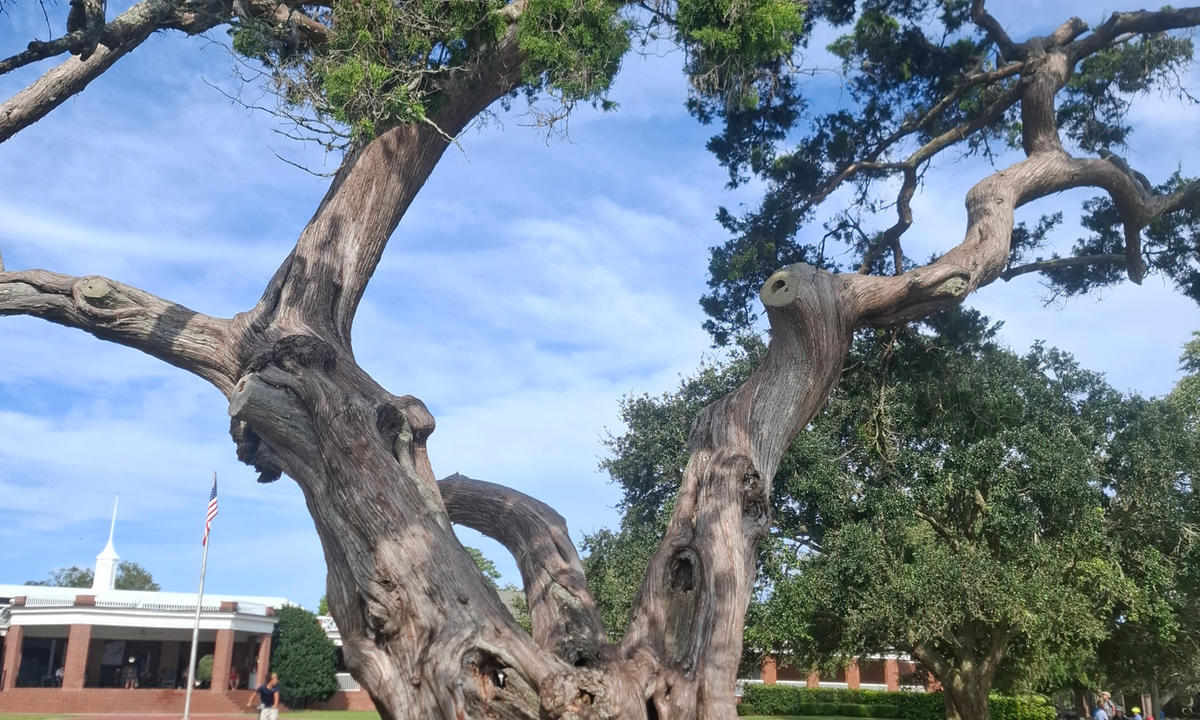
The coastline itself is another landscape altogether. Ancient live oaks, their sprawling branches draped in Spanish moss, give the landscape an atmosphere reminiscent of Louisiana. Because of the low elevation, tidal marshes, winding rivers, and saltwater estuaries stretch for miles.
These wetlands play a vital ecological role, serving as nurseries for fish, shrimp, crabs, and other marine life, while providing habitat for countless species of birds. They also help filter pollutants from the water and protect the coastline from flooding and storm surges. Offshore, a chain of barrier islands provides an additional layer of protection from the Atlantic Ocean.
Today, the area's natural beauty attracts vacationers to places such as St. Simons Island and Jekyll Island. Indeed, during the late 19th and early 20th centuries, Jekyll Island became an exclusive winter retreat for some of America's wealthiest families, including the Rockefellers, Vanderbilts, Morgans, and Pulitzers. Their magnificent cottages and the historic Jekyll Island Club remain reminders of this extraordinary chapter in American history. Others come for the area's excellent saltwater fishing.
Life four centuries ago
But my thoughts were drawn much further back in time, to the late 1500s, when a handful of Spanish Franciscan friars arrived in this remote and unfamiliar territory.
My first impression was how difficult it must have been for the European missionaries to adapt to the environment. Summers here are brutally hot and humid, with mosquitoes, biting flies, and other insects everywhere. To men accustomed to the civilized towns and cities of Spain, the wild coastal landscape, beautiful as it is, would have presented formidable challenges.
The Indigenous Guale people, however, had inhabited this region for centuries and were well adapted to its conditions. They lived in established villages consisting of houses constructed from wooden poles interwoven with branches and coated with clay, a technique known as wattle and daub. Roofs were typically thatched with local vegetation. Their communities often centered around a large council house, where leaders gathered to conduct important affairs.
The Guale sustained themselves through agriculture, cultivating crops such as corn, beans, and squash, while also fishing, gathering shellfish, and hunting. Dugout canoes allowed them to navigate the intricate network of tidal rivers, creeks, and marshes.
The arrival of the Spanish Franciscans
The Spanish presence in this region began with the establishment of St. Augustine, Florida, in 1565, making it the oldest continuously occupied European-founded settlement in what is now the United States. (It is home of the Shrine to Our Lady of La Leche.) From this outpost, Spanish missionaries gradually ventured northward into the territories of the Timucua and Guale peoples.
By the late 16th century, the Franciscans had established a network of missions along the Georgia coast. These were generally modest establishments, consisting of a simple chapel, a residence for the friars, and the surrounding Indigenous village. Unlike the grand stone churches and monasteries of Europe, the mission buildings were constructed largely from local materials such as wood, clay, and thatch.
The martyrdom of five Franciscans
For a time, the missions flourished. But in September 1597, a violent conflict erupted. Fr. Pedro de Corpa, stationed at the mission of Tolomato, had challenged a young Guale leader named Juanillo, who wished to take a second wife. Although Juanillo had been baptized, he resisted the Church's teaching on monogamous marriage. Among the Guale, chiefly succession followed the maternal line, and traditional marriage practices were closely connected to political authority.
When Fr. Pedro refused to compromise, Juanillo and his followers killed him. The violence quickly spread to other missions, where four more Franciscans — Blas Rodríguez, Miguel de Añon, Antonio de Badajoz, and Francisco de Veráscola — were also martyred.
The uprising devastated the Franciscan missions, though it did not bring missionary activity to an end. The Spanish eventually reestablished their presence, rebuilding missions and continuing to evangelize the Guale throughout much of the 17th century.
The final collapse came decades later, as English colonists expanded southward from Carolina. Raids by Native American groups allied with the English, along with pirate attacks and growing political instability, gradually forced the Spanish and their Christian Guale allies to abandon their settlements. By the mid-1680s, the Spanish mission system along the Georgia coast had effectively disappeared, and the surviving Christian communities retreated southward toward Spanish Florida.
A visit today
Today, virtually nothing remains visible of these early missions. Their wooden churches and dwellings have long since vanished, reclaimed by the forests and marshes.
Of the five Franciscans, it is known that two — Fr. Miguel de Añon and Br. Antonio de Badajoz — were killed at the mission of Santa Catalina de Guale, on what is today St. Catherines Island. Although archaeologists rediscovered the mission in the 1980s, the island is privately owned and its interior is closed to the general public.
The other three martyrs died at missions along the mainland coast and its surrounding waterways. Fr. Pedro de Corpa was killed at Tolomato, believed to have been located somewhere near present-day Darien. Fr. Blas Rodríguez died at Tupiqui, possibly near Eulonia, while Fr. Francisco de Veráscola was killed at Asao, a mission thought to have stood near the Altamaha River or perhaps on St. Simons Island. The precise locations of these three missions remain uncertain.
Darien: A monument to the martyrs
Fortunately, there are several places along the Georgia coast that still preserve the memory of these early missionaries and the people among whom they lived.
The first site is the small coastal town of Darien, roughly midway between Brunswick and Savannah. Here stands a charming wooden Catholic church dedicated to the Nativity of Our Lady. On its grounds is a striking bronze monument honoring the five Franciscan martyrs, created by renowned Canadian sculptor Timothy Schmalz and dedicated in 2021.
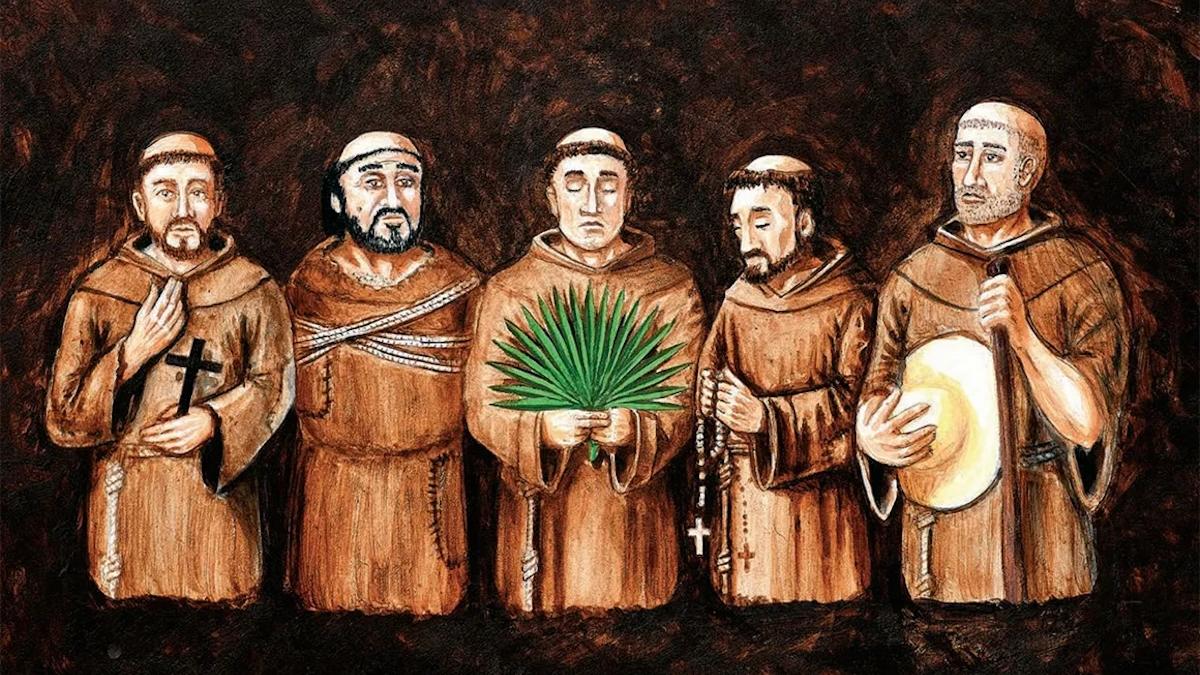
The sculpture depicts the five friars together in a dramatic bronze relief, their figures united in a single composition. It is based on a painting of the martyrs created by Florida artist Dan Nichols in 2014.
Following the tradition of Christian iconography, each friar is depicted with an object associated with his martyrdom.
From left to right, Pedro de Corpa holds a cross, recalling his death on the feast of the Exaltation of the Holy Cross; Blas Rodríguez is bound with his Franciscan cord; Miguel de Añon holds a palmetto branch, symbolizing martyrdom; Antonio de Badajoz carries a rosary, recalling the prayers offered before his death; and Francisco de Veráscola holds a hat and staff, recalling his final journey and the bloodied hat found after his murder.
Fort King George State Historic Site
Just a short drive away from the church stands Fort King George State Historic Site, overlooking the Altamaha River. Visitors can explore the reconstructed fort, a museum explaining the region's Spanish and Guale history, and a recreation of a traditional Guale roundhouse. Walking through the grounds offers a glimpse into the world encountered by the Franciscan missionaries more than four centuries ago.
For a more detailed visit
The Diocese of Savannah has partnered with local companies and associations for a more in-depth exploration. At the Fort King George State Historic Site in Darien, ask for ranger-led tours focusing on the history of the Indigenous Guale people and the Spanish Franciscan missionaries. Visitors interested in the Georgia Martyrs can arrange a specialized tour by calling 912-437-4770.
For a different perspective, several local charter companies offer boat excursions through the Lower Altamaha River Delta, allowing visitors to experience the waterways much as the missionaries would have encountered them more than 400 years ago. Georgia Tidewater Outfitters, for example, offers boat tours that approach Fort King George from the river, providing a unique view of this historic landscape.
For more information, visit: www.thegeorgiamartyrs.org.
With their beatification on October 31, 2026, the Georgia Martyrs are finally receiving the recognition they deserve. My hope is that more people will discover their story and perhaps make their own pilgrimage to this beautiful stretch of the Georgia coast, where five humble friars sacrificed their lives for Christ.