A look at the Second Edition of the breviary: a gift that leads from reading prayers to an incarnational prayer experience, for any lay or consecrated person, but especially for priests.
In October 2025, the USCCB announced that Ascension Press and Word on Fire had been chosen to publish the revised Second Edition of the Liturgy of the Hours.
In June 2026, Aleteia published a piece about Ascension Press’ version of the Second Edition, interviewing their commissioned artist. Here we present Word on Fire’s version, thanks to commentary from some of their project’s design team.
The Word on Fire publication is running an “early bird discount” of $140 off plus free shipping through October 31. Ascension Press has multiple options available for pre-order, with a 5% savings if the full 4-volume bundle is purchased.
A brief history of prayer through the ages
For centuries, Christians have practiced structured prayer. The Acts of the Apostles references the community praying together and testimony indicates certain hours that Christians would gather to do so. The practice was a natural continuation of the Jewish tradition of praying the Psalms at specified times of the day, a “liturgy” throughout the hours of the day.
The practice was further developed and integrated into monastic life by St. Benedict in the sixth century. As other prayers, hymns, and readings were added, multiple books were needed.
The Breviary — the word brevarium was introduced in the 11th century — laid out the format and texts of the practice and consolidated the structure, also adapting to the reality of non-monastic priests. After the Protestant Reformation, the Council of Trent reformed the breviary, consolidating the various congregational breviaries into one.
The Roman Breviary, also known as the Divine Office or the Liturgy of the Hours, was a shortened, less cumbersome compendium promulgated in 1568. With minor changes over the decades, this was the daily prayer commitment of priests and religious until a major reform under Pope Pius X in the early 20th century that restructured certain elements, particularly the 150 Psalms.
A new translation of the Psalms from Hebrew came under Pope Pius XII, implemented by Pope John XXIII in 1960. But it was the Second Vatican Council that desired a return of the Divine Office as the prayer of the whole Church. Revisions were made and it was published as the Liturgy of the Hours in 1975.
The “hours” have held various forms over this history: three times daily based on early Jewish practice, later seven or eight, following St. Paul’s admonition to the Thessalonians to “pray without ceasing” (1 Thessalonians 5:17).
Per the USCCB online tracking of the project’s progression, “In November 2012, the U.S. Bishops voted to revise the translation of the Liturgy of the Hours in light of the Roman Missal, Third Edition and the 2001 Vatican document Liturgiam authenticam. The approval process was completed in November 2024, and on May 29, 2025, the USCCB transmitted the completed manuscript of the Liturgy of the Hours, Second Edition to the Holy See for confirmation.”
Scrolling through the various elements of this “major undertaking,” one can appreciate and value the role of the Liturgy of the Hours.
A focused feel for the pray-er
Bishop Barron offered a video introduction to Word on Fire’s Liturgy of the Hours publication. “With this edition, our goal is to spark a renewal in this great tradition, drawing it into the heart of Catholic life, into our families, schools, parishes and communities.” He called it one of Word on Fire’s “most ambitious publishing projects to date."
The team dedicated to this project was very aware of the reality of smartphones and digital addiction when they set out to design something beautiful, attractive, and aligned with the dignity of the Liturgy of the Hours as “the heartbeat of the Church,” a sacramental and an “extension of the Mass.”
In the video, Fr. Blake Britton, STL, and a contributor to Word on Fire, shared, “In a religion that is sourced on the Incarnation, there is a necessity to ensure that particular aspects are set aside that are consecrated entirely to the glory of God … this includes a text where its only purpose for being is prayer.”
The introduction of smart phones and development of apps like iBreviary and Laudete has introduced thousands of laity to this prayer of the Church. These versions have been used by priests and seminarians as well, often when traveling. The quality of the person’s prayer is of course not dependent on the source used. But Fr. Britton commented his appreciation for how Word on Fire’s version brings the reader a sense of the mystery being embodied.”
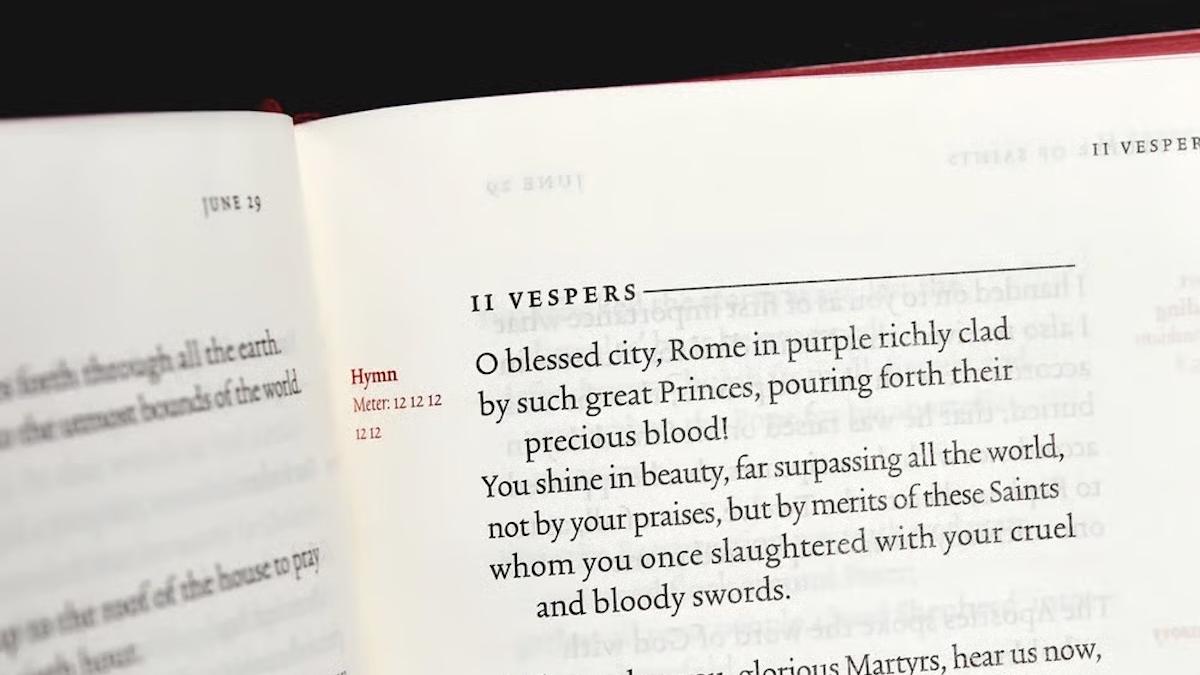
Great attention to the page layout has been given, using the analogy of a tidy desk. Elements like moving rubrics to a sidebar allow for a decluttered look and easier focus. The team even researched a typeface that aligns with how words are read as shapes rather than combinations of letters in contrast to the previous edition’s font.
Nicholas Fredrickson, the Creative Director, told Aleteia, “When you think about the level of focus you can bring to your work when you don’t have stacks of paper scattered about your desk, your pencil is nowhere to be found, etc, we brought that thinking to how we could improve the overall feel the pray-er would experience.
"With the current volumes, the text is crammed from the inside gutter of the page all the way to the outermost edges. You’re constantly forced to stress the binding in order to make out the words in the middle.”
Wanting to organize the content “to enhance the prayer experience,” Fredrickson commented,
“We’ve reorganized the structure to emphasize the prayers more. We’ve also allowed for more margins to ease that tension.
"While some may see margins and think wasted space, they aren’t considering the value of the experience. Would these same people criticize Notre Dame de Paris for not inserting five levels of offices to fill the “wasted space” between the tile floors and the high vaulted ceilings?
“Our approach is cathedralic in many ways, with each 'architectural' choice, however small, being called to serve an end — deeper communion with our Lord.”
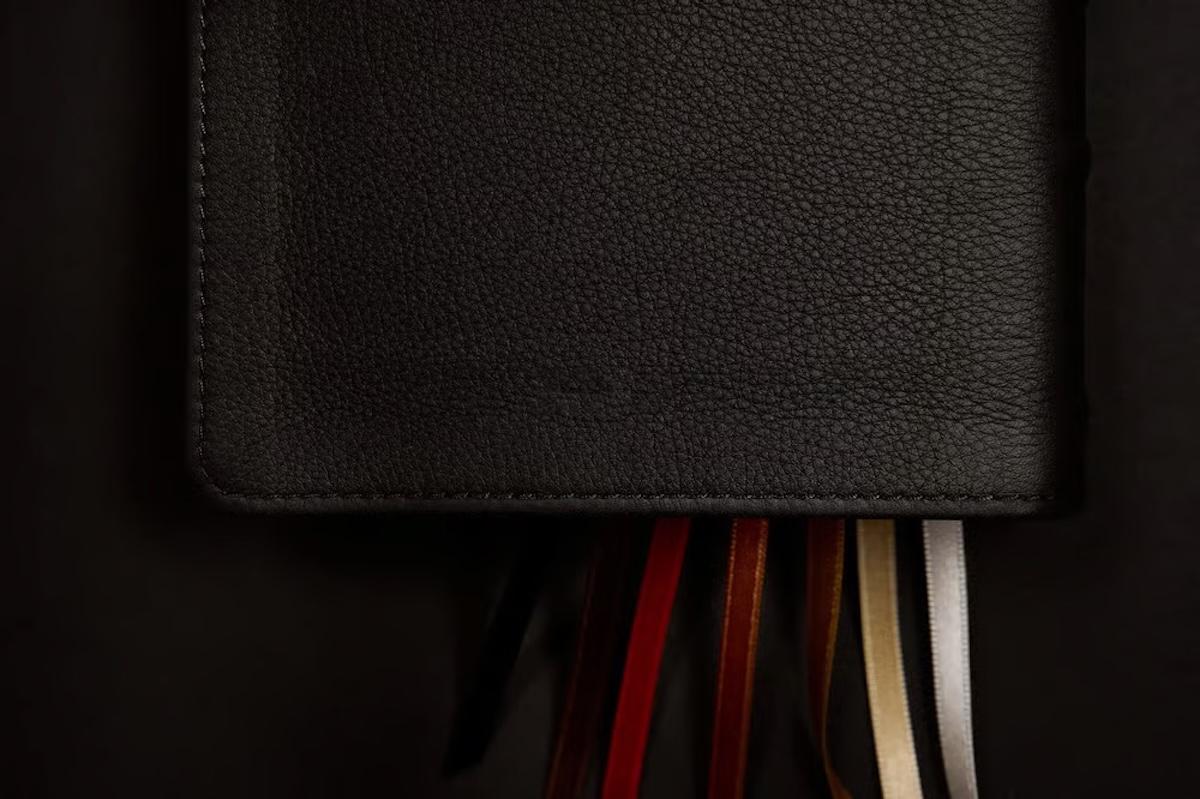
Word on Fire was diligent about choosing their partners for the publication — paper producers based in France, a multi-generational leather tannery that specializes in bookbinding with the material coming from Spain and Portugal, printers in Italy who also bound the books and gilt the page edges — craftsmen chosen for each part of the process.
They have selected dozens of images from the artwork of Gustave Doré, a 19th-century French artist long admired by Word on Fire. “He was prolific and has been able to unlock stories for so many people over the last 150 years, ranging from Dante’s Divine Comedy to a plethora of biblical scenes,” Fredrickson said. “We wanted to bring in that historical tradition, and in some ways, provide a subtle link to our WOF Bible which thoroughly integrates his work.”
In Fr. Britton’s words, there was “room for improvement and growth” in the physical breviary he has prayed with five times daily over 10 years as a priest. “I believe that Word on Fire has answered that call.”
This printing of the Liturgy of the Hours was designed to be a gift -- a gift that leads from reading prayers to an incarnational prayer experience, for any lay or consecrated person, but especially for priests.
Executive Director of Publishing Brandon Vogt shared with Aleteia about Word on Fire’s ongoing commitment to seminarians, especially with Bishop Barron’s dedicated ministry as a seminary formator and director before his appointment as bishop.
“As we were preparing this new edition of The Liturgy of the Hours, we recognized this prayer is a crucial part of seminary formation but also that many seminarians, without parish support or book stipends, would find it difficult to afford the new books. So, we determined to find a way to help.
Thankfully, one of our faithful supporters stepped up in an extraordinary way to provide the needed funds. He originally agreed to cover free book sets for 4,000 seminarians. However, after an explosion in new seminarians -- most seminaries have seen major year-over-year rises -- the supporter bumped up his gift to now cover 5,300 seminarians, the current total.
Every seminarian in the US will now receive the full, four-volume set of Word on Fire’s Liturgy of the Hours, Second Edition, beginning with the initial volume in January 2027. We’re so proud that America’s future priests and bishops will be using our beautiful edition.”
The design team also had in mind the lay Catholics who participate in the same daily rhythm of prayer that forms the Church’s future priests. In Bishop Barron’s own words, “This is a spiritual investment in the future of the Church.”