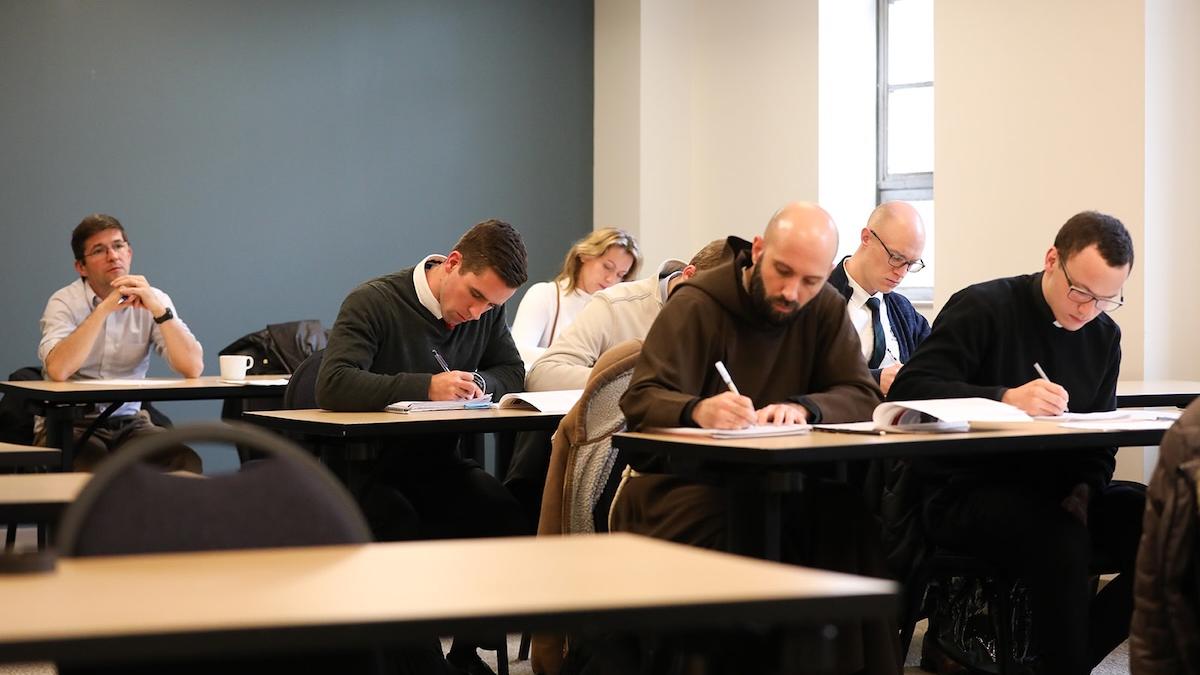
Pope John Paul II envisioned an institute that would study marriage and family in the varied languages and regions of the world. In Washington, DC, one of those institutes works in the context of American culture.
Note: November 1, 2026, is the 80th anniversary of Karol Wojtyla's ordination to the priesthood. On All Saint's Day in 1946, he became a priest of Christ, crowning years of preparation and beginning one of the most instrumental priestly ministries of the 20th century. One element of his legacy is the Pontifical John Paul II Institute for Studies on Marriage and Family. This article takes a look at the Institute's site in Washington.
~
In response to a recommendation from the 1980 Synod of Bishops, the Pontifical John Paul II Institute for Studies on Marriage and Family opened in 1982 (read more about that here). The Institute’s first international site, or session, opened in the United States six years later, in 1988. Later iterations spread through Mexico, Spain, Brazil, Benin, and India in the 1990s and the 2000s, and now also include additional, though smaller, associated centers and programs.
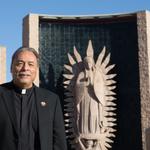
In the US, the current Vice President and Provost, Fr. Antonio López, FSCB, told Aleteia that John Paul II’s vision included “a session of the Institute in each language area.” He also explained that “every session of the Institute outside of Rome is very different.” Each operates as a “fully formed institute,” branching from one root, but allowing them to address and adapt to the needs of each global region. Some of the sessions are more catechetical in nature, while the Washington session’s programs are rigorously academic.
Fr. López, who also teaches Systematic Theology, came to the Institute’s American session in 2002, after completing his doctoral studies at Boston College with a thesis on the metaphysics of gift. A priest of the Priestly Fraternity of the Missionaries of St. Charles Borromeo, he also studied in his home country of Spain and at Rome’s Gregorian University.
He pictures the network of Institutes as a “communio — we are living the same differently.”
He says it’s important for him that the D.C. program remains “in the American context … because theology is also at the service of helping the faith of the people …” This is of course always “a difficult balance.”
The questions of our time, and their answers
“We listen to the questions of our time, the questions that we and the people have,” he said. And for him, working in the United States means taking into account Americans’ particular attentiveness to person, freedom, and rights – the right to life, the right to privacy, etc.
In our culture, questions of truth, he explained, tend to be hidden behind questions of right, understood in the common legal sense. And this requires looking at the question on the meaning of “person” since the person is the holder of rights and what “rights” mean depends on what we mean by person — “either a gift given and a call to respond to what is true, or a self-made individual.”
Anthropological questions can never be ignored and, along with the question regarding God, are at the heart of most of everything else, the priest affirmed. Without this foundation we easily “transform religion into the product of our own choosing.”
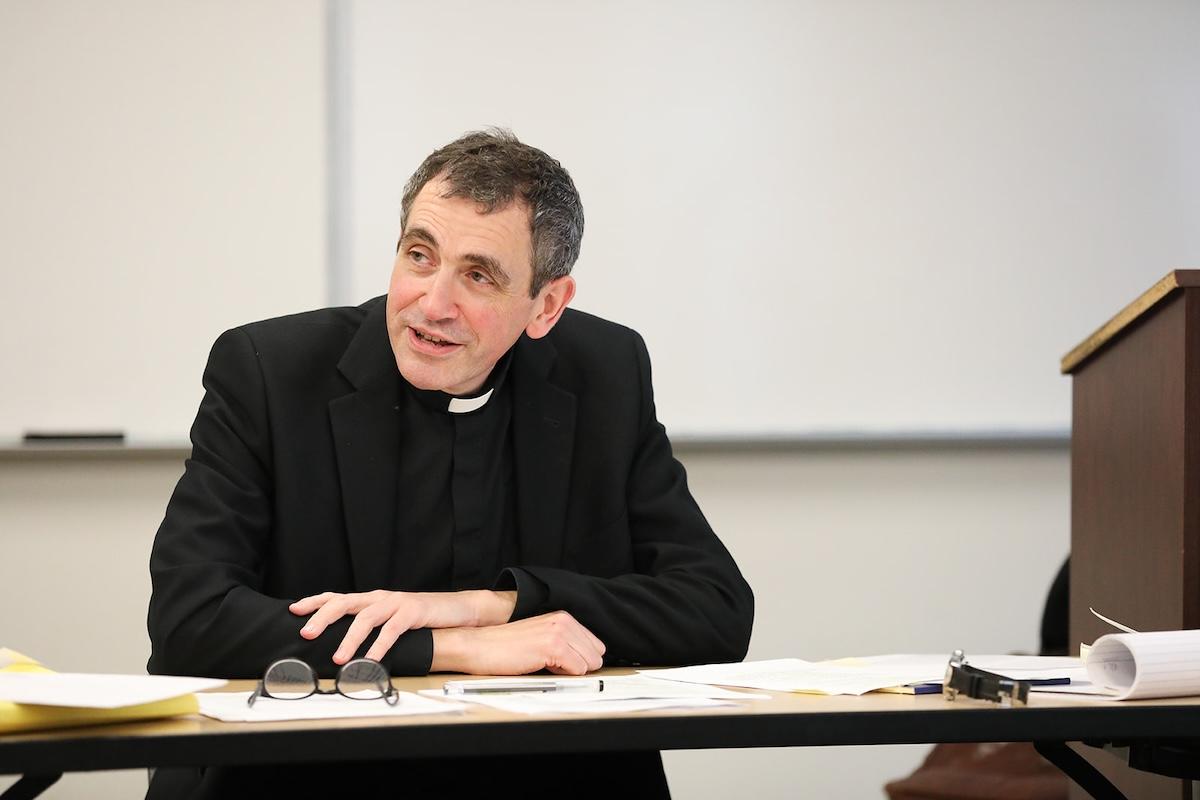
“Cultural issues are central for the work” of the Pontifical John Paul II Institute for Studies on Marriage and Family, their website states.
In particular, “the culture of modernity as developed in America” and the study of this in light of Church history and Christian thought is integral to the “culture of life” the JPII Institute seeks to help generate. This culture recognizes marriage and family as “a way of life” and approaches related moral questions “in the light of the order of being itself: that is, within the context of the transcendentals — truth, goodness, and beauty — all of these integrated into the ‘liturgy,’ or ‘work of glory,’ that John Paul II insisted is “the fundamental destiny of every creature, and above all of man” (Crossing the Threshold of Hope, 18).
“To me,” Fr. López summarized, “at the heart of the Institute is this: John Paul II’s reading of Gaudium et Spes, number 22 — that Christ reveals God to man and man to himself. And, further, that he reveals the mystery of God and the mystery of man, in terms of love … That’s what unifies all the things that we do.”
“Conceiving marriage and the family, and all the moral problems associated with these, within an entire vision of reality,” is stated as the distinguishing feature of the Institute’s study of marriage and the family.
After graduation, then what?
How does this get lived out by JPII students and scholars in their personal, family, and vocational/work lives after graduation?
“The majority of our students have always been laypeople,” Fr. López shared. Of the current 85 students, only one-quarter are religious and priests; the faculty is also predominantly lay.
Dr. David Crawford is the JPII Institute’s Academic Dean and Associate Professor of Moral Theology and Family Law. He told Aleteia that over the years, students and graduates, through their time at the Washington Institute, come “to see reality anew.”
“They have told me that it has brought a deepened faith to their personal lives, which they share with their spouses and pass to their children. This deepened reality, this renewed faith life, does not simply concern one’s relationship to God.
"Rather, if Christ reveals man to himself, then the deepened outlook concerns the meaning of everything in our world, the nature and purpose of all the disciplines, the meaning of the world itself. This sense that everything is at stake in Christ’s revelation is carried over into marriages, family life, vocations, and work following graduation, whether in education or academic work, in the dioceses, in law or politics, or in any number of Catholic initiatives.”
With the education and formation received, graduates go about living it out in their individual lives. Fr. López pointed out, “We endeavor to give our students the deepest theological formation we can, and to help them live radically, think radically and deeply.”
Education as a mission and response
These men and women have carried what they received into multiple professional and pastoral roles – as varied as their personal histories, passions, and interests. Some work for the US bishops' conference, dioceses, or parishes in pastoral work. But they have also gone into every conceivable profession, whether medicine, law, business, or political advocacy or staff work. Others have launched non-profit initiatives. The largest segment of graduates have become educators — everything from middle and high school teachers, headmasters, and founders, to college, university, and seminary professors. As education is “one of the main tasks of the family,” Fr. López referenced his experience among friends who have children, “their ongoing concern is education.”
In response to this reality and task, the Washington Institute has recently introduced a Master of Arts in Catholic Liberal Education. The program looks at how to educate, keeping in mind what and who the person is. It is designed “to lead present and future educators into a deeper appreciation of the Catholic vision that forms the foundation for authentic Catholic education.” This is expected to lead to informed pedagogical decisions, curriculum construction and development, as well as school design. It will also prepare students for higher degree programs and educational leadership.
Returning to paragraph 22 of Gaudium et Spes, the degree page offers:
“The world’s creation and redemption by God in Jesus Christ is its deepest truth, extending to everything and informing all things in the inmost depth of their being. Gaudium et Spes 22, which would form the cornerstone of John Paul II’s pontificate, gives new expression to this ancient conviction in declaring, that Christ, ‘by the revelation of the mystery of the Father and his love, fully reveals man to himself and makes his supreme calling clear.’”
Dr. Crawford, whose education includes two University of Iowa degrees in English and Writing, a law degree from the University of Michigan, and the Licentiate, Masters, and Doctorate from the JPII Institute, shared one acquaintance’s experience. Among his fellow graduates of a prestigious Catholic high school, this person is the only one who still practices the Catholic faith. Dr. Crawford wonders if the issue is not only what they’re teaching, but how.
“For too long, Catholic education has been understood as secular education plus piety. But then, because this external imposition of piety seems to have nothing to do with what the children are learning in their other classes, it quickly withers and dies, like seed thrown on shallow, rocky soil.
“We are failing to form children, to help them to be fully human. If Christ has shown us a new world, a new reality, then education must in the first instance be our introduction to this world as it really is. Yet, we and our children have been deprived of our birthright, of an entire theological, philosophical, and literary tradition, one that focused on deepening and forming intellectual inquiry, virtue, and wisdom.”
Do we wonder what things “are”?
“Modern technocratic society thinks it has no use for philosophy, theology, anthropology, and metaphysics,” Dr. Crawford reflected. “Ultimately, it thinks it has no use for faith or religion, either.”
Americans, he acknowledged, want concrete applications that can make a “real” difference, that can lead to practical outcomes.
“But how is this obsession with ‘practicalities’ working for us if our own technocratic leaders tell us that their inventions have a greater than 10% chance of killing off humanity? How is it working if our official educational system fails to give children even the basic skills they need to learn and understand, ironically even the skills needed for success in technocratic society?
“If this culture is concerned only with how things work, it seems never to pause and ask what things are. What is it to be God’s creature, not just a human creature but any creature whatsoever? We need to reclaim for ourselves and our children our rich theological, philosophical, and literary inheritance.”
When it comes to forming children, he said we need “this deepened outlook before we pass the world on to them. We need to reawaken wonder in all that is given us before we pass on a set of tools.”
More than a JPII “fan club”
Whether the field of study is Marriage and the Family, the questions involving science and technology, law and politics, or Liberal Education, the John Paul II Institute in Washington, D.C. gives their founder, the Polish Pope and saint, “a unique place.”
But as Fr. López clarified, “The Institute’s focus is the meaning of person, marriage and family … For us, the figure of John Paul II is key … but we don’t see John Paul II as the one who has seen it all and said it all …”
His own life and teaching, like that of anyone else, followed a trajectory and was limited.
“He does bring in a lot of important insights into the nature of the Church, of Christ, of man, marriage and family … we endeavor to appropriate and deepen what he was given to see and communicated,” the provost reflected.
“His work and thought was also the fruit of the friendships he had and the people with whom he reflected … He had important relationships with a constellation of authors” – thinkers like Joseph Ratzinger, Henri de Lubac, and Hans Urs von Balthasar among others.
The Institute also recognizes that new advancements in technology and post-modern society bring up anthropological questions. “Theology grows organically,” Fr. López said, and builds on what came before.
Why study Marriage & Family in Washington, DC
The United States session of the Institute has always been in the nation’s capital. It also has long enjoyed a cooperative agreement with The Catholic University of America. Since 2008, their permanent residence has been in McGivney Hall at the center of campus.
Asked about the benefits of studying in a full-residency program versus one that is online or hybrid, Dr. Crawford responded that in this internet age, “the revelation that Christ makes of man to himself is distorted in the depersonalizing elements of modern society.”
“Christ did not project an image to us from afar. Rather, he taught us by becoming one of us, by walking among us and talking to us. Christ shows us the irreplaceability of personal presence.
“Education, properly speaking, happens through just such personal presence: in human encounters, both inside and outside classrooms, in hallways, offices, and our numerous communal events, as well as during the shared social life of students, who discuss what they are learning, both on-campus and at off-campus gatherings in their homes, after a movie, during a shared dinner, or over a coffee.”
Online courses, he says, nullify presence by existing in timeless and placeless “cyberspace.” There are benefits in terms of accessibility, but there is the danger of “reducing learning to information gathering.”
The institution offers scholarships for students, including those with families, and each degree program has students with families.
Speaking with the deans of numerous online programs, Dr. Crawford revealed that no one considers distance learning to be as good or rewarding as traditional in-person learning. “In fact, they concede the opposite: they neither enjoy this new form of education, nor think that the students are learning what they should.
“In-person learning remains the gold standard.”
[This article is brought to you in collaboration with the Institute.]