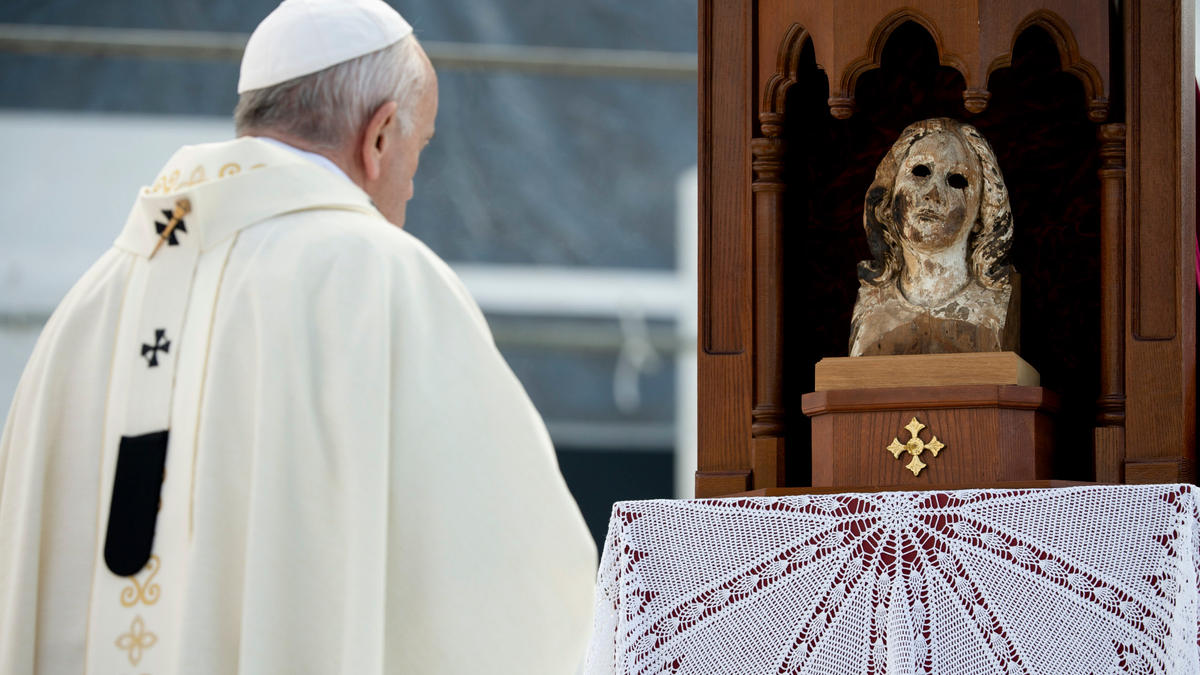
The damaged head of a wooden statue of Our Lady of Nagasaki, found in the ruins of Urakami Cathedral after the 1945 atomic bombing of Japan by the US, has become a symbol of anti-nuclear efforts.
Her missing eyes and cracked face bear a look of horror where there once was eternal glory. Known as Our Lady of Nagasaki or "A-bombed Mary," the wooden bust is all that remains of a statue carved to replicate Murillo's "Immaculate Conception." It stood in the cathedral of Nagasaki, Japan -- center of the country's Catholic population -- from 1928 until the morning of August 9, 1945.
On that day, three days after US President Harry Truman had authorized the world's first use of an atomic weapon against the industrial city of Hiroshima, Nagasaki became the target of a second A-bomb. The bomb was initially meant for Kokura, but weather and garbled communications caused the pilot to choose the secondary target of Nagasaki, where citizens had not been warned and the air raid all-clear had sounded. The Urakami Cathedral was destroyed in fires following the blast, which hit the factories in the valley where it was located. Many were killed instantly or died afterward from radiation exposure.
The object of the bombings was to cause destruction so terrible that Japan would have to surrender to the Allies, ending World War II. The bombings had that effect, but did not, as many hoped, frighten the world into halting the development of nuclear weapons. Instead, although nuclear weapons have never been used again, the development and stockpiling of these weapons by countries around the world continues.
A powerful witness
Some time after the Nagasaki bombing, a Trappist monk named Kaemon Noguchi went to pray at the cathedral's ruins. There he found the wooden statue of Our Lady, shattered and marred. He took the head back to his monastery in Hokkaido, where he kept it until 1975, when he donated it to the church to be placed in the Nagasaki Nuclear Bomb Museum. In 2005, the bust was returned to the rebuilt Urakami Cathedral.
Through the years, Our Lady of Nagasaki has served as a powerful witness for peace and against nuclear proliferation. Along with survivors of the bombings who tell their stories before world leaders, she speaks her silent witness. She has been brought to the United Nations World Headquarters, and Pope Francis celebrated a special Mass in the Nagasaki cathedral next to her statue.
From Nagasaki to New York
Now, the Archdiocese of Nagasaki has announced plans to bring the statue back to the United States for the first time in 16 years. Later this month, a group of Catholic clergy from Hiroshima and Nagasaki and survivors of the bombings will bring the bust to New York for a conference reviewing the Treaty on the Prohibition of Nuclear Weapons, and then to Los Alamos, New Mexico, where atomic weapons were first designed and built.
Among the group will be the 80-year-old Archbishop Emeritus of Nagasaki, Mitsuaki Takami. The archbishop's mother was exposed to the atomic bomb while she was pregnant with him. As Kyodo News reported:
"We are not going with simply a victim mentality," [Archbishop Takami] said, adding that the statue's head may appeal to Americans' "beliefs and conscience" by showing that nuclear weapons are inhumane and incompatible with Christian faith.
The group will leave Japan on November 26 and return December 10. In addition to appearances at the New York conference and in New Mexico, the group hopes to have the statue displayed at the UN headquarters and visit a nuclear weapons museum and local churches in order to carry their message.