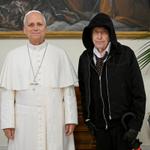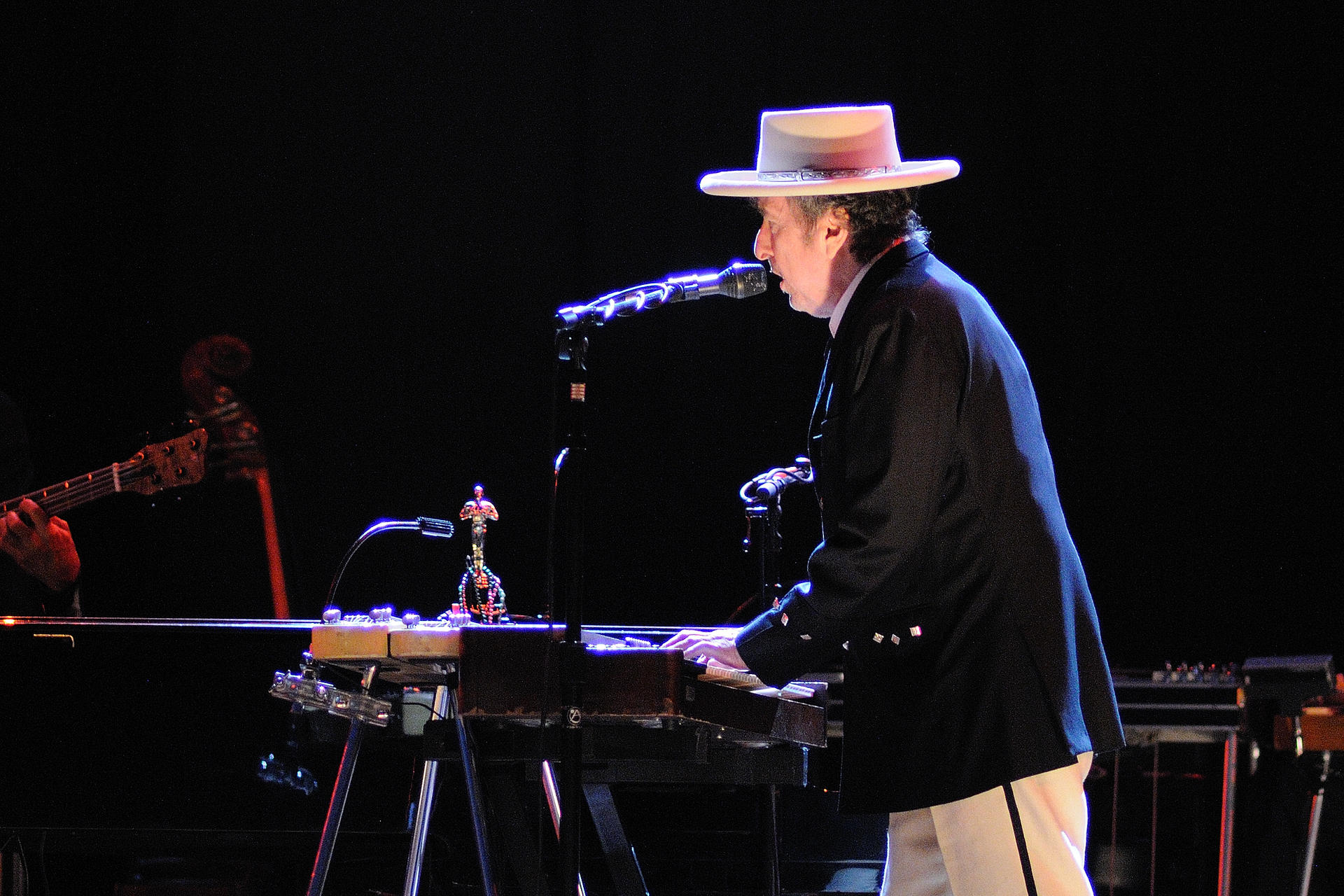
September 27, 1997. Bologna. The 23rd International Eucharistic Congress has drawn some 300,000 young people to hear John Paul II. The night before the Pope’s address, a concert takes the stage: Andrea Bocelli, Lucio Dalla, Gianni Morandi — and Bob Dylan, who closes the set with “Forever Young.”
It was, by any measure, an unlikely combination. Dylan himself would later call it one of the best performances of his life.
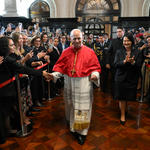
Joseph Ratzinger — then Prefect of the Congregation for the Doctrine of the Faith, standing somewhere in that crowd — was less certain. In his book My Beloved Predecessor, he recalled that John Paul II looked tired, exhausted that evening. And he admitted to a deeper unease. Dylan, he wrote, was a “prophet” of the counterculture — someone whose message was, in his view, “completely different from that to which the Pope was committed.” He was skeptical about involving “prophets” of this type, he said, and in some sense remained so.
It is a rare moment of candor. And it raises a question worth sitting with: What exactly was Ratzinger uneasy about?
A prophet without a denomination
Dylan’s presence in Bologna was not incidental. By 1997, his complicated spiritual journey was well known. He had grown up Jewish, gone through a period of somewhat intense evangelical Christianity in the late 1970s, and had since occupied an ambiguous spiritual territory that defied easy categorization. His appearance before the Pope was major international news precisely because no one quite knew what to make of it — including the future Benedict XVI.
John Paul II, characteristically, seemed to have his own reasons for the event. In his address to the young people gathered that night, he answered Dylan’s most famous question directly. The answer to what is blowing in the wind, the Pope said, is not found in empty winds — it is found in the breath of the Spirit. The only path, he concluded, is Christ.
Whether Dylan heard the remark, or understood it, is not recorded.
What is recorded is that Dylan ended his set that night with “Forever Young” — a song that is, among other things, a prayer. May God’s grace be with you always. May your hands always be busy. May your feet always be swift. As a closing gesture before a papal address, it was either perfectly chosen or perfectly accidental. Perhaps both.
A pope who quotes Dylan — and means it
The story did not end in Bologna. In 2026, Pope Leo XIV — Robert Francis Prevost of Chicago — became the first pope in history to quote Bob Dylan in an official document. In the foreword to Disarmed and Disarming: Peace Is a Gift, a collection of his writings on peacemaking, Leo cited a 1963 Dylan song called "Go Away You Bomb" — a song that was never recorded, that survives only as a typewritten manuscript, and that is directed, with characteristic Dylan bluntness, at nuclear weapons. Leo was seven years old when Dylan wrote it.
That a pope from Chicago would reach back to an unrecorded Dylan protest song to frame a document on peace is the kind of detail that invites speculation. Whether it reflects a lifelong familiarity with Dylan’s work, or a researcher’s well-placed suggestion, Leo has not said. What it means is that the conversation between the Catholic tradition and one of the 20th century’s most restless spiritual and political voices has not closed.
Ratzinger worried, in Bologna, how people would understand Dylan’s message and the Church’s, pointing in different directions. John Paul II seemed to believe they had the same horizon in view from different vantage points, with the Church having the answer to Dylan's restlessness. Leo XIV appears to agree. The wind, it turns out, is still blowing.